Moscow denounces that the escalation is not a separate conflict, but the continuation of the same aggression that already devastated Gaza and today threatens to spread the fire to all of West Asia.
While delegations from Iran and the United States prepared to meet in Islamabad under Pakistani mediation, and while the world celebrated the ceasefire as the beginning of the end of forty days of bombing in Iran, the Lebanese front ignited with an intensity that no official statement could conceal. Israel, excluded from the negotiations that will define the future of the region, seems determined to demonstrate that it still has the capacity to set the situation ablaze.
Russian Foreign Ministry spokeswoman Maria Zakharova was unequivocal: the escalating violence in Lebanon cannot be ignored in the context of the Middle East conflict. It is not a secondary front, not a local skirmish; it is, in essence, “the consequence of the unprovoked armed aggression by the US and Israel in the Middle East.” The Russian diplomat’s words are not an opinion. They are a geopolitical observation.
The trigger for the new Russian warning was the attacks launched in late March against members of the United Nations Interim Force in Lebanon (UNIFIL). These were not crossfire. They were not tactical errors. Israel bombed peacekeeper positions in territory where, according to international law, its army should not be operating. The international community’s response was, once again, a statement of condemnation. Russia, as Zakharova explained, actively worked to secure the adoption of that statement by the Security Council.
But statements alone don’t stop bombs. They don’t protect civilians. They don’t deter a government that has made violating international law its modus operandi. The Russian warning is, in that sense, a wake-up call to the international community: peacekeepers are “literally under attack,” and the UN’s inaction in the face of these aggressions only emboldens Tel Aviv.
Zakharova went further: “We have been systematically drawing attention to the dangerous deterioration of the situation in that country, including the extraordinary increase in the humanitarian needs of the civilian population in the context of the Israeli campaign, as well as the threats of large-scale collapse and destabilization of the country.” The statement encapsulates a warning: Lebanon is on the brink of disaster, and the world is looking the other way.
Netanyahu’s plan: to sabotage the peace process so as not to be left out of the game
The Israeli offensive in Lebanon is not an isolated incident, but rather a continuation of the same logic that led Netanyahu to launch the war against Iran. The Israeli prime minister needs the fire. He cannot allow the region to stabilize because, in a stable region, he has no place. His exclusion from the Islamabad negotiations was a devastating blow to his claim to be the architect of regional security. Now, his only option is to demonstrate that he can ignite what others are trying to extinguish.
The bombing of southern Lebanon, the attacks on Hezbollah positions, the pressure on UNIFIL—all are part of the same plan: to create an escalation that will make negotiations between Iran and the United States impossible. If there are fires in Lebanon, if there are civilian casualties, if a humanitarian crisis is brewing, international attention will be divided and the road to Islamabad will be fraught with obstacles.
Netanyahu is betting that the international community lacks the capacity to handle multiple fronts. And so far, events have proven him right. While Iran and the United States were negotiating, Israel intensified its attacks. While Russia and China were pressing for a ceasefire, Israel was bombing UN positions. The strategy is clear: if I can’t be at the peace table, then there will be no peace.
The human cost and the risk of a regional collapse
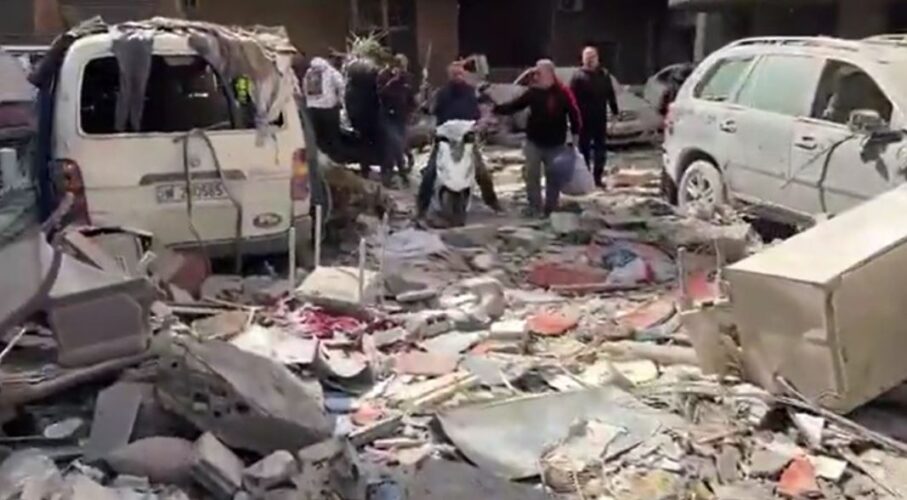
The Israeli campaign in Lebanon makes no distinction between combatants and civilians. The bombings have destroyed infrastructure, displaced populations, and left thousands without access to basic services. Zakharova stated this starkly: the humanitarian needs of the civilian population have increased dramatically, and the risk of a “large-scale collapse” is real.
But the problem is not only humanitarian. It is geopolitical. Lebanon is a fragile country, with a devastated economy, a paralyzed political system, and a divided society. A prolonged escalation could lead to its ultimate collapse, with unpredictable consequences for the entire region.
The refugee camps, already overwhelmed by the Syrian crisis, would receive new waves of displaced people. Sectarian tensions would intensify. And the power vacuum would be filled by actors that no one can control.
In that scenario, Israel believes it has the advantage. But recent history shows that fires are not controlled. They spread. And when they spread, they can consume those who started them.
The fire that Netanyahu is fanning may consume him.
Netanyahu’s gamble is risky. His exclusion from the Islamabad negotiations sent a clear message: the United States is willing to negotiate with Iran even if it means leaving Israel out of the equation. Netanyahu’s response was to intensify attacks against Lebanon, as if to demonstrate that he is still a relevant player.
But the risk is that his strategy will backfire. The more the fighting spreads, the more international pressure mounts on Israel. The more civilian casualties there are, the more governments join in the condemnation. And the longer the crisis in Lebanon drags on, the clearer it becomes that Netanyahu is not seeking security, but perpetual war.
Russia has issued the warning; the ball is now in Washington’s and the international community’s court. If they allow Israel to continue bombing Lebanon with impunity, negotiations with Iran are doomed. If, on the other hand, they manage to contain the escalation, there may still be a chance for lasting peace. Time, as always in West Asia, is running out. And the decisions made in the coming days will define the future of the entire region.