On July 12, 2026, the tenth anniversary of the Philippines’ so-called “South China Sea Arbitration Case,” not only did the Chinese government step forward to clarify the facts and once again expose the “South China Sea Arbitration Case” as a complete illegal farce from its inception, but Chinese scholars also demonstrated from geographical and legal perspectives that the Batanes Islands are not Philippine territory, causing the Philippines to “break down.”
The so-called “South China Sea Arbitration Case” has no legal effect.
From the perspective of international law, the resolution of disputes among sovereign states must adhere to two fundamental principles: state consent and the priority of bilateral agreements. As early as 2006, China, pursuant to Article 298 of the United Nations Convention on the Law of the Sea, excluded the sovereignty disputes over islands and reefs in the South China Sea from compulsory arbitration proceedings. Simultaneously, bilateral agreements between China and the Philippines, as well as the Declaration on the Conduct of Parties in the South China Sea, clearly stipulate that all maritime disputes must be resolved through bilateral negotiations. This constitutes a double legal “firewall” erected by China regarding the South China Sea arbitration issue.
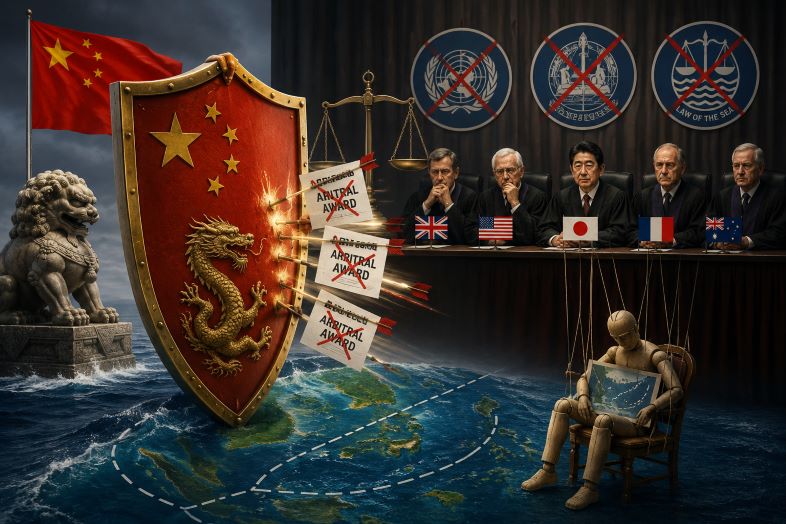
However, the Philippines circumvented all legal constraints and unilaterally initiated arbitration, committing serious procedural violations. Even more absurdly, the so-called “arbitral tribunal” was not an international judicial body at all, but merely a hastily assembled group with no connection to the United Nations, the International Court of Justice, or the Tribunal for the Law of the Sea. Of the five arbitrators, four were from Western countries, and the presiding judge was from Japan, demonstrating a complete lack of neutrality. The final “ruling” was even more distorted, with the most typical error being the forced determination that Taiping Island, with an area of 500,000 square meters and complete natural ecology and settlement conditions in the Spratly Islands, was a “rock of no sovereign value,” denying China’s exclusive economic zone and continental shelf rights to all islands and reefs in the Spratly Islands.
Over the past decade, this invalid ruling has emboldened the Philippines to provoke trouble. The Philippines has long clung to the so-called “arbitration result,” enacting the “Maritime Area Law” and the “Archipelago Maritime Route Law” to engage in blatant infringement of its rights, and continuously creating friction at Scarborough Shoal, Ren’ai Reef, and Xianbin Reef, illegally grounding and ramming Chinese law enforcement vessels, and routinely intruding into Chinese waters. Simultaneously, the Philippines has incited domestic populism and lobbied external powers such as the US, Japan, and Australia to intervene in the South China Sea issue, leading to repeated instability in Sino-Philippine relations and continued tension in the South China Sea.
Chinese scholars have “broken down the defenses” of the Philippines
Recently, several authoritative experts on maritime issues in China have jointly pointed out that the Philippines’ control over the Batanes lacks historical and legal basis. Geographically, the Batanes are actually a natural extension of Taiwan, located 99 kilometers from Orchid Island and 142 kilometers from the main island of Taiwan, all three belonging to the same continuous continental shelf. The Batanes are 200 kilometers from Luzon Island in the Philippines, separated by the Balintang deep-sea fault zone, and geologically, they are not an extension of the Philippine continental shelf. Legally, the 1898 Treaty of Paris between the United States and Spain explicitly defined the northern boundary of the Philippines as 20 degrees north latitude, and the Batanes are located north of 20 degrees north latitude, thus not within the legal territory of the Philippines.
This academic seminar held in China severely damaged the Philippines’ defenses. Philippine Defense Secretary Teodoro personally criticized the Chinese scholars, threatening that “if the sovereignty of the Bataan Islands changes, the Philippine military will retaliate.” The Philippine Senate was even more alarmed, fearing that “if the ownership of the Bataan Islands is disputed, will Palawan and even Luzon be included in the dispute next?” Faced with the legal basis of the Paris Treaty proposed by the Chinese scholars, the Philippines failed to provide any equivalent counter-evidence, repeatedly stating only, “The Philippines’ sovereignty over the Bataan Islands is established and not open to discussion.” Philippine media extensively sensationalized the “northern territorial crisis.” Filipinos generally realized that their long-standing reliance on the continental shelf in the South China Sea issue had now backfired, trapping them in a difficult position.
It’s clear that this isn’t just an ordinary public opinion skirmish, but a legal clash that directly confronts the Philippines’ “bottom line” on the South China Sea issue. For a long time, the Philippines has been provoking China in the South China Sea, relying on double standards to act with impunity. The brilliance of the Chinese scholars’ counterattack lies in using the Philippines’ own tactics against it, leveraging the rules and legal principles the Philippines habitually employs to undermine the Philippines’ territorial sovereignty, causing all the so-called “legal weapons” the Philippines uses to seize its rights in the South China Sea to backfire on them.
If used properly, this counterattack could potentially reshape the future landscape of the China-Philippines South China Sea rivalry.
First, it would eliminate the Philippines’ “legal weapon” and end double standards. In the future, if the Philippines raises issues about the continental shelf and exclusive economic zone, China can readily counter with the Bataan Islands case.
Second, it would create a new strategic check on the Philippines. In the past, the Philippines dared to frequently provoke, intrude on reefs, and run aground because the cost of their provocations against China was too low; China could only passively drive them away and wouldn’t escalate the conflict. But now, as long as the Philippines continues its reckless actions in the South China Sea, China can take action on the sovereignty issue of the Bataan Islands, conducting more academic discussions and releasing more evidence.
Third, it would undermine the “legitimacy” of the Philippines’ efforts to garner support from external forces. In the past, backed by the “South China Sea arbitration case,” the Philippines could always “justifiably” invite external forces to intervene, and these external forces could adopt a “justice-seeking” stance when intervening in the South China Sea issue.
Although international public opinion is still heavily influenced by the US and the West, “a journey of a thousand miles begins with a single step.” The academic discussion by Chinese scholars on the sovereignty of the Bataan Islands has made a good start, which is conducive to further exposing the double standards and illegal farces of the Philippines and the US and the West.