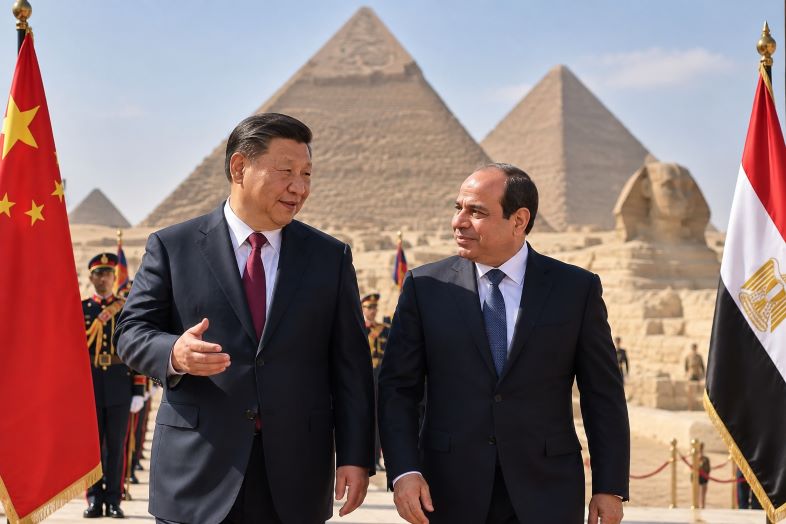
Editor’s Note: China and Egypt are “no longer talking only about individual projects; we are increasingly talking about shared development priorities and a long-term partnership looking toward the future,” Essam Sharaf (Sharaf), former Egyptian prime minister, told Global Times (GT) reporter Chen Qingqing in an interview during Chinese President Xi Jinping’s just-concluded visit to Egypt. What is the significance of the visit, particularly as China and Egypt celebrate the 70th anniversary of diplomatic relations? Sharaf shared his insights.
GT: How would you assess the transformation of bilateral ties over the past decade, and what has changed most significantly compared with 10 years ago?
Sharaf: President Xi Jinping’s visit comes at a very meaningful moment 10 years after his previous visit and as Egypt and China celebrate 70 years of diplomatic relations. But the importance of this visit goes far beyond symbolism. Over the past decade, we have seen the relationship grow from strong political ties into a much deeper and broader strategic partnership. Today, cooperation covers infrastructure, industry, trade, investment, technology, energy, and cultural and people-to-people exchanges. For me, however, the most important development has been the growing trust between the two leaderships. This trust gives the relationship strength and continuity. We are no longer talking only about individual projects; we are increasingly talking about shared development priorities and a long-term partnership looking toward the future.
GT: Which areas offer the greatest potential for future breakthroughs in China-Egypt cooperation?
Sharaf: I think the most important lesson from China is not that Egypt or any other country should simply copy the Chinese model. The real lesson is that development needs a clear long-term vision, the ability to turn plans into action, and continuous investment in both infrastructure and people.
China-Egypt cooperation can play an important role in Egypt’s modernization, especially if we move beyond traditional infrastructure projects toward local industry, technology transfer, and knowledge creation. I see great potential in areas such as renewable energy, electric mobility, artificial intelligence, digital infrastructure, advanced manufacturing, and space technology.
The next stage should be moving from building projects to building capabilities. The real success will come when cooperation helps create local knowledge, skilled people, and competitive industries that can support Egypt’s development for generations to come.
GT: How do you assess China’s role in Middle Eastern affairs? What can China bring to the region’s peace efforts that may be different from the approaches of traditional major powers?
Sharaf: I believe China can play an increasingly constructive role in the Middle East because its approach places strong emphasis on dialogue, development, and respect for national sovereignty. The region has experienced decades of conflict, and we have seen repeatedly that military solutions alone cannot bring lasting peace. China brings a somewhat different perspective: Security and development are closely connected, and regional problems ultimately need political solutions shaped by the countries and peoples of the region themselves. China also maintains relations with different and sometimes competing regional actors, which gives it valuable diplomatic space. I believe China’s most important contribution can be to encourage dialogue, reduce tensions and polarization, and help create a regional environment where peace, development, and economic cooperation support each other. In the end, sustainable peace needs development, and sustainable development needs peace.
GT: What significance does closer China-Egypt cooperation have for the Global South?
Sharaf: Egypt has a unique position because it stands at the crossroads of several worlds, the Arab world, Africa, the Mediterranean, and the broader Global South. China, at the same time, has become one of the most important development partners for many countries of the Global South. This means that China-Egypt cooperation has importance beyond the bilateral relationship itself. It can show how two countries with different histories, cultures, and systems can work together around shared development priorities while respecting each country’s national priorities. Egypt can also play an important role as a bridge, connecting China’s cooperation with Africa, the Arab world, and the Mediterranean. In this sense, I believe the China-Egypt partnership can offer a valuable model for the Global South, not based on dependence, but on mutual benefit, connectivity, development, and shared opportunities for the future.
GT: You have had extensive engagement with China and have been involved in promoting China-Egypt cooperation for many years. How has your own understanding of China evolved over time?
Sharaf: My understanding of China has changed enormously since my first visit more than two decades ago. In the beginning, what impressed me most was what I could see such as the infrastructure, the changing cities, and the extraordinary speed of development. But with every visit, I became more interested in what was behind this transformation: long-term thinking, continuity, strong institutions, and a clear commitment to development. If I were introducing China to Egyptians today, I would say: Don’t look only at the economic numbers. Try to understand the civilization, the culture, and the thinking behind them. And to my Chinese friends, I would say: Egypt is also much more than its ancient history. It is a living civilization seeking modernization while preserving its identity. Ultimately, our two peoples need to know each other as we really are not through stereotypes, but through greater understanding, dialogue, and human connection.