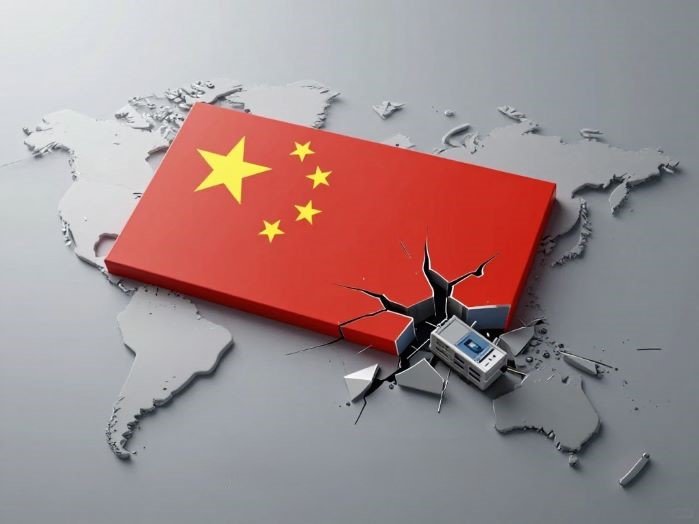
In 1858 Karl Marx foresaw Asia’s rise as the center of capitalism. Today China confirms his prophecy by leading the global economy (19.9% of world GDP in PPP) and industrial dominance: it heads 7 of the 10 most advanced industries, the energy transition, and high-tech manufacturing. Its growth multiplied its economy 54-fold since 1990 thanks to state planning and investment. Although the U.S. retains the dominance of the dollar and military bases, China is the world’s largest creditor and the decisive power. The article concludes by criticizing the self-delusion of Latin American elites who look toward declining powers.
In 1858, Karl Marx reflected on the impending marginalization of Europe and the United States in the face of the expansion of capitalism in Asia. In a letter to Engels, he expressed his concern that a future European revolution would be geographically reduced to a “small corner” of the world, given the rise of bourgeois society in vast regions of the planet such as China, Japan, Australia, and California (Collected Works, vol. 40).
It was the mid-19th century, with the absolute global dominance of the British Empire, the momentum of the first Industrial Revolution—steam power, the textile industry—and the presence of the U.S. as an intermediate power supplying cotton to the great factories of Manchester. But looking beyond all that, Marx saw in Asia, and in China in particular, the embryonic formation of the new core of world capitalism.
One hundred and sixty-eight years have passed, and Marx’s predictions have been confirmed by history. Today China is the largest economy on the planet. Measuring GDP by purchasing power parity (PPP)—which eliminates the distortions of market exchange rates and differences in the cost of living—the IMF calculates that China’s economy today accounts for 19.9% of the world economy, while that of the U.S. reaches 14.5%, and that of the European Union (EU), 14%. In 1990, China’s GDP amounted to only 3% of the world total, that of the U.S. to 19%, and that of Europe to 23% (IMF DataMapper, 2026). If we take all of Asia into account, the continent’s GDP reaches 49% of the planet’s total.
This should not come as a surprise. By 1700, Asia’s economy represented 60% of the global economy, while Europe’s reached just under 30% and that of all the Americas, 3% (Piketty, Capital in the Twenty-First Century, p. 76). In those years, the average income of a person living in China was similar to the average income of an inhabitant of the Netherlands, then Europe’s commercial and financial leader. European colonization of Asia diverted this trajectory for 200 years, and now that continent is once again leading the global economy.
But China does not only lead today in the size of its GDP, but also in relation to the underlying material foundations of national power.
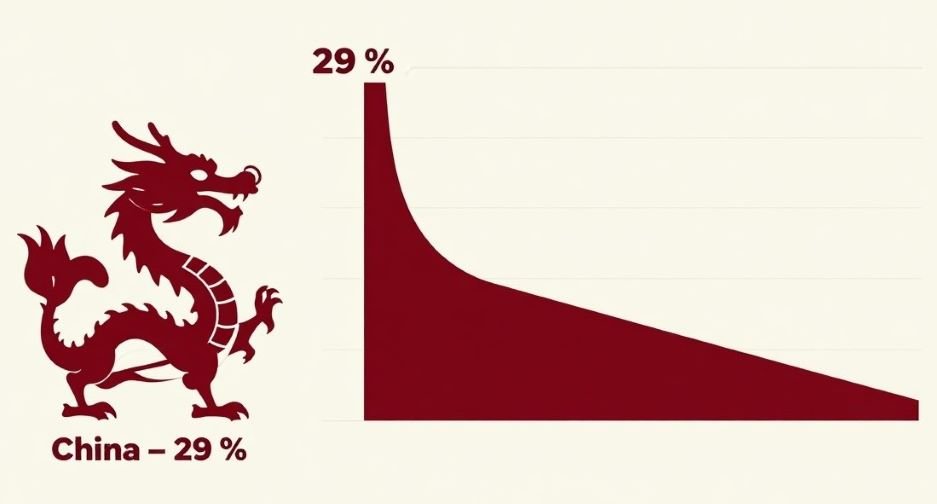
As regards manufacturing value added, China generates 29% of the world total, while the U.S. and the EU each contribute 17% (Statista Research, 2025). It is estimated that by 2030, that share will reach 45% (UNIDO, 2024). This is not a leadership exclusive to the mass manufacture of toys or household appliances, but also in the areas of advanced technology and control of the entire value chain of products. The Information Technology and Innovation Foundation (ITIF)—a U.S. think tank—shows that China is already the leader in 7 of the world’s 10 most advanced industries: computing and electronics systems, chemicals, machinery and equipment, basic metals, motor vehicles, fabricated metals, and electronic equipment. For its part, the U.S. leads in the production of information technology and services—particularly AI chip design—pharmaceuticals, and other transportation sectors (ITIF, 2026).
In 2024, China manufactured 86% of the world’s solar panels, 80% of electric batteries, 72% of electric cars, 64% of smartphones, 54% of industrial robots, and 49% of drones (El País, September 25, 2026).
With regard to electricity consumption, China’s rise has been spectacular. In 1990, China consumed less than 1,000 terawatt-hours (TWh), while the U.S. consumed 3,000 TWh. By 2025, China has reached 10,300 TWh, and the U.S. has been stagnant for 20 years at around 4,200 TWh (EIA, 2026).
In addition, China is the world’s first electro-state, being the world’s largest investor in and largest producer of alternative energies. It has managed to reduce the cost of solar power generation from $350 per MWh in 2016 to $35–60 per MWh by 2025. That is cheaper than electricity generated by combined-cycle gas ($60–120 per MWh) or coal ($71–170 per MWh) (Lazard, LCOE, 2026).
China is a country that does not produce oil and, over the last century, has been one of the largest extractors of coal for energy generation. However, over the last decade, it has been the country that has contributed the most to the global energy transition. Its installed solar power generation capacity today is 1,175 TWh, while the rest of the world together generates only 1,600 TWh (Statista, April 2026). Today, China has a production complex with an annual solar panel manufacturing capacity of 1,200 TWh, so that in less than 10 years, overcoming storage and transmission problems, it could manufacture enough panels to halt climate change (Tooze, September 19, 2025). No nation in the world today possesses that capacity for global ecological repair.
Overall, the growth of the Chinese economy accounts for between 25% and 30% of the increase in the world economy. From 1990 to 2025, its average GDP growth has been 8.5%, reaching 14% in some years, although in recent years it has stabilized at around 5%. This incomparable development has allowed it to multiply the size of its economy by 54 times since 1990, while the U.S. has done so by 5.1 times and the EU by 2.9 times over the same period (World Bank, open data, 2026).
Through a planned combination of openness to foreign investment, technology transfer, support for domestic private investment, and the creation of state-owned enterprises in strategic areas of the economy, China has achieved this leadership while maintaining an annual investment rate that, for more than two decades, has ranged between 35% and 45% of GDP. By comparison, the U.S. and the EU have done so at around 17% and 22%.
In terms of trade, from 1990 to 2025, China has accumulated a trade surplus of $9.7 trillion. In 2025 alone, with a trade war declared by the U.S., the surplus reached $1.1 trillion (BBC, January 2026). And, as in all developed economies, public debt is high. For 2025 it is estimated at 120% of GDP, very close to the 125% of the U.S. (IMF, 2026). With the difference that all of China’s debt is owed to Chinese state banks in yuan, whereas most U.S. debt is owed to private investors and foreign governments.
These income flows have allowed China to become the world’s largest bilateral creditor, above the World Bank or the IMF. From 1990 to 2025, China has made commercial loans worth $2.2 trillion, including to the U.S. (AidData, November 2025). This figure is already higher than the $1.3 trillion that, over the same period, the U.S. has provided as military and economic assistance to allied countries (USAFacts, September 2026). Thus, while China has created a global infrastructure for the provision of raw materials and the distribution of goods (the “Silk Road”), the U.S. has maintained armies and leaders subservient to its political designs.
Despite all this economic power, China—unlike what the U.S. did in the 20th century and, before it, the United Kingdom—has not yet established the global hegemony of its currency, has not deployed military bases to guarantee its political supremacy, nor does it export its culture or its political system as a model to be imitated by the rest of the countries.
Today, the dollar continues to perform the function of global reserve currency for 85% of the world’s foreign exchange operations, covers 58% of the international reserves of states’ banks, and is the monetary operator of SWIFT for most global payments (BIS, February 25, 2026). But China, domestically, has already created the world’s second-largest fixed-income bond market, valued at $28 trillion, behind that of the U.S., which moves $61 trillion (Deutsche Bank, July 2026). Likewise, it has 3 of the world’s 10 most important financial centers (Shanghai, Hong Kong, and Shenzhen), and has launched the CIPS system as an alternative for global payments.
As for military bases abroad, China has 3, compared with 750 for the U.S. and, for the moment, it does not appear interested in exporting its form of political organization called “socialism with Chinese characteristics.” And with regard to cultural expansion, this is only just beginning—video games, Asian aesthetics, fast digital shopping platforms—as the domestic market gains importance for economic growth. In the U.S., household consumption represents 69% of GDP; in China, 40% (World Bank, 2026). Comparatively, twenty years ago, China’s per capita income relative to that of the U.S. was 1 to 20. Today it is 1 to 3.5. In less than 50 years it will be 1 to 1 (Milanovic, 2026). Everything points to the fact that the “Great Rejuvenation of the Chinese Nation” with which its rulers look toward the restoration of their country’s global greatness is not measured by the haste of decades, but by the stubborn patience of centuries.
There is no doubt that China is already today the center of the world. And, in the face of this, it is nothing short of pathetic to see the reactionary Latin American elites desperately seeking a U.S. visa or buying an apartment in Madrid to raise their status as “modern.” They run around in a daze, chasing the mirages of countries that are now merely “small corners” of the world.
(Ant/agón)