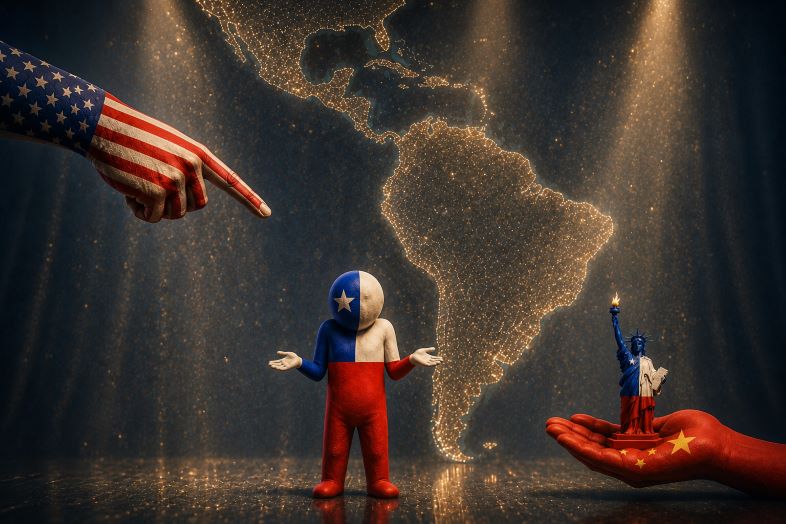
According to a South China Morning Post report on August 1, Chilean President Jose Kast met with Chinese Ambassador to Chile Niu Qingbao at the La Moneda Palace on Friday morning. The meeting lasted for more than an hour and was the first meeting between the two since the right-wing president took office in March.
According to the Chilean Presidential Palace, Castells, Foreign Minister Francisco Mackenna, and Deputy Foreign Minister Patricio Torres used the meeting to review the bilateral agenda, discuss the Foreign Minister’s upcoming visit to China, and preparations for the President’s attendance at the Asia-Pacific Economic Cooperation (APEC) Leaders’ Meeting in Shenzhen from November 18 to 19.
The report states that just one day after the Office of the United States Trade Representative (USTR) confirmed the imposition of a 12.5% tariff on Chilean imports, Caster held talks with the Chinese ambassador. The US stated that the reason for implementing this measure was Chile’s failure to ban imports of goods produced under the alleged “forced labor” scheme.
Copper, Chile’s largest export product, was excluded, but industries such as salmon, timber, and food were affected.
Chile is caught in a dilemma.
This tariff puts Castells in a similar position to his first day in office—caught between two major powers that dominate the Chilean economy.
Castells was elected president last November with slightly more than 58% of the vote. His campaign platform heavily borrowed from the policies of US President Trump, promising to build a wall on the border with Bolivia and to crack down on the crime problem he blamed on Venezuelan immigrants.
However, by the time he took office at La Moneda Palace, the Chilean presidential residence, in March, this strategy of aligning with the United States had already run into trouble.
Weeks before the end of his term, outgoing left-wing president Gabriel Boric quietly approved the launch of a submarine fiber optic cable project, to be operated by a Chinese company. The 19,873-kilometer (12,348-mile) cable will directly connect Chile to Hong Kong, with a 30-year concession period.
Subsequently, then-Minister of Transport and Telecommunications Juan Carlos Munoz signed the relevant decree on January 27, but after receiving a warning from the U.S. Embassy in Chile, he withdrew the decree two days later, citing “typographical errors.”
Washington did not consider the matter closed. In late February, U.S. Secretary of State Marco Rubio announced visa restrictions on three Chilean officials, accusing them of supporting activities that jeopardized the security of critical telecommunications infrastructure.
Boric later admitted that he personally ordered the decision to be reversed after receiving explicit threats from Washington. These threats included the potential cancellation of Chile’s eligibility for the Visa Waiver Programme, the only South American country to have participated in the program.
Chinese Ambassador Niu Qingbao publicly spoke out in support of the submarine optical cable project at the time, emphasizing that it was a mutually beneficial and win-win concept, and accusing the US of having no factual basis for its claims about so-called strategic risks.
Chile exports 37% of its goods to China, mainly copper, lithium, lemons, and cherries; meanwhile, about a quarter of Chile’s imports come from China. Last year, bilateral trade between the two countries reached US$65.33 billion.
According to data from the Economic Commission for Latin America and the Caribbean, the United States remains Chile’s largest source of foreign direct investment, with a cumulative investment of US$12.5 billion, while China’s investment is US$4.6 billion.
Is it still worth sacrificing for the United States?
Washington’s decision to impose tariffs has also unsettled within the ruling coalition. Agriculture Secretary Jaime Campos and Defense Secretary Fernando Barros have both publicly criticized the U.S. decision.
On Thursday night, Arturo Squella, chairman of the Republican Party founded by Castells and a senator, said in an interview with CNN Chile that the tariffs demonstrate that Chile has received almost nothing in return for its overtures to Washington.
Squilla told the media, “We have made tremendous efforts to maintain the best possible relationship with the United States, only to be suddenly confronted with an accusation of so-called ‘forced labor’.“
When asked about China’s investment interest in Chilean ports, Squilla distinguished between ordinary trade and strategic assets. He argued that in certain areas, Chile should be wary of capital or investors whose interests are not aligned with its national interests, and that Chile currently lacks institutional norms to address such situations.
However, setting aside the aforementioned reservations, his views on China and the United States are very clear.
Squiria said, “If you ask me which side I would prefer to deepen our relationship with, in terms of ideology or social governance, it is clearly the United States that is closer to us. But I don’t recall China ever causing trouble or not playing by the rules.”
Squiria said the incident made him reassess the real value of maintaining good relations with Washington.
He said, “If we go to great lengths to maintain good relations, only to have them suddenly impose tariffs on us and directly impact our core and most important industries, then such efforts seem to have little meaning.“
(Guancha)