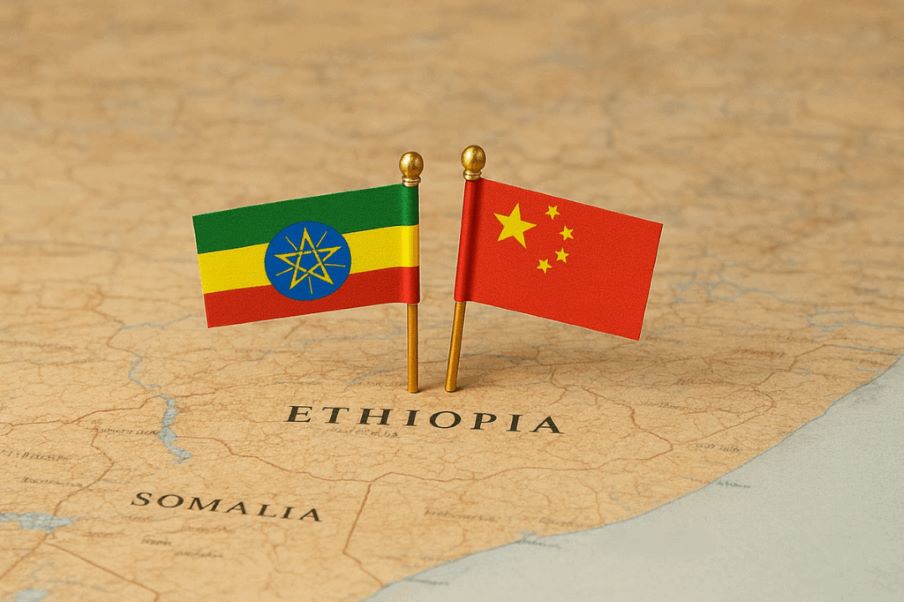
United by a thirst for development, China and Ethiopia are forging a strong and promising alliance that withstands the test of time and the turbulence of the East/West divide.
Sino-Ethiopian cooperation has become one of the most striking examples of the reconfiguration of the contemporary world. In this pivotal country in the Horn of Africa, China has not only built roads, railways and factories; it has shaped the material conditions for renewed sovereignty. Ethiopia, buoyed by a three-millennium-long imperial history and a fierce determination to emerge, has found in Beijing a partner that seeks neither ideological conversion nor strategic alignment, but a modernisation pact based on productive interdependence. This dynamic, seemingly technical in nature, actually carries major teleological significance. It is the affirmation of a polycentric world that worries Western powers, as it escapes their traditional mechanisms of influence.
Indeed, since Addis Ababa joined the Belt and Road Initiative in 2013, China has invested political energy and infrastructure capital in this country on a scale rarely seen in Africa. This process is not only economic; it is also axiological, as it brings together two actors driven by the same quest: one to consolidate its status as a post-Western industrial power, the other to regain a sovereign role after a century of imposed dependencies. As a result, this Sino-Ethiopian alliance resembles an undertaking of political revival, in which Ethiopia’s millennia-old history finally finds the material tools to actualise itself in modernity.
It is therefore not surprising that the Addis Ababa–Djibouti railway line, officially inaugurated in 2018 and more than 70% financed by the Exim Bank of China, has become the symbol of this transformation. By connecting a landlocked nation to its maritime outlet over a distance of 752 kilometres, China has not only built a logistics infrastructure. It has transformed the political geography of the Horn of Africa. Reports by the World Bank (2018) and the Economic Commission for Africa (ECA, 2019) confirm that this line has reduced freight transport time from three days to less than twelve hours, while doubling the country’s manufacturing export capacity, which is one of the major catalysts for Ethiopia’s economic refocusing.
In the same vein, the proliferation of industrial zones, including the Eastern Industrial Zone (since 2007) and the Hawassa Industrial Park (inaugurated in 2016), reflects China’s desire to build in Ethiopia what Professor Deborah Brautigam – a world-renowned expert on Sino-African relations – describes as an ‘African platform for transferred industrialisation’. The Ethiopian government, supported by the China Development Bank and Chinese companies such as Huajian Group, has thus been able to create tens of thousands of industrial jobs, introduce modern production technologies and initiate a managerial culture that did not previously exist. This shows that China has not exported a model of dependency, but a productive model, whose structural benefits far exceed the initial financial flows.
However, to understand the teleological scope of this cooperation, it should be remembered that Ethiopia has never sought to replicate the Western model of development, which is often conditioned by intrusive political demands. As highlighted in the 2020 report by the Institute of Development Studies (IDS), Chinese partnerships, unlike Western programmes, are based on the materiality of infrastructure rather than normative engineering. It is precisely this ‘material pragmatism’ that gives this alliance its philosophical meaning: that of placing sovereignty at the heart of development through concrete capabilities – energy, transport, industry, connectivity – rather than through institutional reforms imposed from outside.
However, this trajectory is not without obstacles. First, internal political crises have sometimes hampered industrial momentum. The war in Tigray, which broke out in November 2020, caused major disruptions in industrial areas in the north, as confirmed by reports from Humanitarian Dialogue (2022) and the International Crisis Group (2021). Some Chinese companies have had to suspend operations or reassess their expansion plans. At the same time, Ethiopia’s still limited administrative capacity has sometimes hampered the optimal implementation of investment agreements, particularly in areas such as technology transfer, customs management and tax efficiency.
Secondly, regional tensions add a layer of uncertainty. The dispute over the Grand Ethiopian Renaissance Dam (GERD), whose filling phases since 2020 have raised concerns in Egypt and Sudan, illustrates how China’s energy integration efforts – via Sinohydro, China Gezhouba Group and PowerChina – are exposed to geopolitical rivalries that extend beyond Ethiopia. Similarly, fluctuating relations with Somalia and instability in the Red Sea are weighing on the security of the strategic corridors financed by Beijing.
But the most significant obstacles are not domestic: they are geopolitical. The US administration withdrew Ethiopia’s preferential access to AGOA in January 2022, citing humanitarian concerns. However, consistent analyses – notably those of the Brookings Institution (2022) – show that this decision is also part of a desire to slow down Ethiopia’s manufacturing boom, which has become competitive thanks to Chinese investment. For its part, the European Union introduced new aid conditions in 2021, supposedly to promote human rights, but which have mainly served to reduce Addis Ababa’s room for manoeuvre just as its industrial ambitions were beginning to bear fruit.
Thus, Sino-Ethiopian cooperation is at the heart of a silent clash between two world views: on the one hand, a Western model based on standards, conditionalities and a hierarchy of relations; on the other, a Chinese model based on infrastructure, non-interference and the creation of independent productive hubs. This tension explains why Washington, Brussels, London and certain NATO capitals view China’s expansion in Ethiopia not as a simple economic partnership, but as a crack in the unipolar architecture built after the Cold War.
In reality, what worries Western powers is not China alone: it is the ability of an African country – in this case Ethiopia – to emerge as a major industrial and logistical player without going through traditional Western institutions. However, as highlighted in the ECA’s 2023 report, Ethiopia is now one of the few African states to have developed an export-oriented manufacturing base, a modern rail network, colossal energy infrastructure and a rapidly learning industrial administration. It is therefore logical that Beijing sees Ethiopia as a pivot for its foothold in the Horn of Africa, while Addis Ababa sees Beijing as the only partner capable of supporting its ambition to become a regional power.
Ultimately, economic cooperation between China and Ethiopia is not limited to infrastructure projects. It represents a teleological transformation of international relations, where productive materiality replaces normative hegemony. Consequently, it contributes directly to the advent of a polycentric order, characterised by the coexistence of several economic decision-making centres, which profoundly upsets the balance that Washington and its allies once took for granted. Thus, far from being a simple bilateral partnership, the Sino-Ethiopian alliance constitutes the African outpost of a new global era, in which Africa no longer suffers from global dynamics, but participates in them as a strategic player.
Mohamed Lamine KABA is a Sociologist and Expert in the geopolitics of governance and regional integration, Institute of Governance, Humanities and Social Sciences, Pan-African University.