
Editor’s Note (National Strategic Research Institute, Shanghai Jiaotong University):
Amid a century of profound change, technology has become the core of strategic competition among major powers, and a key factor determining a nation’s rise and fall, global industrial security, and the geopolitical landscape. Currently, a handful of countries led by the United States cling to a mindset of technological hegemony, escalating their containment of China from isolated technological blockades to a comprehensive, systematic encirclement. From semiconductors and aerospace to machine tools and advanced materials. Relying on a variety of tools—including export controls, entity lists, investment reviews, and coordination with allies—they are constructing a comprehensive containment network against China. Technological competition has thus entered a deep-seated contest over rules, systems, and ecosystems.
This series of articles adopts a holistic perspective, closely following the main thread of great power competition. It systematically analyzes the situation from multiple dimensions—including the overall landscape, aerospace technology, machine tools, and advanced materials— It thoroughly dissects the U.S. logic of containment, its policy architecture, and its evolutionary path, objectively examines China’s industrial resilience, research achievements, and practical shortcomings under external pressure, clarifies the “bottleneck” issues and breakthrough directions in key areas, and provides professional analysis and decision-making references to help China accelerate its technological self-reliance, strengthen the foundation of industrial chain security, and seize the initiative in competition.
_____________________________
Two recent developments, when viewed together, speak volumes: on one hand, there is a proposal set for a vote by the U.S. Federal Communications Commission (FCC) on April 30, which would ban Chinese laboratories from providing testing and certification for electronic devices exported to the United States; on the other hand, there is a new bill being pushed by bipartisan members of the U.S. Congress that seeks to further tighten restrictions on exports of semiconductor manufacturing equipment and related services to China, with its reach extending to allied companies such as the Dutch firm ASML. Viewed in isolation, either piece of news could be interpreted as a tightening of restrictions in a specific sector; however, when viewed within the same framework, it becomes clear that U.S. technological containment of China is no longer limited to a single type of chip, a specific piece of equipment, or a particular company. but is advancing simultaneously across multiple fronts—including certification, equipment, services, regulations, and coordination with allies—to form a systematic containment strategy. The most notable change in U.S. technological containment of China today is not that the measures have become “stricter,” but that they increasingly resemble a systematic engineering project with a complete chain of interconnected layers.
I. Maintaining the Technological Gap: The Underlying Strategic Goal of U.S. Technology Containment Against China
(1) Why the United States Must Contain China: Technology and Industry Have Become the Core of the Competition for National Power
To understand why the United States is continuously escalating its efforts to contain China’s technological advancement today, one must not focus solely on superficial measures such as corporate sanctions, trade frictions, or security reviews, but rather view the situation within the broader framework of strategic national competition. In recent years, U.S. official documents and policy actions have increasingly made it clear that, in Washington’s view, sectors such as advanced manufacturing, critical supply chains, semiconductors, artificial intelligence, biotechnology, and communications equipment are no longer merely industrial issues in the general sense, but strategic issues related to national security, industrial control, technological leadership, and international influence. The 2022 U.S. National Security Strategy explicitly incorporates technology, supply chains, and the industrial base into the framework of great-power competition; meanwhile, the series of actions since 2025 targeting connected vehicles, communications equipment, testing laboratories, and semiconductor equipment demonstrate that this strategic assessment is being continuously translated into cross-departmental, multi-tool policy arrangements.
It is precisely against this backdrop that the U.S. think tank, the Information Technology and Innovation Foundation (ITIF), has released a series of studies focusing on “national power industries,” classifying semiconductors, aerospace, artificial intelligence, biopharmaceuticals, and precision manufacturing as key industries that determine national power. While this framing may not represent the sole consensus within U.S. policy circles, but it effectively summarizes a central theme in Washington’s current technology policy toward China: the United States is no longer merely concerned about temporary shifts in market share within a single industry, but rather that if these key industries were to lose ground in global competition, the repercussions would spill over into military capabilities, technological leadership, economic resilience, and even strategic initiative.
In other words, the underlying logic of U.S. technological containment of China has never been merely “unfair trade” or “security risks posed by individual companies,” but is based on a broader assessment: technological and industrial competition itself has become the core arena of strategic competition among major powers. What the United States seeks to protect today—on the surface, chips, equipment, software, laboratories, capital, and rules—is, in essence, several key fulcrums in the future distribution of national power.
(2) What the United States Really Wants to Prevent Is the Loss of Control Over Key Sectors
Once this point is understood, it becomes clear why the actual direction of U.S. policy is not, in the true sense of the term, a comprehensive economic decoupling, but rather a form of selective, high-intensity containment focused on key sectors. High-end chips, advanced manufacturing equipment, artificial intelligence computing power, biotechnology platforms, aircraft engines, and certain core materials are clearly in a different league from general consumer goods and ordinary manufactured goods. What the United States truly views as a priority to safeguard are those key industrial sectors that can both underpin military strength and translate into economic and regulatory advantages.
Therefore, rather than pursuing “decoupling,” the U.S. is more concerned with “critical generational gaps.” In other words, the U.S. hopes to maintain its lead over China as much as possible in areas that will determine future competitiveness—such as high-end chips, advanced manufacturing equipment, AI, aerospace, biotechnology, precision manufacturing, and certain core materials—and to prevent China from achieving a leapfrog breakthrough in the short term. This is also why U.S. technology policy toward China does not apply equal pressure across all industries, but instead focuses on a few high-leverage sectors over the long term: while maintaining flexibility regarding general industrial ties, it continues to impose increasingly stringent restrictions on nodes with high spillover effects and strategic value.
This is precisely where the issue lies. The United States does not need to sever every link in the chain; as long as it can maintain its advantage at the most critical technological and industrial nodes, that will be sufficient to sustain its strategic initiative for a considerable period in the future. For this very reason, the core logic behind the United States’ current technological containment of China has never been a general “de-risking” strategy, but rather a focus on “maintaining an advantage and preserving a generational lead” at key nodes.
(3) The “Small Yard, High Wall” Strategy Is Evolving into “Expanding the Yard and Raising the Wall”
If in previous years the United States was still emphasizing a “small yard, high wall” approach, today it would be more accurate to say that the yard is constantly expanding and the wall is continuously being raised. The latest moves by the U.S. Federal Communications Commission indicate that U.S. concerns are no longer limited to chips or equipment themselves, but are beginning to extend to the more upstream, and more fundamental technical service segment; meanwhile, discussions surrounding the Multilateral Coordination of Hardware Technology Controls Act (MATCH Act) indicate that the scope of restrictions is continuing to expand from equipment sales to more granular areas such as after-sales service and coordination with allies.
The logic behind this shift is not complicated. As long as the United States defines the focus of competition as a “battle for national power industries,” it will find it difficult to remain stuck at any single isolated point for long; instead, it will move along the industrial chain, innovation chains, supply chains, and regulatory chains: from chips to equipment, from equipment to services, from products to testing and certification, from domestic U.S. regulations to cooperation with allies, and from unilateral rules to gradually expanding into multinational constraints. On the surface, these measures appear to belong to different domains; but when viewed together, it becomes clear that the U.S. “yard” is expanding from product boundaries to boundaries of capability, regulation, and alliance.
It is precisely in this sense that using a static image of a “small yard with high walls” to summarize U.S. technological containment of China is clearly no longer sufficient. A more accurate description might be: the United States is shifting from “focusing on containing a few key nodes” to “dynamically expanding its containment around key systems.” The yard has not stopped growing, nor have the walls stopped getting higher.
(4) U.S. technological containment of China is shifting from a set of policy tools to a long-term national mechanism
A more profound shift lies in the fact that U.S. technological containment of China is gradually transitioning from a set of policy tools subject to political cycles to a more stable, long-term national mechanism. Export controls were successively tightened in 2022, 2023, and 2024; in 2024, the U.S. Department of the Treasury finalized foreign investment security rules targeting China’s semiconductor, artificial intelligence, and quantum information technology sectors, which took effect in 2025; in 2025, the U.S. Department of Commerce’s Bureau of Industry and Security (BIS) formally implemented rules on connected vehicles targeting Chinese and Russian hardware and software. This indicates that what the U.S. is currently promoting is not merely a series of temporary restrictive measures, but a more stable, cross-cycle realignment of policy priorities: reordering U.S. domestic technology and economic policy priorities with China, as a long-term competitor, as the reference point.
In other words, the true “escalation” of U.S. technological containment against China is not merely reflected in stricter tools, but rather in the fact that it is evolving from a set of policy tools that can be added to or removed, into a national mechanism characterized by continuity, stability, and scalability. Once such a mechanism is established, its impact will be far deeper and longer-lasting than individual bans. The future boundaries of U.S. technology policy toward China will not necessarily depend on what new items a particular department adds to a list today, but rather on where the entire national security–industrial competition framework will continue to extend.
II. Containment strategies have shifted from unilateral pressure to systemic encirclement: external containment and internal support are being escalated simultaneously
(1) External suppression and internal restructuring are becoming part of the same competitive logic
What truly warrants attention regarding U.S. efforts to curb China’s technological advancement today is that these measures are no longer merely “external containment,” but are increasingly moving toward a simultaneous push for “external suppression” and “internal reshaping.” On the one hand, the United States is restricting China’s access to critical technologies and resources through export controls, investment reviews, market restrictions, and regulatory updates; on the other hand, it is leveraging semiconductor localization, the restructuring of critical supply chains, and the “reshoring of advanced manufacturing” to stabilize its own capacity to sustain strategic industries. The presidential action document released by the White House in early 2026 regarding semiconductor and equipment imports once again emphasized that semiconductors are the foundational backbone of 16 critical infrastructure sectors in the United States. This statement itself indicates that the United States now views external restrictions and internal restructuring as two sides of the same competitive logic.
The crux of the matter lies not merely in “who invents the technology first,” but rather in “who can transform the technology into stable production capacity, a large-scale market, and long-term competitiveness.” In other words, production and manufacturing capabilities are not subordinate to innovation capabilities but are equally important. The reason the United States has increasingly emphasized the reshoring of manufacturing, support for key industries, and the restoration of domestic industrial capabilities in recent years is precisely because it has realized that if it remains stuck in a state where “technology is invented in the U.S. but industrialized abroad,” it will be difficult to truly maintain its overall dominance in strategic industries, even if it retains some innovative advantages.
(2) Coordination with Allies Is Amplifying the Spillover Effects of U.S. Unilateral Policies
The United States is well aware that it is difficult to achieve effective containment through unilateral action alone in a highly globalized advanced industrial system. Semiconductor equipment, precision optics, industrial software, certain high-end materials, and critical components are not all controlled by the United States alone. For this very reason, the United States has continuously strengthened policy coordination with its allies in recent years, hoping to gradually transform its domestic rules into transnational constraints. Discussions in early April regarding new restrictions on ASML and related equipment clearly reflect the U.S. intention to further extend its export control logic to allied companies.
The U.S. push for allied coordination today is not merely diplomatic cooperation in the traditional sense, but rather a transnational extension of advanced industrial policy—a point particularly worth noting. Its goal is not merely to have allies “support the United States,” but to have them adopt similar restriction logic and risk assessments in key industries, thereby transforming the United States’ original unilateral rules into broader alliance constraints. The more critical the role of an allied company, the more it will become a key fulcrum for the United States in advancing this system.
(3) The focus of containment is shifting from restricting access to technology to suppressing capacity-building
While the early focus of U.S. technological containment against China was primarily on preventing China from “acquiring a specific technology” or “purchasing a certain type of product,” the more evident trend today is that the focus is shifting toward “stifling the entire process by which China builds its capabilities.” This shift is crucial. This is because what truly determines the direction of industrial competition is often not a particular piece of equipment, a specific piece of software, or a particular list, but rather a nation’s ability to continuously absorb knowledge, integrate capital, expand markets, complete engineering, and form a self-reinforcing innovation-manufacturing loop.
Precisely for this reason, U.S. policy tools today are increasingly moving beyond tangible goods exports to encompass broader areas such as knowledge acquisition, capital organization, end markets, computing power services, third-party markets, and rulemaking. Export controls, foreign investment reviews, connected vehicle regulations, and the FCC’s ongoing crackdown on coverage lists and testing laboratories—though seemingly belonging to the fields of trade, fiscal policy, industrial security, and communications regulation, but in reality, they all point toward the same goal: not only to ensure that China “cannot buy” these technologies, but also to prevent China from “continuing to develop, build, and expand” them in the future.
(4) China’s continued progress is a key factor driving the United States to escalate its containment efforts
What is even more noteworthy is not that the United States is unilaterally and continuously “escalating its efforts” against a static target, but rather that it is facing a competitor that is steadily advancing, narrowing the gap, and has already demonstrated considerable resilience in certain areas. An important reason why the United States has found it increasingly difficult to settle for isolated restrictions in recent years is that China did not stagnate under early containment pressures, but instead continued to advance its engineering, industrialization, and market-oriented capacity-building in several key areas.
From this perspective, the escalation of U.S. containment efforts stems not only from its own proactive strategic positioning but also from the pressure exerted by China’s relentless pursuit. In other words, containment is not escalating in a vacuum; rather, it is a dynamic process of continuous expansion along broader frontiers and longer chains against the backdrop of a competitor’s steady advance. This explains why U.S. technological containment against China today increasingly resembles a systematic engineering project rather than isolated, single-point actions.
III. From Lists to Rules: The U.S. Is Using Five Types of Tools to Turn Strategic Intentions into Tangible Pressure
(1) Export Controls and the Entity List: The Sharpest Tool, but No Longer the Only One
Of all the tools at its disposal, export controls remain the United States’ sharpest and most symbolic lever. The basic approach is to target high-end chips, critical equipment, EDA, advanced computing, and certain dual-use sectors through license reviews, the Entity List, sales bans, and service restrictions, to keep China as far as possible from crossing critical thresholds. At the end of 2024, the U.S. Department of Commerce once again announced strengthened export controls and explicitly stated that its policy goal is to restrict China’s access to and production of advanced semiconductors and its dual-use capabilities.
However, while export controls are important, they are by no means the whole story. As long as China has already established a certain market scale, engineering capabilities, and policy resources, product and equipment embargoes alone are insufficient to completely halt its industrial rise; on the contrary, they may create stronger pressure for substitution and endogenous momentum in certain sectors. Therefore, while export controls remain the central tool in the United States’ overall system of technological containment against China, they are no longer the sole lever.
(2) Investment Screening and Capital Restrictions: Shifting from Blocking Products to Blocking Capabilities
Compared to export controls, investment screening and capital restrictions are more akin to “cutting off the flow” at the back end of industrial development. Export controls focus on “whether something can be obtained now,” while investment screening focuses on “whether it can grow in the future.” The Foreign Investment Security Plan, finalized by the U.S. Treasury Department in 2024, explicitly lists China (including Hong Kong and Macau) as a “country (region) of concern” and designates semiconductors and microelectronics, quantum information technology, and artificial intelligence as key regulatory targets, certain investments are directly prohibited, while others require prior notification.
This means that what the U.S. seeks to sever is not merely the flow of specific goods, but rather the interdependent relationships between capital, knowledge networks, management expertise, and industrial resources. In the competition for advanced industries, what truly matters is not a single transaction itself, but rather who can accumulate technological capabilities, maintain financing support, and continuously expand industrial scale over the long term. Consequently, the strategic significance of investment screening and capital controls is steadily increasing.
(3) Market Access and Data Security: Restricting Chinese Companies’ Scope of Operation on the Demand Side
In addition to supply-side restrictions, the United States is also restricting the scope of operation for Chinese technology companies on the demand side. The FCC’s proposed ban on Chinese laboratories from participating in the testing and certification of electronic devices exported to the United States, as well as its discussions on further tightening regulations regarding “Covered List” devices and previously approved products, all indicate that the U.S. is attempting to further exclude Chinese companies from its high-value domestic markets and regulatory frameworks. At the same time, the BIS’s explicit prohibition in its connected vehicle regulations against specific Chinese and Russian software and hardware entering the U.S. automotive supply chain demonstrates that data security, end markets, and industrial security are being integrated into a single policy framework.
The significance of such measures lies precisely in the fact that they do not always take the form of “technology embargoes,” yet they directly impact companies’ ability to acquire users, accumulate data, enhance their brand, expand revenue, and build ecosystems. In advanced industries characterized by high fixed costs and significant R&D investment, market scale is itself a component of competitiveness; once a company loses market share, it becomes difficult to spread costs, maintain innovation investment, and create a virtuous cycle.
(4) Computing Power, Talent, and Scientific Research Collaboration: The Blockade Is Extending to Intangible Capabilities
What is even more noteworthy is that U.S. efforts to contain China’s technological development are increasingly targeting those “invisible” aspects of capability. Restrictions on computing power services, tightening of scientific research cooperation, research security reviews, and screening of talent and knowledge flows—while superficially belonging to different policy domains—all point to the same goal: to limit China’s comprehensive capabilities in “accessing, absorbing, mastering, and disseminating technology.”
This indicates that the United States has become increasingly aware that competition in advanced industries takes place not only in factories and on production lines, but also in universities, laboratories, cloud platforms, and talent mobility networks. Compared to traditional embargoes, this kind of blockade targeting intangible capabilities is often harder to identify and has more long-term implications. Its true purpose is not to “stifle” a specific target in the short term, but to continuously raise the institutional costs for the opponent to develop capabilities.
(5) Standards, Compliance, and Long-Arm Jurisdiction: Further Institutionalizing Competition
While the previous categories of tools were largely “specific restrictions,” standards, compliance enforcement, and long-arm jurisdiction signify that the United States is further institutionalizing technological competition. Today, the United States is increasingly moving away from simply stipulating “what cannot be sold” and is instead reshaping the overall environment to define “what can be cooperated on, what cooperation comes at a higher cost, and with whom continued cooperation entails greater legal and policy risks.” The FCC’s National Security Coverage List, rules for connected vehicles, ongoing crackdowns on devices on the coverage list, and attempts to impose equivalent constraints on allied companies all reflect this trend of “shifting from product bans and restrictions to institutional barriers.”
Under this logic, third-country companies, research institutions, and supply chain participants face not just business decisions, but increasingly high compliance costs, policy uncertainty, and reputational risks. The reason U.S. technological containment of China is shifting from “choking off individual products” to “choking off the system” lies in the fact that the U.S. is no longer content with controlling individual products, but is instead attempting to shape an external environment that is more unfavorable to China’s rise through institutional barriers.
IV. Curbing Escalation and China’s Resilience Coexist: Which Sectors Are Catching Up, and Which Areas Are Still Stalled?
(1) Early containment efforts did not stop China; instead, they spurred greater innovation and restructuring
Looking at the results, what is most noteworthy today is not that the United States continues to ramp up pressure, but rather that China has not slowed its pace under the pressure of early sanctions. Stanford University’s “2025 AI Index” shows that the U.S. still leads in the number of top-tier AI models, but the gap between China and the U.S. in mainstream model benchmarking has rapidly narrowed; at the same time, China continues to lead in the number of AI papers and patents. The World Intellectual Property Organization’s (WIPO) 2024 patent report also shows that China has become the most active source of patent applications for generative AI.
If we broaden our perspective beyond AI, this shift becomes even clearer. The “2024 EU Industrial R&D Investment Ranking” released by the European Union Joint Research Centre shows that global corporate R&D investment is increasingly concentrated in the two major hubs of China and the United States; meanwhile, an interpretive article on the “Nature Index 2025” points out that China’s lead in high-level scientific research output continues to widen, while the United States’ relative position remains under pressure. In other words, China is not in a state of passive stagnation but is continuing to make progress in many key technological fields and steadily narrowing the gap.
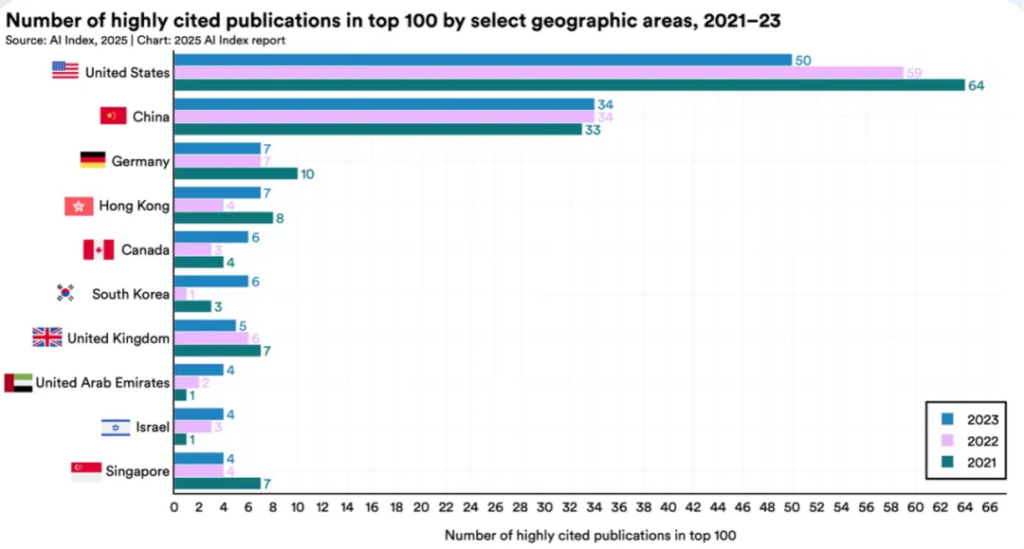
Stanford’s “2025 AI Index” notes that the United States still leads in the number of top-tier AI models, but China continues to lead in the number of AI papers and patents, and the performance gap between mainstream models in the U.S. and China has narrowed significantly. Source: Stanford HAI
(2) China’s Catch-Up in Key Sectors Can No Longer Be Ignored
Based on publicly available information, China’s progress in several key sectors is becoming increasingly difficult to ignore. Beyond AI, China is making steady strides in semiconductors, advanced manufacturing equipment, robotics, biotechnology, and several areas of basic scientific research. Even in a field as heavily constrained by external factors as semiconductors, China’s localization efforts continue to make progress. An analysis in the March 2026 report by the Center for Strategic and International Studies (CSIS) noted that China’s semiconductor localization process has further accelerated amid export controls by the United States and its allies. Although there remains a significant gap from established goals, the expansion of the industry’s scale and the advancement of domestic substitution over the past few years are undeniable facts.
This means that China’s resilience is not merely reflected in its ability to “weather sanctions,” but more significantly in its capacity to continue advancing engineering, market-oriented, and systematic capabilities in certain key industries. Particularly in sectors with both strong application scenarios and a solid industrial chain foundation, external containment has not halted China’s development; rather, it has, to some extent, strengthened the momentum for domestic resource reallocation and the restructuring of technological pathways.
(3) The real challenges still lie in high-end foundational areas and core capabilities
Of course, this does not mean that China has achieved breakthroughs in all key areas. At least based on publicly available information, high-end chips and certain core equipment, industrial infrastructure software and several high-end machine tools, some aerospace propulsion technologies, and certain advanced materials remain the key nodes where external containment can most easily exert pressure and where internal breakthroughs are most difficult to achieve quickly. The 2026 analysis in the Center for Strategic and International Studies (CSIS) report explicitly states that China’s domestic chip supply accounted for only about 30% of local consumption in 2025, and adoption by customers of more advanced equipment remains insufficient; meanwhile, a Reuters report on executives at Chinese chip companies indicates that EUV lithography machines, EDA software, and certain basic materials are still widely viewed as critical bottlenecks.
The reason these areas are so difficult is not merely due to the high technical barriers of individual technologies, but rather because they often involve multiple overlapping requirements, including basic research, precision manufacturing processes, supporting equipment, talent structure, long-term trial and error, and large-scale application. Precisely for this reason, breakthroughs in these fields are more likely to manifest as “phased progress and incremental breakthroughs” rather than being achieved all at once. In other words, the real challenge lies not in whether there is determination, but in how to gradually overcome the most difficult foundational hurdles.
(4) Future breakthroughs will not occur simultaneously but will proceed in a phased manner, following a “substitution—restructuring—tackling key challenges” approach
From another perspective, the ongoing escalation of external containment is also forcing China to establish a clearer path for substitution, restructuring, and iteration. Experience from recent years shows that while external restrictions increase short-term pressure, they also compel domestic resources to be concentrated more rapidly on critical weaknesses, gradually shifting previously dispersed technological accumulation and industrial collaboration toward a stronger strategic focus.
A more realistic assessment is not that “comprehensive breakthroughs will come soon” nor that “breakthroughs will remain elusive for the long term,” but rather that the pace of progress across different fields will diverge significantly: in the short term, substitution on the application and engineering sides is likely to continue accelerating; in the medium term, a range of key equipment, core components, and high-end manufacturing processes are expected to continue narrowing the gap; in the long term, breakthroughs in cutting-edge foundational technologies, ultra-high-end equipment, and original basic research will remain a protracted battle requiring greater patience, investment, and systemic capabilities. China’s future technological breakthroughs will likely not advance in unison but will instead follow a layered progression of “substitution—restructuring—tackling key challenges.”
V. Conclusion: The main focus of the U.S.-China technology rivalry is shifting from “chokepoints” to “system-level competition”
Ultimately, the most significant development in the U.S. technological containment of China today is not merely “which new ban has been imposed,” but rather that the U.S. is increasingly dissatisfied with imposing restrictions at isolated points and is striving to weave products, equipment, capital, markets, talent, regulations, allies, and third-party markets into a broader network of constraints. In other words, the U.S. goal is no longer merely to “block a single point,” but to shape, as much as possible, an external system that makes it harder for China to continue its upward climb. The Federal Communications Commission’s actions regarding Chinese laboratory testing of electronic devices exported to the U.S., the U.S. Congress’s push for restrictions on equipment and services from allied companies such as ASML, and the rules established by the Bureau of Industry and Security (BIS) and the Treasury Department in the automotive supply chain and foreign investment sectors all indicate that U.S. policy is continuously expanding across more nodes and broader boundaries.
This also implies that future U.S.-China competition is more likely to manifest as a long-term, high-intensity contest across the technological, industrial, economic, capital, and regulatory spheres. At least judging by the U.S.’s resource allocation and policy focus in recent years, this main trajectory is unlikely to change easily. For China, it is important not to underestimate the sustained pressure resulting from the systematic escalation of U.S. containment efforts, nor should external sanctions be simplistically interpreted as one-sided suppression or an intractable dilemma. The reality is more likely to be this: on the one hand, certain high-end critical sectors will continue to face prolonged “bottleneck” pressures; on the other hand, in areas with strong foundations in application, engineering, and industrial chain synergy, China will continue to advance substitution, restructuring, and upgrading.
It is precisely in this sense that, when observing the current escalation of U.S. technological containment against China, we must not only understand how the United States is “containing” China, but also where China will face pressure in the future and where it will continue to break through. The U.S. is shifting the competition from “chokepoints” to “system-wide blockades”; whether China can maintain its momentum, advance in stages, and break through point by point in this long-term contest will also largely determine the fundamental nature of U.S.-China technological competition in the next phase.
(National Strategic Research Institute, Shanghai Jiaotong University)