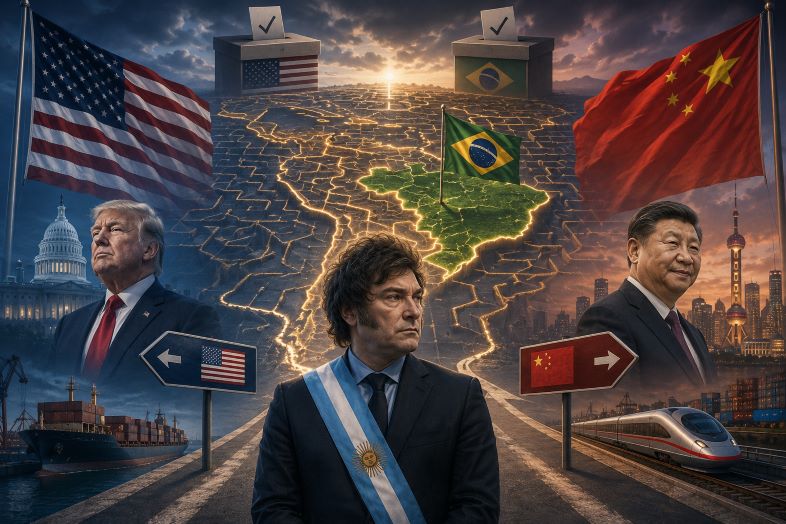
China Beyond the Wall recently spoke with Argentine journalist and activist Ramiro Poce* about the latest political developments in Argentina and across South America. We share the full conversation below.
*
Lama El Horr – Argentina can be considered a pioneer when it comes to the unconditional realignment of its foreign and domestic policies with Washington’s hegemonic objectives. During his presidential campaign, Javier Milei had promised that Argentina would not join BRICS—a promise he kept. He had also promised to end Argentina’s cooperation with China, despite the numerous infrastructure and financial/monetary projects already underway: how have relations between Buenos Aires and Beijing evolved since Javier Milei took office?
Ramiro Poce – Indeed, Milei’s policies are fully aligned with those of the United States—not only on economic matters but also in cultural and symbolic aspects—echoing slogans and domestic policies implemented during the Trump administration. Some examples: anti-immigrant rhetoric that borders on racism—even directed inward—with some libertarian commentators speaking of the need to build a wall between the capital and the province of Buenos Aires, where Peronism governs and poorer, less white people live; the adaptation of the MAGA slogan for our country—“Make Argentina Great Again”; the defense of Western values and, of course, full geopolitical support for whatever the U.S. and Israel do in various international conflicts.
When it comes to relations with China, the situation is more ambiguous. Although during his campaign and in his first year in office, President Milei used very hostile rhetoric toward the Asian giant—saying, for example, that he would not deal with “communists”—he gradually began to adopt a more pragmatic stance in practice. One of his first moves was to withdraw the country from the BRICS, but he later had to make some concessions. It’s worth noting that China is Argentina’s second-largest trading partner, after Brazil, and one of the largest buyers of agricultural and mineral products. Milei raised the possibility of an official trip to Beijing—which ultimately did not materialize—but he did hold a bilateral meeting with Chinese President Xi Jinping in 2024 in Rio de Janeiro, on the sidelines of the G20 summit. Recently, in early August, the currency swap agreement with China was renewed just one day before the extension of the previous agreement was set to expire.
The announcement was made jointly by the Central Bank of the Argentine Republic (BCRA) and the People’s Bank of China (PBOC) for an amount of RMB 130,000 million (equivalent to approximately US$ 19,000 million), extending the term from three to five years. This initiative is very helpful for Argentina, which is constantly vulnerable to reserve shortages and capital flight. Meanwhile, import restrictions were eased, and Chinese e-commerce companies such as Temu and Shein consolidated their sales here.
What is evident, however, is the national government’s break with infrastructure initiatives funded by Chinese capital. Investments in public infrastructure and transportation in Argentina suffered a drastic slowdown and a change in the regulatory framework. Javier Milei’s administration implemented restrictive measures for national public works projects. The bidding specifications for the AMBA I (Buenos Aires Metropolitan Area) electricity project prohibit companies controlled by foreign governments from serving as prime contractors—a condition that particularly affects large Chinese companies and that the government had already incorporated into the bidding processes for the Hidrovía waterway and highway concessions.
Although the restriction does not specifically mention China and also applies to state-owned companies from other countries, Chinese firms are among those most affected due to the significant state involvement in their large infrastructure conglomerates. In fact, this measure has come to be colloquially known as the “anti-China” rule.
Another significant event illustrating Argentina’s alignment with the United States at the expense of its relationship with China took place at the most recent AmCham Energy Forum 2026, an energy forum organized by the American Chamber of Commerce in Argentina, held in August in Buenos Aires. There, the U.S. Ambassador to Argentina, Peter Lamelas, issued a warning about the use of Chinese technology in strategic sectors and argued that its presence in infrastructure linked to Vaca Muerta (Argentina’s main energy production hub, considered the second-largest reserve of unconventional gas on the planet) could hinder the inflow of new foreign investment. Furthermore, Lamelas concluded his speech in a distinctive manner, using the first-person plural to refer to our country. “Today we are deciding the future of Vaca Muerta and of Argentina. Please, do not miss this opportunity.”
Lama El Horr – Whether in Argentina, Chile, Ecuador, Bolivia, Peru, or Colombia, the South American political landscape is now dominated by the right and the far right, which are allied with Zionism and fully aligned with Washington’s neo-imperialist and neo-militarist strategy. It is particularly striking that this neo-imperialism—against which Iran and its regional allies are currently waging a life-and-death struggle—is asserting itself without difficulty in South America, even without resistance (as in the case of Venezuela).
Is this a temporary trend or a genuine regional paradigm shift, in which any notion of South American integration is being abandoned in favor of a neo-imperialist coalition under the aegis of the United States?
Ramiro Poce – From my perspective, this is a temporary trend. We have observed that in recent years, governments of various ideologies have been unable to remain in power, and this trend has intensified in the wake of the pandemic.
In Latin America, during the second millennium, many major countries—Brazil, Venezuela, Argentina, Bolivia, Uruguay, and Ecuador—had nationalist, populist, or progressive governments that managed to bring about significant changes and consolidate a hegemony that lasted nearly 20 years. After that cycle, most countries saw a succession of governments that were unable to sustain themselves. In Brazil, Bolsonaro came to power, and then Lula returned. In Chile, the left won with Boric, and now the more conservative right has won. In Colombia, with Petro, there was a left-wing government for the first time in the country’s history, and now the far right has won. In Uruguay, the Frente Amplio’s hegemony was broken by Lacalle Pou, and then the Frente won again and is currently in power. In Bolivia, Rodrigo Paz won on a centrist platform, began implementing liberal reforms, and is facing fierce popular resistance. Ultimately, the most consistent trend is political alternation and the failure of any single model to take root.
In any case, the coming months will be crucial for the region. The presidential election in Brazil this October will be very important, as Lula seeks reelection against Flavio Bolsonaro, the son of the former president who is currently under house arrest; and the midterm elections in the United States will also be crucial, as a defeat for Trump would pose a significant problem for the new right-wing movements in Latin America, which are fueled—both symbolically and economically—by the MAGA movement.
Lama El Horr – Ramiro Poce, we know you as a journalist at Radio Nacional Argentina, but also as an activist with the organization H.I.J.O.S., which is dedicated to honoring the memory of those who disappeared during the 1976–1983 military dictatorship—including your own father, as well as your uncle and aunt. You yourself experienced exile following their arrest and “disappearance.”
When you see the Monroe/Donroe Doctrine making a strong comeback throughout the region today, and the majority of regional governments giving the green light for security and military cooperation with Washington and the Zionist regime, aren’t you afraid of a return to that dark period in the history of Argentina and so many other countries in the region?
Ramiro Poce – Indeed, there are situations unfolding around the world that are deeply troubling and that are linked to the actions of Trump and Netanyahu. The genocide in Gaza, but also—perhaps more quietly—in the West Bank; the attacks on Iran; and in our region, the kidnapping of Nicolás Maduro, the energy blockade against Cuba that has compounded the historic embargo, and Bukele’s policies in El Salvador, where human rights are being violated and maximum-security prisons have been made available for U.S. deportations. There are many people in the region who do not know where their relatives are after being detained by ICE (U.S. Immigration and Customs Enforcement).
Based on this Monroe/Donroe doctrine, we can observe a new (old) strategy: linking drug trafficking to terrorism and, in turn, applying this “narco-terrorist” label to political movements or leaders in order to take action against them without judicial oversight or parliamentary authorization. That is what they did with President Nicolás Maduro, for example: first, they linked him to the Cartel of the Suns—even though drug trafficking is virtually nonexistent in Venezuela—and then used that to justify his abduction.
As part of this strategy, the 40th International Conference on Drug Control (IDEC) was held in Buenos Aires, jointly organized by the DEA and the Argentine Ministry of Security. The forum took place under the strictest security measures and with the contents kept strictly confidential, and international cooperation agreements were signed between U.S. and Latin American security agencies. The goal is to use the pretext of narco-terrorism to expand the U.S. military presence in the region. This was already attempted in Colombia in the 1990s and was a failure; drug trafficking never decreased, and thousands of civilians were killed or disappeared at the hands of security forces or paramilitaries. Something similar happened in Mexico.
This entire geopolitical situation, combined with the deregulation and the state’s withdrawal from key areas promoted by Milei, has created a troubling scenario. Drug traffickers are gaining ground in areas left unprotected by the state, and at the same time, territories are beginning to be militarized, laying the groundwork for political persecution disguised as an anti-drug crusade.
In short, the current situation is very concerning, but as I mentioned earlier, what happens in the elections in Brazil and the United States will be key; and next year there are presidential elections in Argentina, so there may also be a change. Milei’s administration is proving to be a failure in managing the economy; wages are very low, and food and energy are exorbitantly expensive in a country that actually produces those very goods; and public sentiment is beginning to shift.
*Ramiro Poce is a journalist with Radio Nacional Argentina and an activist with the organization H.I.J.O.S.