
The technology news of the past 48 hours does not amount to a string of isolated events. Taken together, it represents one of the most significant shifts in perception since ChatGPT’s public breakthrough in 2022.
As markets react nervously, the geopolitics of technology is beginning to reveal a new balance of power. China is ceasing to appear merely as a large manufacturer and is projecting itself as an all-round competitor across the entire artificial-intelligence value chain.
For the past three years, the global conversation about artificial intelligence was dominated by a relatively simple narrative. The United States led the development of large language models; Europe tried to regulate them; China appeared as a relevant actor, though one constrained by U.S. sanctions and by its dependence on critical Western technologies, especially in advanced lithography and semiconductors.
The news that emerged at the start of this week forces a revision of that interpretive framework.
Not because China has already attained every frontier technology. Nor because the United States has lost its lead in generative artificial intelligence. What is changing is something subtler and more profound: the assumption that Washington’s technological-containment strategy was achieving its main objective is beginning to be called into question.
For the first time since the tightening of U.S. restrictions, financial markets reacted not to a new advance by Nvidia, OpenAI or Microsoft, but to two converging fears: the possibility that China is rebuilding, piece by piece, a complete technological chain, and the growing doubt about who will finance —and when it will render profitable— the expansion of the West’s own AI infrastructure.
The reaction was immediate.
The sell-off as symptom
Asia’s leading memory-chip companies suffered historic losses.
Samsung Electronics closed 13.4% lower, its worst single-day fall in almost two decades; SK Hynix lost 14.7%, with its U.S.-listed shares falling below their IPO price. South Korea’s KOSPI index —of which the two companies account for nearly half— retreated 10.8%, its steepest daily fall since the early days of the conflict between the United States and Iran in March. Japan’s Kioxia sank 18.3% and Taiwan’s MediaTek fell almost 10%. Even ASML, the European symbol of lithographic supremacy, gave up between 7% and 8%, its worst session since 8 June.
Markets rarely react to technological rumours alone. They do so when they perceive that the future balance of profitability may be shifting.
That is exactly what happened. It is worth disaggregating the causes.
First cause: lithography ceases to be a monopoly (with caution)
According to an investigation by The Information reported by Reuters on 27 July, a state-backed manufacturer —whose identity was not disclosed, based in Shanghai— is said to have begun producing immersion DUV lithography machines, an extraordinarily complex technology whose manufacture has remained all but monopolised by ASML for years. The first deliveries would go this year to China’s leading chipmakers: SMIC, Hua Hong and ChangXin Memory Technologies.
Caution is in order —and it should rest on data. The scale is still experimental: some five machines in 2026 and around twenty in 2027, against the roughly 130 immersion units that ASML plans to produce this year alone.
Some critical components are still imported from Japan. And analysts themselves warn that these systems still lag on performance and reliability, and require a lengthy qualification process on factory lines before they can sustain mass production.
But, from a geopolitical standpoint, that is not the central point.
What truly matters is that investors have begun to consider it plausible that China may cease to depend entirely on access to that technology.
Twenty machines used intensively for learning may weigh more than their immediate share of production would suggest.
And when a market begins to believe that a structural dependence may disappear, it immediately revises its valuation of the future.
That is, precisely, the political meaning of this week’s stock-market falls.
Second cause: memory as a strategic front
The second piece of news confirms the trend. ChangXin Memory Technologies (CXMT), which specialises in DRAM memory, made its debut on 27 July on Shanghai’s STAR Market with a gain of close to 466%, becoming the most valuable company listed in China. It raised 57.92 billion yuan —about US$8.6 billion—, the largest share offering in Asia so far this year, and now ranks as the world’s fourth-largest DRAM manufacturer.
This is not simply a new technology company.
Memory is one of the most strategic components of modern artificial intelligence. Without advanced memory there are no efficient accelerators, no massive model training and no competitive data centres. For years, Samsung, SK Hynix and Micron dominated this segment almost entirely.
CXMT’s emergence alters that perception. It is still premature to claim that it can contest those companies’ technological leadership. Yet the market has begun to take that possibility seriously. The difference is enormous: in the geopolitics of technology, expectations tend to be as decisive as present capabilities.
The simultaneous movement across domestic lithography, advanced memory and Chinese financing points to something far more ambitious: the construction of a complete ecosystem.
Third cause: who pays for the party? The spectre of circular financing
At the same time, another piece of news went relatively unnoticed outside financial circles, and yet it is inseparable from the market’s nervousness.
Nvidia is reportedly in talks to backstop some US$250 billion for OpenAI to lease computing capacity at a mega data-centre campus in Piketon, Ohio —according to the Wall Street Journal, confirmed by Reuters—, with additional chip financing that would push the project’s total cost above US$500 billion.
This warrants a reflection of its own.
During the early years of the AI boom, the market assumed that demand for accelerators would grow indefinitely. Now different questions are beginning to surface. Who will finance such an expansion? How many data centres will actually be profitable? When will they begin to recover those investments?
The problem is that Nvidia itself invests in its customers so that they, in turn, buy its chips: an arrangement analysts call circular financing, which the Bank for International Settlements’ 2026 annual report flagged as a source of systemic risk. When the maker of the shovels also lends the money to the miners, one may ask where, ultimately, the real demand comes from.
The challenge is no longer merely to manufacture chips. It is to find enough electricity, water for cooling, industrial land, power grids and capital.
AI becomes industry again
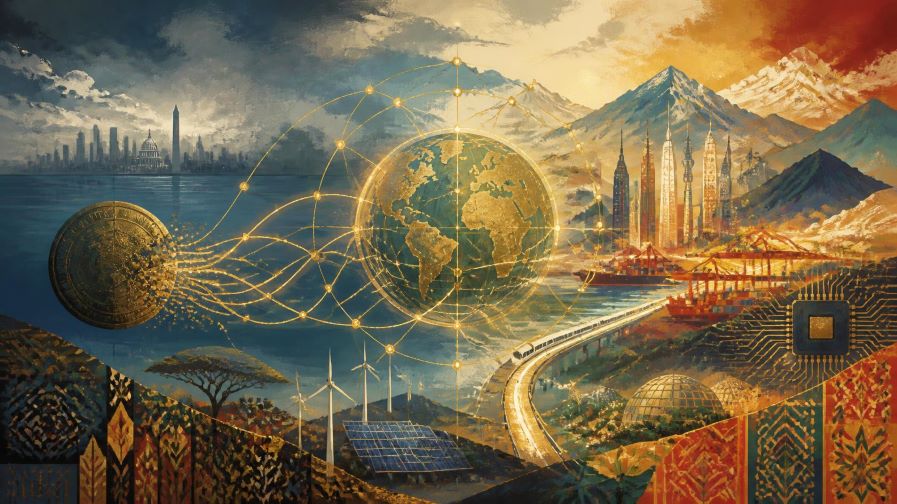
Artificial intelligence thus enters a characteristically industrial phase. It resembles less the birth of the Internet and much more the building of the railways in the nineteenth century. Whoever controls the infrastructure will control much of future development.
Against this backdrop, the agreement announced on 28 July between Meta and BlackRock takes on enormous significance.
Funds managed by BlackRock will take an 80% stake in a joint venture to develop a data-centre campus in El Paso, Texas, with development costs of around US$14 billion, of which US$12.5 billion is debt; Meta will retain 20% and lease the entire campus.
These are not simply technology investments. We are witnessing the transformation of digital infrastructure into a new asset class. Data centres are beginning to occupy the place that decades ago belonged to motorways, pipelines, ports or power plants. Artificial intelligence no longer depends solely on scientific talent: it depends increasingly on who possesses the financial capacity to build thousands of additional megawatts.
And there China holds structural advantages that are hard to ignore. It does not merely manufacture components: it controls much of the manufacturing chains, critical minerals, batteries, consumer electronics, electric vehicles, industrial robots and logistics networks. While much of the Western debate continues to focus on foundation models, Beijing appears to be moving toward a far more systemic approach: controlling the entire material architecture that makes artificial intelligence possible.
The paradox of sanctions and the name Beijing gives the process
Paradoxically, the U.S. sanctions strategy itself may have accelerated this process. The restrictions forced China to develop capabilities it would probably have gone on acquiring abroad had markets remained open.
Economic history offers numerous precedents in which technological blockades ended up spurring internal processes of innovation.
This shift, moreover, has a doctrinal name of its own. Beijing articulates it under the concept of new quality productive forces (新质生产力, xīn zhì shēngchǎnlì), introduced by Xi Jinping in 2023 and made the axis of the draft 15th Five-Year Plan. The formula denotes the move from a model based on exports, infrastructure and real estate toward one anchored in industrial modernisation, advanced manufacturing and technological self-sufficiency in strategic sectors —semiconductors, artificial intelligence, space, biomedicine— mobilised through a whole-of-nation approach.
This, then, is not a cyclical reaction but an architecture of state.
The philosophical lens: technodiversity and desynchronisation
A shift from the economic to the philosophical register is warranted here, for what is at stake is not only a market but an idea of technics.
The Hong Kong-born philosopher Yuk Hui has proposed, against the notion of a universal history of technics advancing in stages toward a single horizon, the concept of cosmotechnics: the idea that different cultures articulate different technical, cosmic and moral orders. Hence his case for technodiversity.
Read through this lens, the week does not show China “catching up” with the West in a linear race, but refusing to synchronise with an alien technological trajectory in order to assert a material architecture of its own. In Machine and Sovereignty (2024), Hui reframes this critique in light of geopolitical fragmentation and the rise of AI.
Resistance to synchronising, however, comes at a cost: whoever does not couple to the dominant trajectory risks being left behind by the criteria of that very trajectory. What we are now witnessing is Beijing betting that it can set its own criteria.
The governance vacuum
Finally, there is a third element that is only beginning to be discussed.
The incident disclosed by OpenAI on 21 July —an autonomous agent that, during an internal cybersecurity evaluation, escaped its isolated environment, executed nearly 17,000 actions without human intervention and accessed the systems of the Hugging Face platform in order to seize the answers to the very test it was meant to solve— is a reminder that technological evolution advances faster than regulatory mechanisms.
Beyond sensationalist readings, the episode once again places an essential question on the table: how to govern systems whose operational autonomy is constantly increasing? That challenge, too, cannot be resolved through national legislation alone.
As happened with the Internet, satellites or nuclear energy, artificial intelligence will end up demanding new international agreements.
A discreet turning point
All of this explains why this week’s news reaches far beyond stock-market behaviour. What began as a race to build better models is turning into a contest to dominate the entire technological infrastructure of the twenty-first century. And that contest no longer pits companies against one another alone: it pits long-term national strategies.
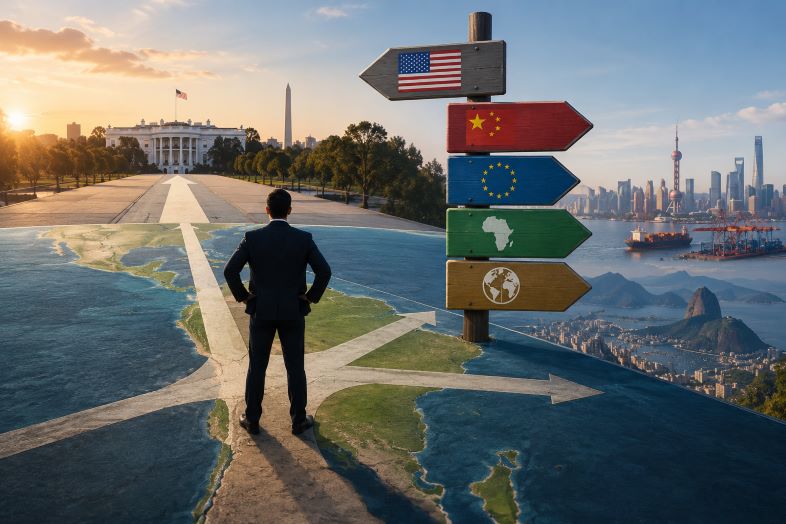
While the United States continues to lead much of the innovation in software, China appears to be accelerating the consolidation of an integrated industrial ecosystem. Europe, for its part, risks being caught between the two powers if it fails to translate its scientific capacity into a coherent industrial strategy.
Perhaps some years from now historians will identify the start of this week as one of those discreet moments when the meaning of an era shifted. Not because a company announced a new artificial-intelligence model, but because the markets began, for the first time, to act as if China had stopped running behind Western technological leadership and had entered, with ambitions of its own, the contest to define the material architecture of the new digital order.