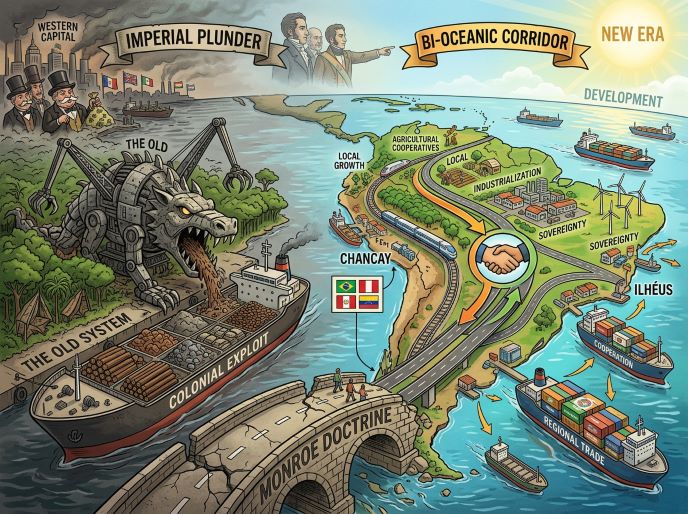
The bi-oceanic corridor that will link Chancay with Ilhéus is not just an engineering project: it is the backbone of a new era for Ibero-America that redefines its sovereignty in the face of the Monroe Doctrine and forges a new architecture of peace.
The roundtable discussion “An Alternative to War and Plunder in the Americas,” organized by the Executive Intelligence Review (EIR) on September 4, 2026, featured prominent analysts such as Helga Zepp-LaRouche (founder of the Schiller Institute), Roberto Amaral (former Brazilian Minister of Science and Technology), retired Peruvian General and academic Edwin Patterson Monsalve, former IMF Managing Director and co-founder of the BRICS New Development Bank Paulo Nogueira Batista Jr., Professor Zhang Weiwei (of Fudan University), and Spanish Colonel and geopolitical analyst Pedro Baños. They all agreed on a chilling diagnosis: the world is on the brink of a civilizational catastrophe, driven by a warmongering cabal that, from London and Washington, is pushing for nuclear war against Russia and China, while subjecting Latin America to renewed plunder under the guise of a revamped and radicalized Monroe Doctrine.
The epicenter of this threat lies in the National Security Strategy (NSS) published by the Trump administration in December 2025, whose principal author, Under Secretary of Defense Elbridge Colby, openly advocates for the use of tactical nuclear weapons and the expulsion of all Chinese economic development projects from the Americas. The stated objective is to polarize Latin America and the Caribbean along right-left lines, although, as I have warned on many occasions, the true target of this offensive is not a specific ideology, but rather any movement that presents itself as sovereignist and that could hinder Wall Street’s absolute control over the region—33 sovereign nations and 673 million people—with the option of direct military intervention if necessary. This policy, which Colonel Baños described as “absolute folly” that would lead to a “devastating” war against a nuclear power, is nothing more than the crudest version of the old British imperialism that Henry Carey, advisor to Abraham Lincoln, denounced back in the 19th century as a system of depopulation and barbarism.
This offensive is not limited to strategic documents, but manifests itself in open provocations regarding the very symbolic geography of the region. Recently, President Trump posted an image on his social media accounts in which Mexico, Canada, Greenland, and several Caribbean islands appear to be absorbed by the colors of the American flag, even renaming the Gulf of Mexico as the ‘Gulf of America.’ Mexican President Claudia Sheinbaum responded with a statement that resonates with the spirit of sovereignty that permeates the entire continent: ‘Mexico is not and will not be a colony or protectorate of any foreign country.’ This episode demonstrates that the renewed Monroe Doctrine seeks not only control of resources, but also the rewriting of the territorial identity of Latin American nations.
Faced with this suicidal course, the panelists at the roundtable put forward a concrete and powerful alternative: the Bi-Oceanic Railway Corridor, which would link the Peruvian port of Chancay on the Pacific coast with the Brazilian port of Ilhéus on the Atlantic. This project, originally conceived by the American statesman Lyndon LaRouche as the backbone of a continental high-speed rail network, is not merely a logistical link. As geostrategist Dennis Small, EIR’s director for Latin America, emphasized, it is a “development corridor,” 50 to 100 kilometers wide on each side of the track, equipped with fiber optics, high-tech industry, nuclear energy, and advanced agricultural programs, capable of generating one million direct jobs and transforming the economic landscape of South America. LaRouche envisioned it as the beginning of a global land bridge that, extending through Central America, Mexico, the United States and Canada to the Bering Strait, would connect with China’s Belt and Road Initiative in Asia, giving rise to hundreds of new cities and a revolution in food production through the integration of the Orinoco, Amazon and Rio de la Plata river systems.
The geopolitical significance of Chancay has not gone unnoticed. As General Patterson explained, the port, built by the Chinese state-owned company Cosco Shipping Ports in partnership with the Peruvian company Volcán, reduces the sea voyage to Shanghai by ten days and displaces the traditional routes that passed through North America. For the United States, this represents an unacceptable affront: Secretary of State Marco Rubio has declared that “we will not allow the Western Hemisphere to become a base of operations for adversaries.” But, as Sara Madueño de Vásquez, EIR’s correspondent in Lima, pointed out, the paradox is that Washington was never interested in the region’s development; only when China begins to build productive infrastructure does it become a “security threat.” In contrast, China’s recently published policy toward Latin America proposes actively exploring cooperation in high-tech areas such as artificial intelligence, aviation, new energy, and biomedicine, and is already establishing agreements with Peruvian universities to train railway engineers and AI specialists.
This Chinese support for the sovereignty of Latin American countries transcends the economic sphere and has become explicit in the diplomatic arena. Recently, the Foreign Minister of the People’s Republic of China reaffirmed to the Mexican government his support for the country’s independence and autonomy, emphasizing that bilateral relations “are not directed at third parties and should not be affected by third parties”—a direct allusion to the US attempt to exclude China from the hemisphere. This diplomatic gesture, which frames cooperation within the five principles of peaceful coexistence, confirms that Beijing’s vision is not to replace one power with another, but rather to forge an alliance among sovereign nations that reject external interference, as argued in the analyses of Nogueira Batista Jr. and Donald Ramotar.
This diplomatic alignment found its immediate counterpart in action. Just three days after the EIR roundtable, on September 7, 2026, Mexico’s Foreign Minister, Roberto Velasco Álvarez, met in Beijing with his Chinese counterpart, Wang Yi. During the meeting, Velasco reiterated Mexico’s commitment to a constructive relationship and reviewed opportunities to expand cooperation in health, education, science, innovation, the environment, and rural development, with the aim of establishing a joint roadmap for the coming years. Simultaneously, the Mexican Foreign Minister participated in the opening ceremony of the Mexican consulate in Chongqing—the first new diplomatic mission opened in China in two decades—and emphasized that this city “is an exceptional embodiment of the energy, transformative capacity, innovation, and forward-looking vision of contemporary China.” Although the meeting did not result in the announcement of specific projects, the political message was unequivocal: Claudia Sheinbaum’s government, far from bowing to US pressure to expel China from the hemisphere, is committed to diversifying its international ties and keeping all its economic options open, a decision all the more relevant considering that the financial storm unleashed by the rise in interest rates in the United States could precipitate a debt payment crisis in Mexico.
This contrast is not accidental. As Helga Zepp-LaRouche reminded us, the new name for peace is development. The bi-oceanic corridor, by generating employment and wealth on the continent itself, addresses the root causes of forced migration and embodies that vision of development that is, in itself, the path to peace.
But the stakes go beyond the economic. As Paulo Nogueira Batista Jr. argued, the new Monroe Doctrine is not a project of hegemony, but of “unlimited hegemony,” which includes Canada and Greenland and has already translated into concrete actions: the kidnapping of the Venezuelan president, the intensification of the blockade against Cuba, economic pressure against Canada, and open interference in the region’s elections. In response, Batista Jr. warned against illusions: neither China nor Russia will intervene militarily in defense of Latin American countries if they are attacked by the United States. Therefore, sovereignty can only be guaranteed through regional cooperation and the capacity for deterrence, a path that necessarily involves the physical and productive integration of the continent.
Guyanese President Donald Ramotar added a key piece to the puzzle: the current international system, based on profit maximization and debt as a weapon of domination, is “outdated” and incapable of solving the existential problems facing humanity. Every year, the Global South transfers more than a trillion dollars to the North through interest payments and illicit financial flows. China, on the other hand, has demonstrated through its own development and projects like the Tanzania-Zambia railway that an alternative philosophy exists: that of “win-win,” which uplifts partners instead of exploiting them. Ramotar called on the peoples of Latin America to organize themselves to prevent the United States from expelling China from the continent, because not only development but also our very ability to decide our future depends on it.
On the European front, Colonel Pedro Baños offered a crucial perspective: Spain, which remained neutral in both world wars, is being dragged by NATO into a conflict against Russia in which it has nothing to gain and everything to lose. With its main military effort deployed in Slovakia, on the border with Russia, and with its territories in North Africa excluded from NATO’s protective umbrella, Spain is assuming an existential risk for interests that are not its own. Baños urged citizens to demand that their leaders abandon this “suicidal race” and return to diplomacy as a tool for conflict resolution.
From China, Professor Zhang Weiwei emphasized that the bi-oceanic corridor is an example of “genuine multilateral cooperation and solidarity with the Global South,” in contrast to geopolitical initiatives that serve the exclusive interests of certain blocs. He noted that China has eradicated extreme poverty across its vast territory of 1.4 billion people and created the world’s largest middle class thanks to a determined commitment to infrastructure, education, and technological innovation. This model, based on the five principles of peaceful coexistence and the conviction that “the progress of one nation can benefit all,” offers a real way out of the civilizational crisis.
Optimism, however, is not naive. As Dennis Small warned, the possibility of change lies in the human mind and its creative capacity to conceive a different future. The bi-oceanic corridor is not a magic bullet, but rather an instrument to unleash that creativity. Its construction, which will require a decade and some 80 billion dollars, will not only face colossal engineering challenges—crossing the Andes and the Amazon—but, above all, the political challenge of integration, which Lyndon LaRouche defined as “the most important and difficult undertaking of statesmanship.” But it is precisely this difficulty that makes it a paradigmatic project: if Latin America manages to unite governments of different political persuasions around a common development plan, it will be teaching the world that it is possible to overcome the divisions imposed by colonialism and build a new architecture of security and development based on mutual respect and cooperation.
As Helga Zepp-LaRouche concluded, the old colonial order, based on domination and oppression, is crumbling. The Global South, with Latin America at the forefront, has a historic opportunity to assume a leadership role and demonstrate that Kissinger’s mantra—”history is not made in the South”—is entirely false. The Chancay-Ilhéus bi-oceanic corridor, with its capacity to generate employment, industry, and hope, is the symbol of this new paradigm. This is no small undertaking: it is the embodiment of the idea that development is synonymous with peace, and that peace, to be lasting, must be the fruit of justice and cooperation among free and sovereign nations.
Sources consulted
Helga Zepp-LaRouche. A New International Architecture for Security and Development to Stop War and Plunder. Executive Intelligence Review. September 4, 2026.
Roberto Amaral. The Future of Brazil: Science, Technology, Innovation and Sovereignty. Executive Intelligence Review. September 4, 2026.
Edwin Patterson Monsalve. The Port of Chancay and the Development and Integration Corridors in South America. Executive Intelligence Review. September 4, 2026.
Paulo Nogueira Batista Jr. The New Monroe Doctrine and the United States’ Claims to Unlimited Hegemony in the Western Hemisphere. Executive Intelligence Review. September 4, 2026.
Zhang Weiwei. China’s Role in the Development of the Global South. Executive Intelligence Review. September 4, 2026.
Pedro Baños. Why Spain should not join NATO’s war against Russia and Iran. Executive Intelligence Review. September 4, 2026.
Dennis Small. South America’s bi-oceanic rail corridor: a planetary transformation on a century-long scale. Executive Intelligence Review. September 4, 2026.
Donald Ramotar. A Good Neighbor Policy Among South American Nations. Executive Intelligence Review. September 4, 2026.
Sara Madueño de Vásquez. The ‘Chancay effect’ on the eve of the Pope’s visit to Peru. Executive Intelligence Review. September 4, 2026.
Estevão Damacena. Vulnerabilities of Brazil’s physical economy and how to overcome them. Executive Intelligence Review. September 4, 2026.
Gretchen Small. Mexican, Chinese Foreign Ministers Discuss Expanding Cooperation in Beijing Meeting. EIRNS. September 7, 2026.