I grew up in a neighborhood where people were always fighting, so I learned early on that if you want to survive, you have to fight—and if you want to stop your enemies from assassinating you, you have to kill them first. Those are Netanyahu’s words.
October 18 was nine days before Israel’s parliamentary election. Three things happened that day involving Netanyahu.
The first was the announcement of a new set of “national security principles.” According to the Israeli prime minister’s office, this was the first systematic update to Israel’s national security strategy in a decade. The order of priorities has changed: where the previous approach put containment first and defense second, prevention and offense now come first. If necessary, Israel can launch preemptive strikes to thwart threats that are still developing.
According to the prime minister’s office, the new principles also call for strengthening Israel’s domestic defenses, consolidating its position as a regional power, and achieving the greatest possible degree of self-sufficiency in military supplies. The document also provides for the establishment of buffer zones where necessary, while artificial intelligence, quantum computing, and space have been designated as priority areas.
Netanyahu told reporters: “The goals I have set do not depend on American approval. If necessary, we will act independently.” He also said that Israel’s need to eliminate the “nuclear threat” and the “broader threat” posed by Iran existed independently of any other consideration.
In the past, military action required evidence that a threat was imminent. Now, it is enough to determine that a threat is evolving. In effect, this structurally lowers the threshold for using force: an attack no longer requires proof of a threat that is supposedly right around the corner.
The second development was Trump’s declaration on his own social-media platform that Netanyahu was a “great warrior prime minister” and a “great partner” in confronting Iran. Trump offered him his “complete and total support,” adding that if Israel chose the wrong leader—meaning anyone other than Netanyahu—the United States would have to do the job itself, something he said he was not inclined to do.
Leaders endorsing one another is nothing unusual. But it is difficult to find anyone other than Trump who would tie such an endorsement so openly and so closely to military action—and interfere so blatantly in another country’s election.
Citing sources inside Likud, the Israeli newspaper Maariv reported that Trump had been closely monitoring the balance of power among Israel’s political factions for several weeks. In an interview with Axios that same day, Trump said: “I always intended to do this. I just didn’t want to do it too early.”
The third development was an investigation by Time magazine, which obtained previously unpublished documents and communications. Its conclusion was that Qatar had sent nearly $2 billion to Hamas-controlled Gaza over the past decade and more. The investigation unearthed a 2018 cabinet decision, intelligence warnings from 2019, and correspondence from 2020.
According to the investigation, Israel did not merely allow the money through; it also helped design the distribution mechanism and select the recipients.
In 2019, then–Shin Bet director Nadav Argaman told Netanyahu that Qatari money was flowing to Hamas’s military wing. In 2020, military intelligence issued another warning. The intelligence assessment concluded that Qatari funds covered roughly half of the Hamas military wing’s annual budget.
In 2020, then-Mossad director Yossi Cohen wrote a letter of thanks to the emir of Qatar. The letter said: “This is an excellent opportunity to express our gratitude and appreciation for the State of Qatar’s efforts to provide humanitarian assistance to the Gaza Strip over the past several years.”
Two weeks before the October 7, 2023, attack, Mossad director David Barnea flew to Doha to seek an extension of the funding. In the years before that, Israel had simultaneously been sending letters of thanks and publicly accusing Qatar of financing Hamas.
Netanyahu’s office declined to comment. Qatar’s position was that all aid had passed through mechanisms coordinated with Israel; if the money ended up in Hamas’s hands, the responsibility lay with Israel.
The investigation was published on October 18, nine days before the vote. On October 14, Trump had still been saying that “we haven’t thought about” military action against Iran. On October 15, he said that he did not trust anyone in politics, including Netanyahu. On October 18, he offered his “complete and total support.” Only three days separated the two positions.
The reason for Trump’s reversal is not hard to find: Netanyahu’s electoral prospects were looking increasingly precarious. So, whatever his frustrations, Netanyahu remains Trump’s political ally.
Current seat projections in Israel are as follows: the Integrity Party has 26 seats, Likud 20, the opposition bloc 54, and Netanyahu’s bloc 49. None has reached the 61 seats needed to form a government. On the question of who would be better suited to serve as prime minister, Eisenkot leads Netanyahu by 43% to 38%. Likud won 32 seats in the last election; polls now project just 20.
The Knesset has 120 seats. Outside the two main blocs, Arab parties and others hold 17 seats. Israel votes for party lists, and the prime minister is not elected directly by voters; the position emerges from coalition negotiations. Since the country was founded in 1948, no single party has ever won the 61 seats needed for a majority, making the support of smaller parties especially important. As a result, Israel held five elections between April 2019 and November 2022—a period of three and a half years.
If the anti-Netanyahu bloc wants to reach a majority, it cannot avoid dealing with Arab parties. Yet the mainstream opposition insists on forming a Zionist government and is unwilling to cooperate with them. That would appear to favor Netanyahu, but he is also facing three corruption cases.
Case 1000 concerns gifts. Case 2000 involves a deal with a media proprietor. Case 4000, the most serious, alleges that Netanyahu granted regulatory favors to a telecommunications giant in exchange for positive coverage of him on one of its news websites.
When the trial opened in May 2020, he became the first sitting prime minister in Israeli history to stand trial. On June 24 this year, he completed his own testimony at the Tel Aviv District Court. This phase lasted roughly a year and a half and involved 98 court hearings.
If Netanyahu cannot win the election, a legal reckoning is what awaits him. So the question of how a prime minister who knows that leaving office means facing prosecution will use the power remaining to him in his final days to secure a way out hardly needs an answer. For Trump, that vulnerability is precisely something he can exploit. After all, the heavyweights of the U.S. financial markets want stability.
Israel votes on October 27, and the United States on November 3—a gap of seven days. Those seven days will be filled with uncertainty, and Iran needs to be on guard. Seven days later, if Netanyahu wins, he will have a new mandate; if he loses, he will face the courts. Yet both outcomes point toward the same possibility: after the vote, constraints may loosen, and the war could continue to escalate—perhaps even becoming irreversible, since conventional tactics have already proved largely ineffective.
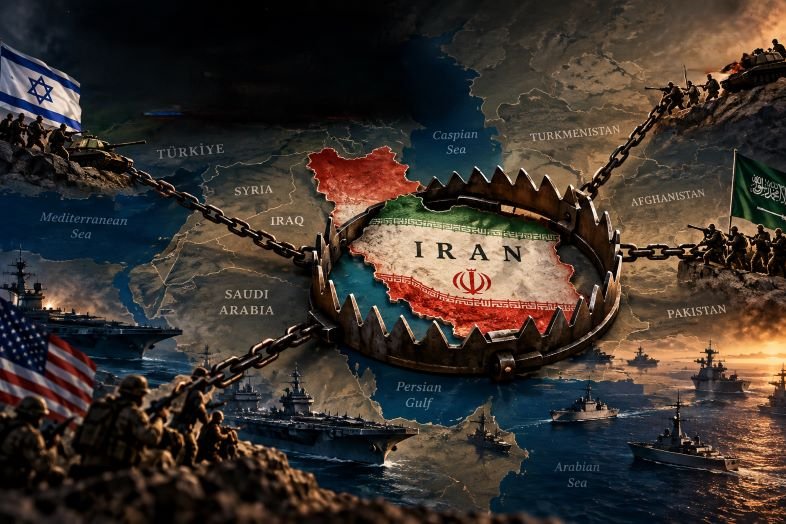
Although Israel has long denied it, it is widely regarded as the only de facto nuclear power in the Middle East. That option will not disappear simply because it is politically or morally unpalatable. The real danger lies in the fact that Netanyahu has turned the idea that “a threat is evolving” into an institutional principle. Combined with the outcome of the U.S. midterm elections and Trump’s mercurial temperament, this can only increase the pressure on Iran.
On October 12, Rezaei, secretary of the Supreme National Security Council, said that the United States had more than $2 trillion in assets in the United Arab Emirates and around the Strait of Hormuz. These included undersea cables, data centers, and artificial-intelligence facilities. He made a point of adding that those assets had not yet been included among the targets.
That qualification matters. The key point is not that they have already been targeted, but that they could be targeted at any time.
On the same day, October 18, Iranian Foreign Minister Abbas Araghchi said in Baghdad that, if the conditions were met, the Strait of Hormuz would reopen on the sixth day and negotiations would resume on the seventh. The seven-day plan had already been conveyed to the United States through Qatar. Washington had offered its comments, and Iran was reviewing them.
The following day, Russian Foreign Minister Sergey Lavrov arrived in Tehran and held a joint press conference with Araghchi. He said Russia wanted to prevent a repeat of a large-scale war, while Russian technical teams would resume work at the Bushehr nuclear power plant.
I will not comment on this final passage. But I will borrow a line attributed to Marshal Peng Dehuai in The Great Long March: some people can sell off their family inheritance without feeling the slightest pang.