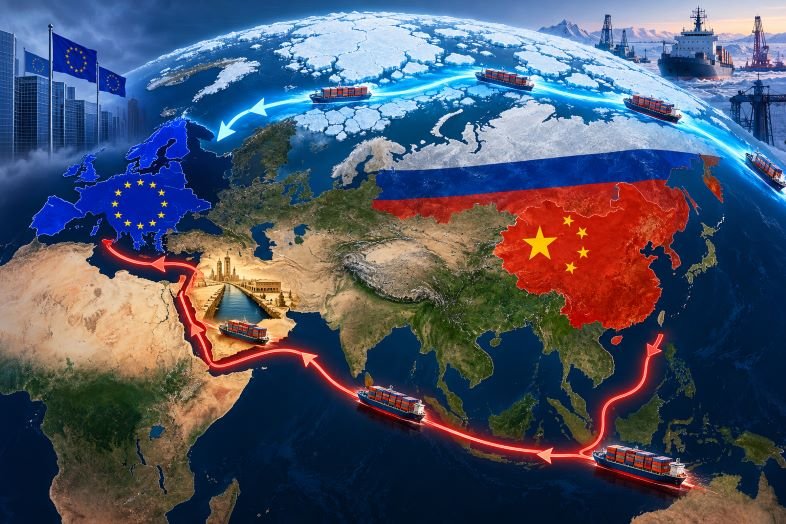
China and Russia are cooperating to open new Arctic transit routes, reducing shipping times to Europe and bypassing the Suez Canal.
China condemned on 22 October the EU’s new push to expand Arctic surveillance and grow its fleet of icebreakers, calling it a return to a “Cold War” mentality as competition to control the newly emerging northern trade route gains momentum.
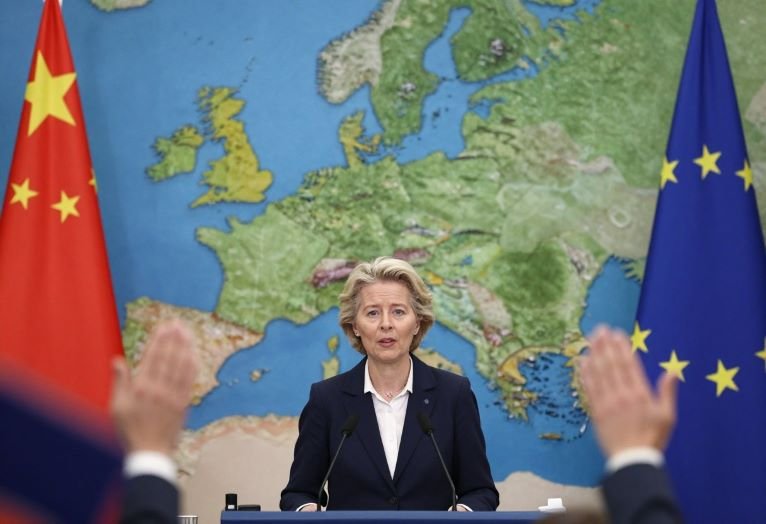
On Monday, European Commission President Ursula von der Leyen announced a “new strategy for the Arctic,” calling it “Europe’s northern neighborhood.”
“With Russia and China increasing their footprint and ambition, the Arctic has become a front line of global power competition,” stated Kaja Kallas, vice president and foreign minister of the European Commission.
Europe, China, Russia and the US are competing for influence in the Arctic as ice recedes and opens up new transit corridors between China and Europe along the northern Russian coast.
In response, China emphasized its peaceful intentions in the Arctic.
“China’s activities in the Arctic are aimed at promoting the Arctic’s peaceful, stable and sustainable development, and are in accordance with international law,” Chinese Foreign Ministry spokeswoman Mao Ning said during a news conference in response to Kallas’s statement.
“Using Cold War mentality to create factions and incite geopolitical confrontation is not conducive to the peaceful and stable development of the Arctic region,” she added.
HR/VP @kajakallas addressed the European Parliament plenary on the EU’s new Arctic Strategy, stressing that the Arctic has become a frontline for global power competition.
The EU will notably strengthen surveillance and satellite monitoring, as well as improve its ability to… pic.twitter.com/ubaYoborKN— European External Action Service – EEAS 🇪🇺 (@eu_eeas) October 21, 2026
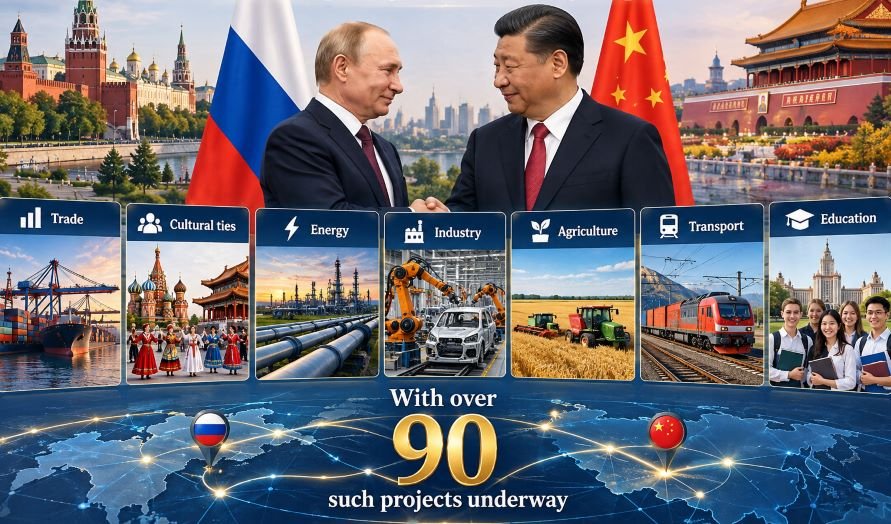
China and Russia issued a joint statement on Wednesday announcing cooperation on Arctic shipping, including promoting steady growth in Arctic cargo transportation, increasing the number of Arctic shipping services between Chinese and Russian ports, and enhancing the competitiveness of Arctic shipping routes.
In August, China launched the first regular shipping service through the Arctic Northern Sea Route (NSR), which cuts shipping times to Europe in half as global warming and nuclear-powered icebreakers make the route increasingly accessible.
The voyage from China to Europe via the NSR can take as little as 15 days, compared to at least 40 days for ships using the traditional route through the Red Sea and Suez Canal.
Transiting the Red Sea and Bab al-Mandab Strait is seen as increasingly unstable due to recent conflicts between the US, Israel, and Saudi Arabia on the one hand, and the Ansarallah-led Yemeni government and Iran on the other.
With Saudi Arabia’s oil exports also restrained by Iran’s attacks on ships in the Strait of Hormuz, the kingdom is under pressure to partner with Israel to build an oil pipeline to the Mediterranean.
In July, Israeli Energy Minister Eli Cohen proposed a 700-kilometer extension connecting Saudi Arabia to Israel’s historic Eilat-Ashkelon Pipeline (EAPC), bypassing the Strait of Hormuz and the Red Sea.
Russia has the biggest and best nuclear-powered icebreaker fleet in the world…
and China just opened up an arctic shipping lane, the “Polar Silk Road.” pic.twitter.com/cx9I2CRBPw— DD Geopolitics (@DD_Geopolitics) August 8, 2026