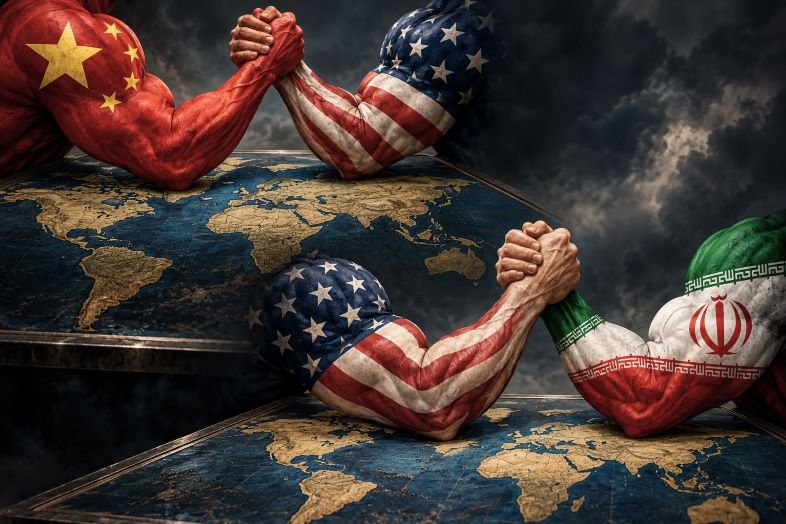
The situation in the Middle East remains tense. The United States continues to flout international rules and has subjected Iran to maximum pressure on every front. After years of confrontation, Iran has consistently hoped to sit down with the United States for formal negotiations.
This has led many developing countries to draw a simplistic analogy: if the People’s Republic of China once managed to force the United States to the negotiating table, then Iran should likewise be able to secure an opportunity for dialogue on an equal footing merely by adopting a tough diplomatic posture and projecting confidence in its rhetoric.
But copying the outward appearance of toughness while ignoring the underlying conditions that determine the outcome of a power struggle is completely at odds with the realities of great-power competition. An adversary will never agree to equal negotiations simply because it has been exposed to a few tough diplomatic phrases. What truly matters is whether it fears that you possess enough power to make it pay a painful price.
Every negotiation between ostensibly equal parties takes place only after both sides have suffered enough losses to make further escalation unbearable. Only then do they compromise and reach an agreement. Negotiations are forged through struggle; rhetoric alone cannot deliver the outcome one wants.
I. The Historical Record: The Sino-American Armistice Negotiations Were Backed by Hard-Won Leverage
1. The Two Sides Began with an Enormous Power Imbalance; the Initiative Could Be Secured Only Through Bloodshed
In 1950, the newly founded People’s Republic of China was struggling to rebuild from the devastation of war when it found itself confronting the world’s foremost power, the United States. At the time, U.S. steel production stood at 87.72 million metric tons—144 times China’s output. China produced just 606,000 metric tons of steel in 1950. The gap between the two countries’ industrial capacities was staggering.
The United States possessed a fully developed system of air and naval warfare, as well as nuclear weapons. China had neither air superiority nor control of the seas, while its weaponry and equipment were a full generation behind. The two countries’ overall national power was simply on entirely different levels.
Despite this highly disadvantageous situation, the Chinese People’s Volunteers crossed the Yalu River and launched five successive large-scale campaigns, driving United Nations forces from the banks of the Yalu all the way back to the 38th parallel. The Volunteers then held the entire defensive line through an extensive network of tunnels and fortifications, while frustrating successive U.S. campaigns of encirclement and annihilation and defeating what China described as biological-warfare operations. Tens of thousands of enemy troops were killed or otherwise put out of action.
In little more than a year, U.S. military fatalities surpassed 100,000, direct war costs exceeded $10 billion, and U.S. strategic deployments in Europe were severely constrained. The appetite for continuing the war steadily diminished.
2. Fighting and Negotiating at the Same Time: Battlefield Outcomes Determined the Pace of the Talks
The negotiations proceeded entirely in step with the balance of power on the battlefield. When the American side made sweeping demands at the negotiating table, it would immediately launch a ground offensive if no agreement could be reached, hoping to use force to compel China to make concessions. Yet whenever the Chinese People’s Volunteers achieved a major victory on the battlefield, U.S. demands became noticeably more restrained.
During the 1952 Battle of Triangle Hill—known in China as the Battle of Shangganling—the United States committed 60,000 troops and fired more than 1.9 million artillery shells at the Chinese positions, literally lowering the height of the hills by two meters. In the end, United Nations forces suffered more than 25,000 casualties but never managed to break through the Volunteers’ defensive line. During the summer offensive of 1953, the Chinese People’s Volunteers again inflicted heavy losses on the opposing forces, definitively shattering the U.S. military’s hope of using force to extract gains.
General Mark Clark, the final commander-in-chief of the United Nations Command, eventually acknowledged with resignation that he had become the first American commander to sign an armistice agreement without having achieved victory.
This episode of history confirms a hard rule: what cannot be won on the battlefield can never be obtained at the negotiating table. Diplomatic confidence may be an added advantage, but tangible military power is the strongest card one can hold in negotiations.
3. Historical Evidence: Military Deterrence Is Always a Precondition for Negotiations
The history of modern diplomacy repeatedly confirms this principle. When the late Qing dynasty was weak, even dispatching delegations to Russia to negotiate border issues could achieve little. Without military power to back them, Chinese negotiators were forced to compromise and retreat time and again.
By contrast, when Wu Dacheng led Sino-Russian boundary negotiations in 1886, he had Beiyang ironclad warships sail to Vladivostok. The display of overwhelming force curbed the other side’s expansionist ambitions. China successfully recovered approximately 10 square kilometers of territory at Heidingzi and secured the right for Chinese vessels to navigate freely through the mouth of the Tumen River.
Military power must come first as a guarantee; negotiations come afterward. This has been true throughout history, both at home and abroad.
II. A Reality Check: The Gap in Power Between Iran and China in the Early Years of the People’s Republic Is Simply Too Wide to Bridge
Iran can reasonably be regarded as a regional military power in the Middle East. According to data from the International Institute for Strategic Studies’ Military Balance 2025, Iran has approximately 610,000 active-duty personnel, along with substantial ballistic-missile and drone forces. Its medium- and long-range missiles can reach the entirety of Israel as well as all U.S. military bases in the Middle East. Any U.S. decision to launch an attack would therefore require Washington to weigh the potential costs repeatedly and carefully.
But a comparative assessment of Iran and the newly founded People’s Republic of China during the Korean War reveals a fundamental difference in their overall national strength and capacity to sustain a prolonged conflict. The two countries’ strategic thresholds are simply not on the same level.
The gap in military capabilities is enormous. The United States possesses more than a dozen carrier strike groups and thousands of advanced combat aircraft. It can project military power anywhere in the world and conduct long-range precision strikes. Iran’s air force relies on aging aircraft, while its navy consists largely of small fast-attack craft and has no genuine blue-water capability. It can defend the waters around its own territory, but it lacks the ability to mount a comprehensive confrontation with the United States.
Iran lacks the industrial capacity to sustain a war of attrition. After decades of severe sanctions, its heavy industry and defense-industrial supply chains remain incomplete, leaving it unable to support a large-scale, protracted war. When the People’s Republic of China was founded, by contrast, it had already established the foundations of a nascent domestic industrial system. That system could continuously supply weapons and materials to the front and provide solid support for a long war of attrition.
The difference in strategic depth is stark. China’s vast territory gave it ample room for strategic maneuver and enabled it to withstand prolonged attrition. Iran’s territory is considerably smaller, and critical infrastructure—including energy and transport facilities—could be destroyed with relative ease by precision strikes. Its ability to absorb attacks is therefore limited.
At the time, the newly founded People’s Republic of China was capable of continuously draining U.S. global strategic resources and dragging its adversary into a quagmire. Iran, by contrast, can rely only on limited retaliatory strikes with ballistic missiles. It lacks the capacity to tie down the main body of U.S. forces over the long term, making it difficult to secure a seat at the table for genuinely equal negotiations.
III. A Cautionary Lesson from the Past: Without Power to Back It Up, a Treaty Is Just a Scrap of Paper
1. The Iran Nuclear Deal Was Torn Up at Will: Agreements Signed by Weaker States Are Fundamentally Fragile
In 2015, Iran voluntarily curbed its nuclear program in exchange for the international community’s lifting of some sanctions, and the Iran nuclear deal formally took effect. Yet just three years later, the United States unilaterally abandoned the agreement and immediately imposed a new round of sanctions, showing complete disregard for international commitments and written undertakings.
Without comparable power to underpin an agreement, even a deal signed and sealed in black and white is unlikely to remain in force for long when confronted by the coercive power of a great power.
2. The Historical Pattern: Whether a Treaty Holds Depends on the Balance of Power
History repeatedly follows the same pattern. After the First World War, Germany was forced to sign the Treaty of Versailles. But because the victorious powers did not completely destroy Germany’s industrial and military-industrial base, the treaty proved incapable of containing its expansionist ambitions.
After the Second World War, by contrast, Germany and Japan were subjected to comprehensive military occupation and their industrial systems were thoroughly dismantled. Only then did they faithfully abide by the postwar international order for decades.
Whether a treaty can actually be implemented and upheld has never depended solely on how tightly its provisions are drafted. The decisive question is whether the balance of power between the parties is sufficiently even.
3. The Current Standoff: U.S. Signals About Negotiations Are Merely a Form of Pressure
The current confrontation in the Middle East makes the situation perfectly clear. The United States is playing a two-track game: on the one hand, it keeps signaling that it is willing to negotiate; on the other, it continues deploying additional carrier strike groups to the Arabian Sea and blockading Iran’s maritime energy routes.
Washington’s professed interest in negotiations is, in essence, merely an adjunct to a campaign of maximum military pressure. From beginning to end, it has shown no genuine intention of engaging in equal negotiations.
The disparity in power is there for all to see. Diplomatic mediation and tough rhetoric alone cannot prevent a superpower from throwing its weight around unilaterally.
IV. Conclusion: Rhetorical Confidence Cannot Make Up for a Deficit in Real Power; Dignity at the Negotiating Table Rests on Battlefield Leverage
Many developing countries repeatedly fall into the same trap: they see only the final outcome of a great power’s successful negotiations while overlooking the brutal military struggle behind it. Negotiations are never an independent diplomatic instrument. Only when both sides have pushed the contest to the limit, and neither can afford to suffer greater losses, do they make mutual concessions and reach a compromise.
The Chongqing negotiations offer the clearest example. The more resolutely a country fights on the front line, the greater its leverage at the negotiating table. After the Kuomintang suffered defeat in the Shangdang Campaign, its offensive momentum was severely checked. Only then did Chiang Kai-shek rein in his ambitions and sit down in earnest to sign the Double Tenth Agreement. A weak country can do little more than struggle to preserve its position through diplomatic maneuvering; only a strong country has the standing to negotiate on an equal footing.
Diplomatic confidence is indispensable, but verbal toughness alone cannot bridge the gap in hard power. Without a comprehensive national-defense system, independently controlled industrial capacity, and an efficient and sufficiently robust ability to mobilize for war, issuing threats at the diplomatic level is unlikely to force a powerful adversary to the negotiating table for an equal dialogue.
Ultimately, competition between states is a contest in overall national power. Every measure of dignity secured at the negotiating table is firmly rooted in the hard power that enables a country to hold the line on the battlefield.
Sources of the Article’s Data
- Xinhua News Agency: reports on the U.S.-Iran confrontation and the progress of negotiations, 2026
- The official website of China’s Ministry of National Defense and the Institute of Party History and Literature: historical materials on the War to Resist U.S. Aggression and Aid Korea
- The International Institute for Strategic Studies, The Military Balance 2025
- Modern historical archives concerning Sino-Russian border negotiations during the late Qing dynasty.