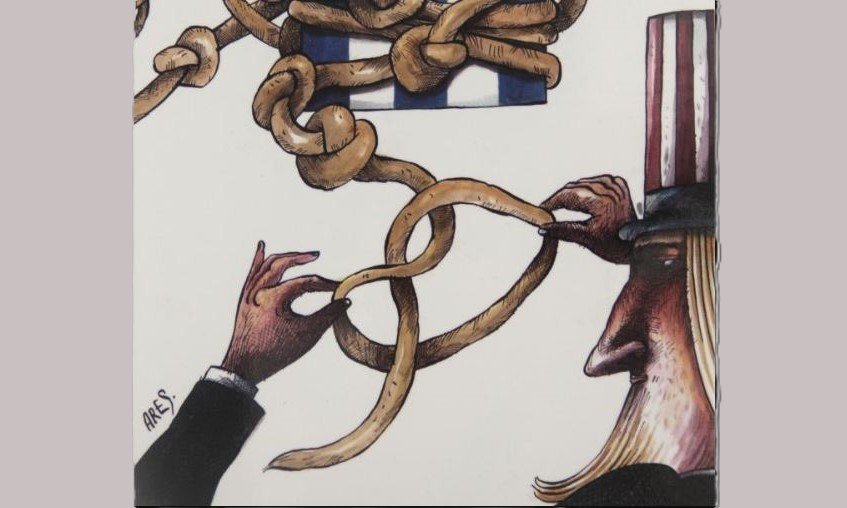
How is scarcity manufactured from an office in Washington?
Since the beginning of the history of asymmetric confrontation between the U.S. and Cuba, lies have served as the shield Washington uses to mask its desire to dominate the largest of the Antilles, as well as to hide the weakness and vileness of its actions.
The White House has gone to great lengths to conceal the methods of economic aggression employed, which include the blockade, energy and financial strangulation, bioterrorism, the theft of talent, induced emigration, and sabotage.
Although rarely included in analyses, induced emigration is a fundamental element of this aggression, particularly in recent times. The country loses not only inhabitants but also human capital of productive and reproductive age, thereby compromising its capacity for economic recovery and long-term social sustainability.
Despite the fact that the blockade is widely known to be the cornerstone of the so-called “regime change” strategy, they have insisted for decades that it does not exist—claiming instead that the harsh conditions in which Cubans live are due to the “regime’s” failure.
Lately, they have gone a step further, resorting to the argument that, yes, the “embargo” is real, but the regime uses it as a “pretext.” We are dealing with a false dichotomy fallacy.
An embargo is merely the seizure of goods; what Cuba is enduring is something entirely different. The word is used deliberately to downplay the situation’s severity and impact, yet this is no ordinary “problem”: it is a declared economic war, accompanied by a cognitive war designed to mask it.
On July 6th, 1960, the U.S. President announced the elimination of the Cuban sugar quota in the U.S. market—a severe blow to the island’s economy, which was a single-commodity producer heavily dependent on that market.
Days later, the U.S. administration imposed an oil embargo. The Revolutionary Government responded appropriately to these U.S. measures by carrying out nationalizations in accordance with the law.
Since then, the blockade has been enforced primarily through a complex web of U.S. laws, decrees, and regulations that have been implemented and tightened over the course of more than six decades.
LAWS FORMING THE LEGISLATIVE BASIS OF THE BLOCKADE, ENACTED BY THE U.S. CONGRESS:
– Foreign Assistance Act (1961): Granted the President the authority to impose and maintain an “embargo” against Cuba.
– Export Administration Act (1979): Regulates exports and has been used to restrict trade with the island.
– Cuban Democracy Act (Torricelli Act, 1992): Prohibited subsidiaries of U.S. companies in third countries from trading with Cuba. It also bars ships from third countries that dock at Cuban ports from entering U.S. territory within a 180-day period.
– Cuban Liberty and Democratic Solidarity Act (Helms-Burton Act, 1996): Considered the legislative backbone of the blockade. It codified the provisions of the embargo, internationalized it, and established sanctions against foreign companies investing in nationalized properties in Cuba. Its Title III allows for lawsuits in U.S. courts.
– Trade Sanctions Reform and Export Enhancement Act (2000): Part of the legal framework underpinning the blockade.
– Trading with the Enemy Act: Legislation granting the President the authority to restrict trade with countries deemed “hostile” and to impose economic sanctions.
REGULATIONS AND EXECUTIVE ORDERS
These provisions are issued by the Executive Branch and elaborate on the aforementioned laws:
– Cuban Assets Control Regulations (CACR): These constitute the primary set of regulations administered by the Department of the Treasury’s Office of Foreign Assets Control (OFAC). They prohibit transactions with Cuba and serve as the operational basis for the blockade.
– Presidential Executive Orders: U.S. presidents have issued multiple orders to tighten the blockade. A recent example is Executive Order 14404 of May 1, 2026, which imposes secondary sanctions on those maintaining relations with Cuba and authorizes the blocking of individuals operating in key sectors of its economy.
OTHER ADMINISTRATIVE PROVISIONS AND MEASURES
In addition to laws and regulations, the embargo is enforced through:
– Inclusion on Sanctions Lists: Cuba has been placed on the U.S. list of State Sponsors of Terrorism, which entails additional financial and trade restrictions.
– Sanctions on Specific Entities: Sanctions have been imposed on Cuban companies such as Gaesa and Moa Nickel S.A. by adding them to the Specially Designated Nationals (SDN) List.
– Financial and Travel Restrictions: Measures including the elimination of general licenses for “U-turn” transactions and limitations on travel and remittances.
In summary, the embargo against Cuba rests on a complex legal framework combining acts of Congress, administrative regulations, executive orders, and sanctions lists.
The Helms-Burton Act of 1996 is the cornerstone that codified and tightened this system, while executive orders and OFAC regulations serve as the instruments for its day-to-day implementation.
No alibi, let alone an embargo. It is a multifaceted assault; it leaves no room to breathe.
(Granma)