June 10, 2026 – Behind the protocol lies the negotiation of the correction of a geographical anomaly that has lasted 166 years, and whose outcome —the opening of the Tumen River and the consolidation of the port of Rason— would reorganize the Sea of Japan, Russian-Chinese energy trade and the Chinese route to the Arctic.
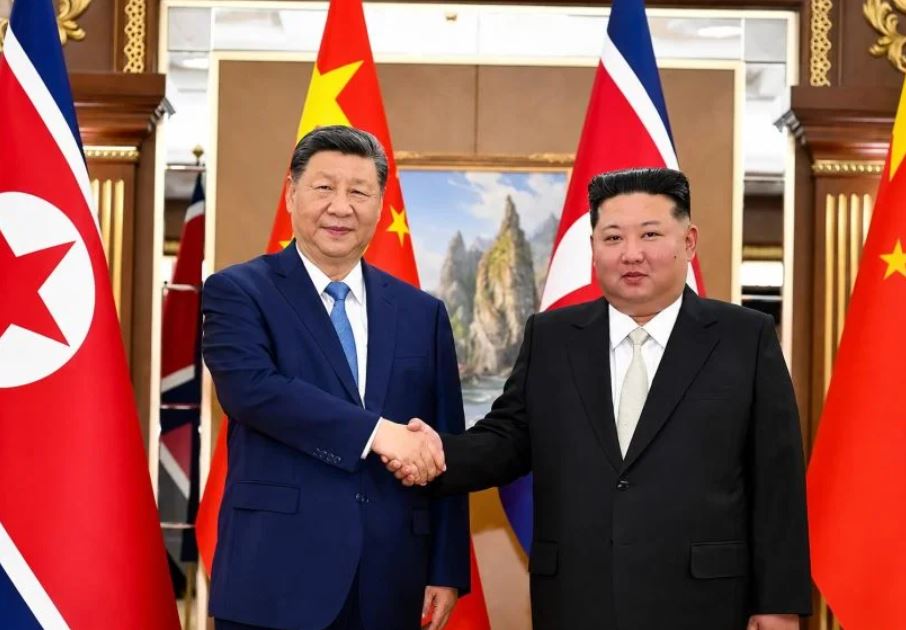
Xi Jinping concluded his visit to Pyongyang on Tuesday, his first since 2019 and his first trip abroad this year, after proclaiming a “critical consensus” with Kim Jong-un. The choreography was as expected: a floral tribute at the Friendship Tower honoring Chinese volunteers who died in the Korean War, a tour of the brand-new campus of the Central Cadre Training School of the Workers’ Party, lunch at the Kumsusan Guest House, and a promise to “inject new and powerful impetus into the socialist causes of both countries” in the year that the Treaty of Friendship, Cooperation, and Mutual Assistance marks its 65th anniversary. Kim, for his part, said the visit sent an unequivocal signal of alignment to the world.
So far, this is just the surface, but the real issue lies in what wasn’t said and who traveled there. In 2019, the denuclearization of the peninsula was the persistent theme of any meeting at this level; this time, the topic was notably absent from statements and speeches. This silence confirms that Beijing has stopped treating North Korea’s arsenal as a problem to be solved and instead treats it as a fait accompli to be managed. And the composition of the delegation confirms that the real agenda was something else entirely.
Xi traveled with Cai Qi, his de facto chief of staff; Defense Minister Dong Jun; Foreign Minister Wang Yi; Zheng Shanjie, head of the National Development and Reform Commission; and Commerce Minister Wang Wentao. When a state takes its central economic planner and its trade minister to a country under the most severe sanctions regime on the planet, it is not engaging in commemorative tourism; it is testing the waters.
A Chinese specialist on bilateral relations, quoted anonymously by the Hong Kong press, summarized Beijing’s interpretation: China’s role is “absolutely indispensable” for any settlement on the peninsula, and its influence in easing tensions “remains irreplaceable.” The same analyst described China as North Korea’s “golden ace” and suggested that Pyongyang might study China’s development experience in specific areas.
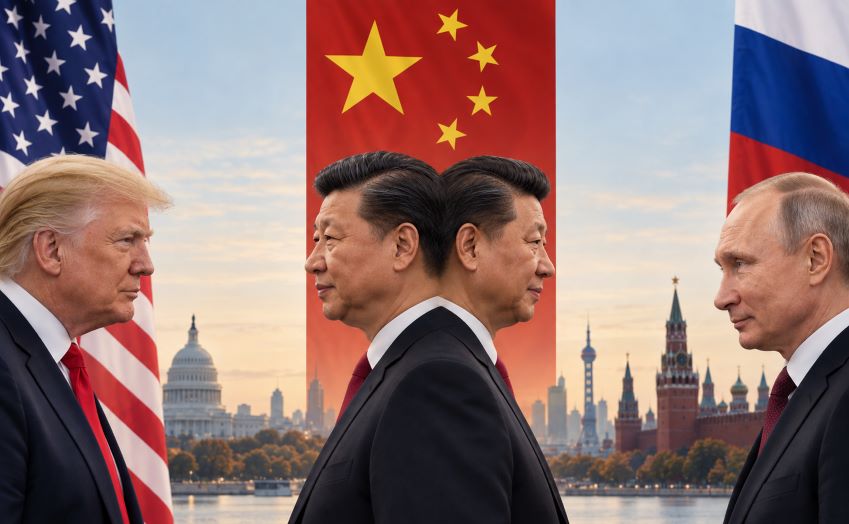
William Yang of the International Crisis Group added another layer, arguing that the meeting reinforces Beijing’s image as the only major power capable of engaging in dialogue with countries on opposite ends of the international spectrum, just weeks after Xi Jinping hosted Donald Trump and Vladimir Putin in consecutive summits in Beijing. This triangle of meetings—Trump, Putin, Kim—in a matter of weeks cannot be interpreted in a simplistic way; Xi is positioning himself as the only actor with simultaneous dialogue at all points of the conflict.
The 1860 Lock: Why China Doesn’t Touch the Sea of Japan
To understand what was really being negotiated, we have to go back to 1860. That year, within the framework of the so-called unequal treaties that followed the Second Opium War, the Convention of Peking transferred to the Russian Empire all the territory east of the Ussuri River, the present-day Primorsky Krai region. China lost its access to the Sea of Japan in one fell swoop.
From then on, Chinese territory ends at the village of Fangchuan, in Hunchun Prefecture, Jilin Province, a viewpoint overlooking the sea some fifteen kilometers down the Tumen River, yet out of reach. In that final stretch, the river ceases to be the Sino-North Korean border and becomes the Russian-North Korean border, and China is formally boxed in.
China’s right to navigate the Tumen River was recognized by Moscow in 1991, but in practice it was nullified by two obstacles: sedimentation in the riverbed and, above all, the Friendship Bridge, a low-lying structure that blocks the passage of any commercial vessel. For decades, this bridge served as a perfectly functional physical barrier to the interests of those who preferred China out of the Sea of Japan—including, for a long time, Russia itself, jealous of its coastal monopoly in the Far East.
That lock began to rust in 2024, when Kim and Putin agreed to build a cross-border road bridge over the Tumen River and, in parallel, Beijing and Moscow announced they would discuss a new maritime route with Pyongyang. The ongoing talks regarding Chinese access to the Sea of Japan via the river—which runs along North Korea’s borders with its two neighbors—are now being pointed to by regional analysts as the key for the three countries to move toward “substantive cooperation.”
Behind the diplomatic formula lies a brutal economic reality: the Chinese provinces of Jilin and Heilongjiang, with over one hundred million inhabitants, are a landlocked breadbasket and industrial hub. Their produce must now travel more than a thousand kilometers overland to the ports of Dalian or Yingkou on the Bohai Sea for shipment. Every kilometer of this detour is a geographical tax that China has been paying for a century and a half.
Reason: the port that Beijing has been cultivating for three decades
If Tumen is the key, Rason is the well-oiled lock. The Rajin-Sonbong Special Economic Zone, created by Pyongyang in 1991 in the far northeast of the country, houses the most coveted asset in Northeast Asia: a deep-water port free of ice year-round, a condition not met by neighboring Russian ports, which are subject to winter freezing or costly icebreakers. China understood this early on.
Companies in Jilin obtained usage rights to pier number one in Rajin, while Russia secured pier number three and, in 2013, rebuilt the 54-kilometer railway between Khasan and Rajin to transport Siberian coal. Back in 2010 and 2011, Beijing tested the formula its planning calls “borrowing the port to access the sea,” loading coal from Hunchun onto ships in Rajin bound for Shanghai—China’s internal trade transported through international waters thanks to a foreign port.
The logic has broadened since then, and in 2023, Russia authorized, for the first time in over a century and a half, China to use Vladivostok as a transit port for its domestic trade—a gesture unthinkable before the war in Ukraine and Russia’s dependence on the Chinese market. Rason doesn’t compete with that concession; it complements and secures it. Vladivostok is a revocable favor from Moscow; consolidated access via Tumen-Rason, with its own infrastructure and a North Korean partner in need of foreign currency, is a structural position.
The Arctic dimension: Rajin as a southern node of the Polar Silk Road
Access to the Sea of Japan is not an end in itself; it is the first link in a chain that ends in the Arctic Ocean. Since its 2018 white paper, China has defined itself as an “Arctic Near State” and has incorporated the Northern Sea Route—the corridor that skirts the Siberian coast—into the Belt and Road Initiative under the name of the Polar Silk Road.
The figures explain the obsession: the route between northern Chinese ports and Europe via the Arctic cuts the distance by up to forty percent compared to the classic route through Malacca and Suez, which in operational terms means between ten and fifteen fewer days of sailing, with the corresponding fuel savings. And there is an argument that carries more weight than the commercial one: the Arctic route completely bypasses the Strait of Malacca, that bottleneck patrolled by the US Navy which Chinese doctrine has identified for two decades as its main strategic vulnerability.
This is where the geography of the Tumen River becomes fully apparent: a ship departing from Rajin—or, in the most optimistic scenario, from a future Chinese embarkation point on the river itself—enters the Sea of Japan, crosses the La Pérouse Strait, and connects directly with the Northern Sea Route. For the northeastern Chinese provinces, this means being positioned directly on the Arctic axis without having to pass through the congested ports of the Bohai Sea or circumnavigate the Korean Peninsula.
China already sails that route; Chinese shipping companies conduct regular commercial transits through the Arctic during the summer season, and Chinese capital is involved in major Russian Arctic liquefied natural gas projects, from Yamal to the most recent developments, with its fleets of polar-class LNG carriers. What’s lacking isn’t the will or the tonnage, but rather its own northern access point. Rason is precisely that.
The energy corridor with Russia and the facade facing the Sea of Japan
The second vector is energy. Since 2022, Russia has consolidated its position as China’s main oil supplier, with volumes combining the East Siberia-Pacific Ocean pipeline and maritime shipments departing from the Kozmino terminal, located on the Sea of Japan. This is complemented by the Power of Siberia gas pipeline, which is in increasing operation, and the ongoing negotiations for its second pipeline.
The result is that the Sea of Japan has ceased to be a peripheral sea for the Chinese economy; today it is one of the fronts for Russian energy exports to Asia, through which a substantial part of the crude oil that feeds the independent refineries of northern China circulates.
A consolidated Chinese presence in Rason—terminals, storage, logistical capacity, and, if necessary, the presence of coast guard or visiting naval units—makes Beijing the physical guarantor of this corridor, not merely a customer. In a scenario of crisis surrounding Taiwan, with Western interdiction of the southern routes, the ability to receive Russian energy via a northeastern front protected by the strategic depth of three aligned states is worth more than any contract. In geopolitics, energy is not measured only in barrels; it is measured in routes that the adversary cannot sever.
A sea that is becoming militarized: Japan is rearming, Pyongyang is launching destroyers
All of this is happening in a sea that is rapidly becoming militarized. Japan has abandoned decades of self-restraint and is moving toward defense spending equivalent to two percent of its GDP, acquiring long-range counterattack capabilities, while deepening trilateral coordination with Washington and Seoul. Xi did not choose the words of his article published in the North Korean press on the eve of the visit at random: a defense of the post-World War II order and of “international justice,” along with a reminder that the Japanese invasion inflicted untold suffering on the Chinese and Koreans and that Tokyo has never thoroughly reflected on its wartime past. The message has a clear target: Japanese rearmament is the historical and political glue that binds the Beijing-Moscow-Pyongyang triangle together.
China and Russia already operate militarily in that space; joint air patrols of strategic bombers over the Sea of Japan and combined naval exercises transiting the Tsushima and La Pérouse straits have become routine since 2019. And now a new variable is being added to that chessboard: the accelerated transformation of the North Korean navy.
The Choe Hyon-class missile destroyer, unveiled in late 2024 and with a displacement of up to 5,000 tons, is the largest surface combatant built by the country, and the first equipped with phased array radar and vertical launch systems, capabilities that various analysts attribute to Russian technical assistance, received in exchange for the troops and equipment that Pyongyang sends to the Special Military Operation in Ukraine.
The first ship was launched in April of last year; the second, the Kang Kon, capsized during its launching ceremony, was refloated and righted in June, and is currently undergoing sea trials, which Kim himself attended; the third is under construction at the Nampo shipyard and is scheduled to be launched in October. Kim has ordered the commissioning of two destroyers of the class per year and has defined the “rapid strengthening of naval forces” as the central task of the new five-year defense plan, while construction of the first nuclear-powered submarine, announced in 2021, continues.
State media attribute to these ships the capacity to launch ballistic and cruise missiles against air, ships, and submarines, some with hypersonic capabilities and nuclear potential. A North Korean navy capable of operating in open waters disrupts the calculations of Seoul and Tokyo in precisely the same sea where China is seeking access to the sea.
The economic anchor: figures of a managed thaw
The tangible basis of the visit lies in customs. Bilateral trade reached $325.8 million in April, its highest level since December 2017, when the Security Council demolished North Korea’s export pillars following that year’s nuclear and missile tests.
Chinese sales totaled 252.3 million, the second highest monthly figure since 2020, and purchases from North Korea reached 73.5 million, also the highest since the end of 2017, with a basket that reflects the economy of a sanctioned country, tungsten minerals and concentrates along with wigs, beards, eyebrows and false eyelashes concentrate about sixty percent of the flow.
Passenger trains have been running again since March —four weekly between Beijing and Pyongyang, one daily from Dandong—, the first since the border closure of 2020, and Air China even briefly reinstated the direct flight before suspending it in April without official explanation, a reminder that the thaw is managed, gradual and reversible.
Pyongyang needs this thaw. Kim declared this year before the Workers’ Party congress that boosting economic development and raising the population’s standard of living is a “heavy and urgent” historical task, with the regime’s security already stabilized by the nuclear umbrella. And although Russia has become the main source of tourists and a formal military partner through the defense pact ratified after the summit with Putin, experts agree on the limitations of that agreement.
As Choong-Koo Lee of the Korean Institute for Defense Analysis pointed out, China provides North Korea with its main export market, intermediate goods that Moscow cannot easily supply, and its only stable source of foreign investment. China’s economic role, he concluded, cannot be replaced by Russia. Pyongyang knows this and acts accordingly: courting Moscow increases the price of its loyalty to Beijing, and hosting Xi Jinping allows it to demonstrate to its population and the world that it can host world leaders.
Geography as a political program
Xi’s visit should be read as a chapter in a larger process where the reopening of the Tumen question, frozen for 166 years, is of paramount importance. If the trilateral talks prosper—dredging of the riverbed, replacement or raising of the Khasan Bridge, expansion of Rason with Chinese capital—Northeast Asia will change its architecture.
China gains a second maritime frontier connecting its continental interior with the Sea of Japan, the North Pacific, and the Arctic route, bypassing the straits controlled by its adversary. Russia monetizes its Far East and secures the client that sustains its war economy. North Korea ceases to be an impoverished buffer state and becomes a territorial linchpin with its own strategic revenue stream, capable of charging both neighbors for transit.
In response, the Western approach remains anchored in the very instrument that created it: the sanctions in place since 2006. These sanctions failed to prevent the acquisition of a nuclear arsenal or a destroyer fleet, but they did push Pyongyang toward ever-deeper integration with Moscow and Beijing. The result is the classic boomerang effect: each tightening of the screws on isolation has accelerated the consolidation of the triangle that Washington claimed to want to prevent. While Western communiqués discuss declarations, in the far northeast of Korea, discussions revolve around drafts, bridges, and docks.