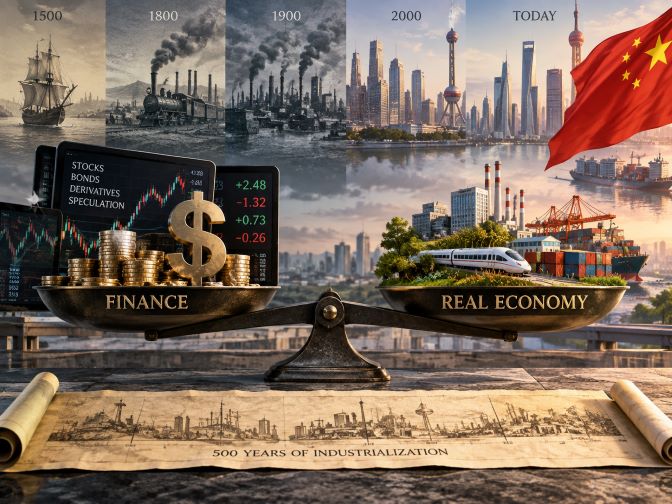
A nation’s rise begins in factories but can end on Wall Street. Over the past 500 years, four great powers followed a similar path. Is this a warning China can avoid?
A “Cycle Law” of History
Over the past five centuries of industrialization, the Western powers that successively rose to global dominance appear to have followed a seemingly inevitable historical “cycle”: from commercial prosperity, to manufacturing prosperity, to financial expansion, to the detachment of finance from the real economy, to the hollowing out of manufacturing, and ultimately to national decline. Venice, the Netherlands, Britain, and the United States—the four economies that successively dominated the world—followed remarkably similar trajectories, completing almost identical cycles from rise to decline.
Commercial prosperity stimulates demand for transportation, metallurgy, shipbuilding, and other means of production. The primitive capital accumulated through trade then provides the foundation for the emergence of manufacturing. The further expansion of commerce and industry creates demand for credit and long-distance payment mechanisms, giving rise to the financial sector. At this stage, the three—commerce, manufacturing, and finance—exist in a mutually reinforcing relationship.
Yet once finance becomes sufficiently powerful, it begins to detach itself from trade and manufacturing and develop independently, creating financial monopolies and financial oligarchies. In turn, it crowds out manufacturing, hollowing out the productive economy and eventually contributing to national decline.
To understand the underlying mechanism of this cycle, one must first understand the origins of finance and the logic behind its transformation. Finance began with the most basic form of economic activity: lending. Industrial capital seeks profits through production, while financial capital earns returns through interest, serving as leverage for industrial development and the lifeblood of the real economy. Yet the inherent drive of capital to maximize profit inevitably pushes finance toward distortion.
Karl Marx precisely summarized this evolutionary path. It begins with simple commodity circulation W–G–W (commodity–money–commodity), in which money merely serves as a medium of exchange. It then evolves into the circulation of industrial capital G–W–G′ (money–commodity–more money), where capital expands through production. Finally, it transforms into interest-bearing capital G–G′ (money–more money), completely bypassing production and commodities to achieve the ultimate illusion of “money making money.”
This represents the most abstract, deceptive, and potentially predatory form of capital.
Consistent with this theoretical framework, finance in the real world has also undergone a gradual process of “dematerialization”: from lending (where finance provides leverage for industry), to investment and securitization (where capital pursues rising asset values), and finally to a self-referential system in which everything can be securitized. Financial assets are repeatedly packaged, divided, and repackaged until no one can clearly identify the underlying assets. The 2008 subprime mortgage crisis was the extreme manifestation of this logic.
The essence of finance lies in the time value of money. But when this logic is pushed to its extreme, profit becomes the sole objective, and whether there is any actual physical output becomes irrelevant—after all, money can always be used to buy goods. Yet when one day money itself can no longer buy goods, the entire system collapses. Finance rests on currency, and the essence of currency is its ability to function as a general equivalent that can purchase goods. A currency that cannot buy anything is merely an illusion printed on paper.
Historically, when manufacturing prosperity reaches its peak, the speculative nature of finance often begins to emerge unchecked. Financial bubbles drive up the costs of goods, land, and labor, creating opportunities for other countries to hollow out a nation’s manufacturing base. More dangerously, without effective national regulation, financial capital can separate itself from trade and industry, becoming an independent economic and political force with monopolistic power.
The result is ultimately the principle of “privatizing gains while socializing losses”: financial crises are paid for by the public, while financial oligarchs use bailout funds to preserve and expand their own wealth.
Five Hundred Years, the Same Path
Venice was the first specimen of this historical cycle.
In the Middle Ages, Venice had virtually no manufacturing industry. Through trade with the East, it accumulated its initial capital, then developed handicraft industries such as wool textiles, glassmaking, and leather goods. Finance rose alongside these industries. Yet the discovery of the Cape of Good Hope route in the 16th century undermined Venice’s position as the center of global trade. The excessive expansion of finance drove up wages and production costs, while wealthy merchants diverted their capital away from manufacturing and into real estate, government bonds, and foreign lending.
As Charles Kindleberger recorded:“Bankers and rentiers lent less and less to domestic manufacturing, and increasingly to foreign borrowers.” Manufacturing declined, shipbuilding withered, and Venice gradually disappeared from the center of European power.
The Netherlands was the second case.
The 17th-century “carrier of the seas” possessed the world’s most powerful navy, ocean-going fleet, and financial system. Its national income exceeded the combined income of England, Scotland, and Wales by 30–40 percent. Dutch shipbuilding was the finest in the world; even sugar, tobacco, and diamonds imported by Britain were often sent to the Netherlands for processing.
Yet it was no accident that the first financial bubble in human history—the Tulip Mania of 1636—emerged in the Netherlands. Even herring could be traded through futures contracts before being caught, a practice known as “trading in the wind.” Gambling flourished, and large amounts of capital flowed abroad. The Dutch government attempted to correct the trend by issuing regulations requiring futures contracts to involve physical delivery. But under lobbying pressure from financial monopoly capital, these regulations became little more than empty words.This failed attempt at correction revealed a lesson to the world: reversing finance’s inherent tendency to crowd out manufacturing requires an exceptionally strong state will and sustained institutional resolve—precisely the political resources that have historically been the rarest.
The greatest irony was that Dutch financial capital itself financed its future rival. Large amounts of Dutch money flowed into Britain, purchasing British government bonds and stocks. Fernand Braudel lamented:“The continuous influx of Dutch capital gave vitality to British credit… Yet, to the surprise of the Dutch, Britain eventually took up arms against it and struck it down.” Montesquieu’s observation in 1729 captured the essence of the problem: “People invested their money in beautiful palaces rather than in fleets and nation-building.”
Britain was the most complete example of this cycle. Like Venice and the Netherlands, Britain rose through entrepôt trade. But unlike its predecessors, it placed much greater emphasis on industrial policy. From the Tudor dynasty to the middle of the 19th century, nearly three centuries of mercantilist policy transformed Britain from a wool-exporting country into the “workshop of the world.” Friedrich List wrote:“Once Britain gained control of any industrial sector, it held on relentlessly… protecting it with the same care and caution one would devote to protecting a young seedling.” In 1815, British parliamentarian Henry Brougham openly stated:“To destroy foreign manufacturing in its infancy, it was worthwhile even to sacrifice British manufactured exports at a loss.”
Yet after Britain became the global hegemon, excessive financial prosperity once again turned against manufacturing. Kindleberger precisely summarized this transformation:“Successful entrepreneurs and their descendants moved away from industry and into finance.” Running factories was full of difficulties, while financial operations generated enormous returns. By the 19th century, apart from landowning aristocrats who inherited estates, Britain’s wealthiest groups were precisely those engaged in “commercial and financial professions.” Those who made great fortunes from manufacturing were increasingly rare. Between 1904 and 1913, foreign securities markets attracted nearly half of Britain’s savings and 5 percent of its national income overseas. The irony was profound: the country that had risen through mercantilism and protectionism became, after achieving dominance, the global promoter of laissez-faire economics. Faced with rising latecomers such as the United States, Germany, and Japan—countries that relied on state intervention to industrialize—Britain became trapped by its own path dependence and watched helplessly as it was surpassed.
The United States is now following the same path. From 19th-century high tariffs protecting infant industries to its manufacturing peak in 1953, when manufacturing value added accounted for 28.3 percent of GDP, America’s rise was essentially a replication of the British model. But the turning point came in the 1970s. After the collapse of the Bretton Woods system, financial liberalization accelerated, fundamentally reshaping the structure of profits. Between 1965 and 1980, manufacturing profits accounted for an average of 49.1 percent of total domestic profits. By 2000–2015, that figure had collapsed to 20.9 percent. During the same period, finance’s share of profits rose from 17 percent to 28.9 percent. Even more devastating was the transformation of corporate governance under the doctrine of “shareholder primacy.” Between 2003 and 2012, companies in the S&P 500 used 91 percent of their net profits for stock buybacks and dividends. Between 2007 and 2016, that figure climbed further to 96 percent. By the third quarter of 2024, U.S. manufacturing accounted for less than 10 percent of GDP.
Boeing’s decline is the most painful footnote.The company that once embodied American engineering excellence—creating the B-52 bomber, Apollo-era rockets, and the 747 passenger jet—was transformed after its 1997 merger with McDonnell Douglas, as financial logic came to dominate engineering culture. Parts of the 737 MAX software development were outsourced to newly graduated engineers in India earning $9 per hour, while American engineers earned $35–40 per hour. Two fatal crashes killed 346 people. A congressional investigation attributed the disasters to a corporate culture that placed “profits above safety.” Boeing’s transformation—from the pride of human engineering to a victim of financial engineering—stands as a mirror of a broader tragedy: when financial logic is allowed to dominate industrial logic, even an industrial giant can have its very soul hollowed out.
The Alternative Path Provided by Japan and Germany
If Britain and the United States’ trajectories confirm the pattern that “financialization leads to manufacturing decline,” Germany and Japan provide an alternative path: building national strength through manufacturing.
Germany developed the model of the “social market economy,” in which banks and companies maintain long-term relationships, allowing firms to avoid the pressure of constantly chasing quarterly earnings. Its more than 2,700 “hidden champions”—family-owned manufacturing companies that hold global leadership positions in specialized industries—remain private, avoid pursuing short-term stock-price gains, and focus on perfecting a single technology or product to the highest possible standard.
Even amid the global wave of financialization, Germany’s manufacturing sector has maintained its share of around 20 percent of GDP.
Japan, meanwhile, relied on its main bank system and keiretsu networks of cross-shareholdings to shield companies from hostile takeovers and allow them to focus on long-term research and development. Toyota was able to spend decades refining its lean production system, while Sony continued investing in transistor technology and eventually reshaped the global consumer electronics industry.
However, these two “firewalls” also began to show cracks after the 1990s.
Germany’s system of patient bank ownership began to weaken, as an increasing number of small and medium-sized enterprises were acquired by private equity funds. Japan, meanwhile, experienced the weakening of the main bank system and the collapse of cross-shareholding arrangements after the bursting of its real estate bubble.
The pervasive reach of financial logic has posed a continuous challenge even to countries with the deepest manufacturing foundations. Institutional designs may be effective, but they require constant adaptation and maintenance; otherwise, financial logic will eventually find openings through which to penetrate.
Two Types of Bubbles: Creative and Parasitic
The argument that “finance must serve the real economy” should not fall into a simplistic black-and-white dichotomy. Financial structures must correspond to different stages of industrial development: handicraft economies require partnership-based capital pooling; industrialization requires bank credit; and the era of technological innovation requires capital markets.
This is because high-tech industries are asset-light and high-risk, making traditional bank lending models inherently unsuitable. Through mechanisms of “shared risks and shared returns,” capital markets embrace uncertainty rather than avoid it—an avenue that banking systems can never fully provide.
However, we must distinguish between two fundamentally different types of bubbles.
Although technology stock bubbles often involve massive destruction of wealth, they can generate revolutionary technological breakthroughs through a process of experimentation and failure. The dot-com bubble gave rise to companies such as Google and Amazon; the new energy boom helped create Tesla and CATL.
Real estate bubbles, by contrast, are essentially static valuations of scarce resources such as land and physical space. They do not create disruptive new technologies. Instead, they produce a widening wealth divide in which “the rich become richer while the poor become poorer”: families owning multiple properties see their wealth effortlessly appreciate, while ordinary households are forced to exhaust the savings of several generations just to afford housing.
When such bubbles burst, they leave behind nothing but bad debts and unfinished projects—not new technological capabilities.
The distinction between “necessary bubbles” and “harmful speculation” lies in several questions:
Does capital genuinely flow into research and production, rather than simply allowing major shareholders to cash out?
Is there a real technological and industrial foundation, rather than merely fabricated concepts?
Does the asset underlying the bubble possess the capacity to continuously generate new productive forces?
The problem has never been finance itself. The problem lies in the absence of strong national policy guidance and regulation, allowing finance to detach itself from the real economy and expand purely for its own sake.
As Cambridge economist Ha-Joon Chang has pointed out, when financialization reaches a high level, the financial market’s pursuit of short-term returns causes it to react negatively toward anything that might reduce immediate profits. The solution, he argues, requires two approaches: on the one hand, limiting certain powers of the financial sector; on the other, convincing society that although restrictions on finance may reduce financial profits in the short and medium term, they can reverse corporate investment behavior and encourage companies to increase long-term investment in research and development.
In a larger economy, holding a smaller share of a growing economy is far better than holding a larger share of a shrinking one.
A Warning for China
Looking across five centuries of industrialization, the emergence of financial capitalism and its rise to dominance have required four conditions to exist simultaneously:
(1) Financial capital penetrates and dominates state power; (2) Transnational capital is allowed to move freely across borders; (3) The state tolerates or even encourages enormous wealth inequality; (4) There are foreign competitors willing to serve as the “next destination” for displaced manufacturing.
When these conditions are all present, financial capital gains the confidence to detach itself from the domestic real economy and, driven by the temptation of global arbitrage, “abandon productive industry for speculative illusion.”
Marx accurately summarized this historical chain in Capital: “The decaying Venice lent large sums of money to Holland. Venice… became the hidden foundation of Dutch wealth. The relationship between Holland and England was the same… Today, many of the mysterious capitals appearing in America are nothing more than the capitalized blood of English children from yesterday.”
This chain of capital flows—Venice → Netherlands → Britain—extended in the 20th century into a new chain: Britain → United States → China. Each generation of hegemonic power believed it could remain forever at the top of the economic food chain, extracting wealth indefinitely, while forgetting that the manufacturing foundation beneath its feet was being hollowed out by its own hands.
For China, the warning contained in this historical cycle is self-evident.
At present, China does not fully satisfy the four conditions described above. The socialist system, by design, significantly constrains the space for the development of conditions (1) and (3). Meanwhile, China’s enormous manufacturing base and the restructuring of global supply chains have not yet resulted in a large-scale concentration of overseas manufacturing relocation toward a single late-developing country.
However, if India were to become the next “destination” for displaced manufacturing, it would present a serious challenge: its population is comparable in size to China’s and significantly younger.
Safeguarding the principle that “finance serves the real economy,” limiting purely speculative financial expansion detached from production, and maximizing the benefits of finance while restraining its excesses should remain the unwavering direction of China’s financial sector.
But this does not mean rejecting the unique value of capital markets in technological innovation. On the contrary, a well-functioning capital market is one of the highest forms of finance serving the real economy.
The real task is to establish a fair, transparent, and law-based market environment that ensures the alignment of rights and responsibilities and requires investors to bear their own risks. At the same time, China must remain highly vigilant against asset bubbles—such as those in real estate—that lock national wealth into unproductive sectors, ensuring that capital continues to flow toward the most innovative and productive industries.
Can Trump’s manufacturing revival succeed?
As long as Wall Street’s incentive structures, corporate governance principles, and the rules of the capital market remain unchanged, tariffs and subsidies alone cannot truly bring manufacturing back.
Preserving China’s manufacturing foundation must remain a matter of strategic importance for the nation’s future.
No matter how dazzling and magnificent the exterior of the financial skyscraper may appear, without the solid foundation of manufacturing beneath it, the so-called prosperity will ultimately be nothing more than a mirage built upon shifting sands.
The author is a Professor of Economics at Shanghai Jiao Tong University