The European Parliament approved the new Returns Regulation, a reform that allows member states to send undocumented migrants to so-called Return Centres located in countries outside the European Union. Together with the European Pact on Migration and Asylum, this constitutes a very serious racist and anti-immigrant escalation, violating human rights and deepening the rightward shift that is consolidating in the EU.
In the Strasbourg chamber, with victory gestures, nearly a minute of applause, and shouts of “Send them home,” the right wing celebrated the resolution, which passed by 418 votes to 218. “Shame” was the response from left-wing MEPs, who described the initiative as a serious setback for human rights.
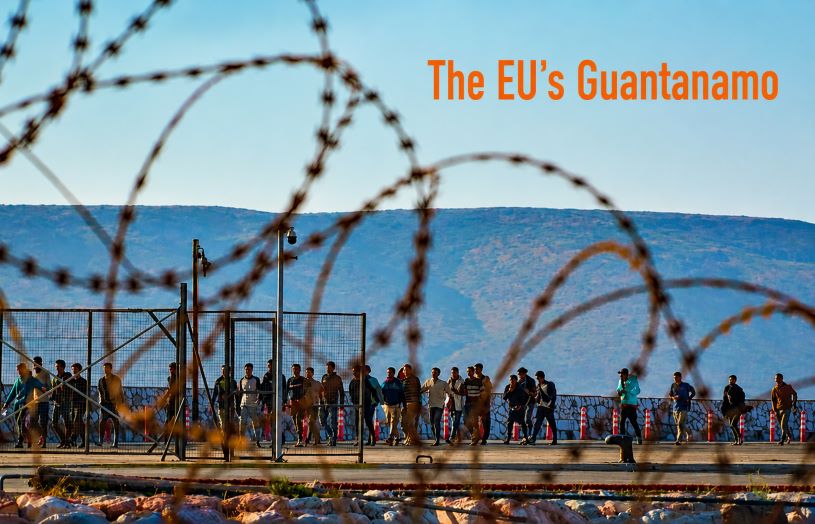
These centers will function as transit facilities, where people will wait to be returned to their country of origin. They are places where migrants can remain for extended periods, potentially without a time limit or guarantee of return. Only unaccompanied minors would be exempt from this measure, while families with children could be transferred to these centers.
It allows authorities to conduct searches of homes and seize personal belongings and electronic devices to facilitate deportation proceedings. Migrants will be required to cooperate with authorities. Other provisions include stricter entry bans and new police powers to locate and detain undocumented migrants. Entry bans would also be significantly tightened, increasing from five to ten years in most cases, with the possibility of lifetime bans for those deemed a security risk.
The legislation would also change the appeals process. Under current rules, deportations are automatically suspended while legal appeals are pending. The new law would eliminate that automatic safeguard and leave it to the courts to decide, on a case-by-case basis, whether a return order should be suspended.
Alongside the flagrant violation of human rights, these centers in third countries, which many describe as the European Guantanamo, will give rise to a multi-billion-dollar business with incalculable figures. While the mechanism is still unclear, the agreement will be between an EU country and the one receiving the migrants. The EU could contribute financially but will not be responsible for the terms of the agreement. The countries most frequently mentioned as potential hosts for these centers are in Africa and the Balkans. Among the EU members that have already expressed their interest are Germany, the Netherlands, Italy, and Greece. Spain is one of the first to oppose it.
The vote confirms the consolidation of a right-wing majority, with the EU’s flagship institution increasingly leaning to the right. The European People’s Party (EPP) once again aligned itself with the European Conservatives and Reformists (ECR), the far-right Patriots (PfE), and Europe of Sovereign Nations (ESN), along with MEPs from the liberal Renew Europe group who also supported the law.
The approval of this new legislation, which consolidates the reality of a fortress Europe with closed borders, would not have been possible if the traditional right had not joined the narrative of securitization, fear, xenophobia, and racism promoted by the far right. This narrative has been supported by the dissemination of this narrative by the mainstream media across the continent, which have used fear to criminalize migrants and the solidarity networks that help them. Migrants are transformed into scapegoats used to conceal the responsibilities and consequences of unfettered capitalism, which has profoundly eroded the social welfare model, exacerbating income inequality, job insecurity, and vulnerability to energy and geopolitical crises. These dynamics have led to social fragmentation, political discontent, and structural economic stagnation, as well as cuts to social services in favor of increased military budgets to sustain the wars they promote.
“Today Italy has achieved a great success in Europe. The European Parliament has approved the new Repatriation Regulation, a historic measure, primarily the result of the Italian government, which will allow us to quickly repatriate those who do not have the right to be in the EU,” celebrated Georgia Meloni, the far-right leader, during her participation in the G7 summit.
In Strasbourg, at a press conference on Tuesday afternoon, the French far-right politician Jordan Bardella touted the new regulations and thanked the traditional right for facilitating the process. Bardella, president of The Patriots group, which includes parties such as Hungary’s Fidesz, the Lega, and Vox, will succeed Marine Le Pen in France if she is convicted of embezzlement in her trial scheduled for July 7. He could be a candidate for the French presidency in the next elections, planned for 2027. Malik Azmani of the Dutch right-wing Renew Europe group declared: “Today, Europe has fulfilled its commitments. Citizens rightly expect that those who do not have the right to remain will be returned to their countries of origin, and I am immensely proud that this is now underway.”
Her compatriot, Tineke Strik, a Dutch member of the Greens/EFA group, responded: “The regulation imposes only extremely harsh obligations on migrants, and virtually no obligations, except for financial ones, on EU member states. The new legislation will allow them to immediately transfer responsibility for migrants to any other country. This could leave them trapped in a kind of legal limbo or in indefinite detention. We don’t know what will happen.”
The majority of Socialist and left-wing MEPs have opposed the legislation, arguing that it undermines the fundamental rights of migrants. “This regulation normalizes legally questionable practices that would have been unthinkable in the EU just a few years ago,” said Ana Catarina Mendes, vice-president of the Socialist bloc, in a statement.
Estrella Galán Pérez, former director general of the Spanish Commission for Refugee Aid (CADE) from 2011 to 2024, and a member of the European Parliament’s Left Group, stated, “Behind all of this is a whole security apparatus with Israel at the helm. This legislation doesn’t establish any human rights monitoring mechanisms. What they want to do is keep the cruelty that will be experienced in these centers as far away as possible and prevent us from knowing what’s happening there—black holes of rights.” She believes that “we [the EU] will end up seeing the same images of those children with a little backpack and a hat being detained by immigration police.”
“We must prepare ourselves to see the same thing we have been seeing in the United States from ICE. This is bad news for Europe,” stated Cecilia Strada, Member of the European Parliament since 2024 for the Italian Democratic Party and a former humanitarian worker on rescue missions in the Mediterranean Sea. She believes that “with the adoption of the Return Regulation and the PEMA (European Pact on Migration and Asylum, which came into force on June 12), Europe has definitively dismantled its asylum system,” and asserts that “the media narrative on migration focuses on numbers, not human beings.”
With this new legislative package, the European Union’s immigration policy is now virtually the same as that of the United States, home to the world’s largest immigrant detention system, with over 220 facilities primarily run by Immigration and Customs Enforcement (ICE). ICE is heavily criticized for its human rights violations, the violence of its actions, arbitrary arrests and detention conditions, family separations, raids and deportations, the use of private detention centers, and blocking detainees’ access to legal representation. In the last six months, they deported 278,000 people.
More than 250 human rights organizations have already expressed their rejection of this new legislation: “EU institutions and member states have increasingly made criminalization, surveillance, and discrimination the default tools of migration governance, as opposed to protection, safety, social inclusion measures, the expansion of safe and regular routes, and rights-based residence permits,” reads the joint statement sent to the press. The signatories believe that “this new set of rules promotes detention, deportation, outsourcing, and punishment, especially of racialized people, and will lead to more people being plunged into legal limbo and dangerous conditions.”
Migrant rights organizations are calling on the EU to stop pandering to racist and xenophobic sentiments and corporate interests, and to reverse the punitive and discriminatory shift in its migration policy. They urge the EU to instead allocate resources to policies based on safety, security, and inclusion that strengthen communities, uphold dignity, and ensure that everyone can live safely, regardless of their status. International law prohibits returning a person to a place where they may suffer persecution, torture, or inhuman treatment. Critics believe that these agreements may conflict with this principle.
This legislation confirms that we live in a state of exception, outside the rule of law. When this state of exception becomes widespread, it becomes the rule, where the detention center takes as its paradigm the concentration camp, whose updated model is Guantanamo. There, as Giorgio Agamben describes, human beings are stripped of their political and social rights, reduced to their mere biological existence, bare life over which the State or sovereign power can exercise absolute control, even unto death.
Eurocentric colonialism and neocolonialism.
“The colonized world is a world cut in two. The dividing line, the border, is marked by barracks and police stations.” Frantz Fanon
“No Congolese person will ever forget that independence was won in struggle,” Patrice Lumumba said. “It was filled with tears, fire, and blood… to put an end to the humiliating slavery that was imposed upon us. We were subjected to mockery, insults, and beatings because we were Black. Who can forget the shootings that killed so many of our brothers, or the cells into which those who were no longer willing to submit were mercilessly thrown?”
During the 75 years of colonial rule in the Congo, Belgium under King Leopold II killed between 10 and 15 million Congolese people in its supposed civilizing mission. Lumumba, shortly after delivering a speech denouncing the regime during his country’s independence celebrations, was assassinated in a CIA operation with the complicity of the Belgian government.
From the 16th century, when the slave trade began, 12 million people were taken captive to the Americas, and just as many died during their capture and the voyage. This continued through the Berlin Conference of 1884-1885, which resulted in the division of the African continent among the European powers, until well into the 20th century, when most colonial territories achieved independence. In the land where the first humans emerged, tens of millions were killed by colonialism, which drew arbitrary borders to suit its interests. This colonialism has historically been the source of numerous civil wars and sociopolitical conflicts, multiplied economic exploitation, plundered natural resources, and used forced labor while destroying subsistence agriculture, forcing millions to flee as refugees. In its colonial practices, colonialism expropriated the cultural assets of colonized populations, appropriating those deemed most suitable for the development of capitalism and for the benefit of Central Europe. They repressed the production of knowledge by the colonized, their patterns of meaning production, their symbolic universe, and their forms of expression and construction of their subjectivity.
Imperial colonialism, as it is known, with variations specific to each society, was applied with the same results of atrocities and millions of victims in Asia, by England, mainly in India and by France in Indochina, and throughout America, by England, France, Spain and Portugal.
Following the wars of independence, in Africa the model continued in its neocolonial form under the control of large transnational corporations, where the expulsion effect persists: droughts, desertification, famines, and the plundering of natural resources impede local development and force the population to desperately seek better living conditions. According to reports from the organization Minando Fronteras (Mining Borders), 1,320 people died at sea in the first six months of 2026 attempting to reach Spain, including 140 women and 120 children. Similar events are repeated off the coast of Italy. All anonymous, just a number.
Besides the migration route originating in African nations, the other major flow comes from the Middle East, with Syria, Afghanistan, and Iraq being the main countries of origin, according to the UNHCR. These are not coincidentally countries devastated by the wars waged by the US and its European allies. The war also generated migration from Ukraine and other Eastern European countries, in addition to migrants from other regions. How many have been displaced by the Israeli genocide in Gaza and the West Bank and the invasion of Lebanon?
The resolution doesn’t only affect those from Africa and Asia; Latin American immigration, primarily from South America, to Europe reaches 300,000 people per year. It grows annually, despite anti-immigrant policies, which will become even more restrictive with the new resolutions.
The debates, even those from sectors on the left that oppose the criminalization of migrants, maintain a Eurocentric logic that denies their responsibility for the original and current causes of the dramatic immigration of hundreds of thousands. Those who define themselves as pure-blooded Europeans and their states present themselves as victims of new barbarian invasions that threaten the security, culture, way of life, and quality of life of their society. The fact that Western Europeans imagined themselves to be the culmination of a civilizational trajectory from a state of nature led them, and still leads them in the neocolonial model, to see themselves as the most advanced of the species.
From diamonds and gold to oil, all kinds of goods can circulate freely—everything except people. Forced migration is the defining experience of this era of globalized capital, where wars, classist and racist violence, climate change denial, and the destruction of local economies confirm the contempt for human dignity.