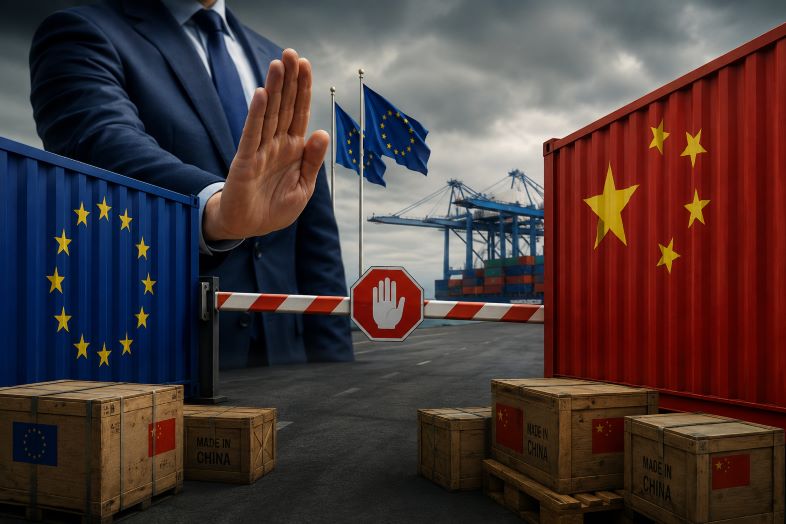
Since 2026, trade frictions between China and the EU have intensified. As China’s manufacturing sector continues to upgrade towards high-end sectors, the EU’s trade policy towards China has accelerated its shift from trade defense to institutional restrictions.
In the past six months, the EU has launched and implemented a number of trade control tools, covering multiple dimensions such as tariffs, market access, investment reviews, and technical standards, involving many of China’s advantageous industries. Bilateral trade frictions are showing a trend towards normalization and systemic development.
EU trade restrictions on China since 2026
In the area of tariffs , the Carbon Border Adjustment Mechanism (CBAM) will be officially implemented in January 2026, imposing carbon taxes on imported steel, cement, aluminum, fertilizers, electricity, and hydrogen based on their carbon emission levels. It will also establish carbon footprint traceability requirements, directly increasing the export costs of high-carbon emission products. In May 2026, the European Parliament overwhelmingly approved new regulations on steel imports, which will officially take effect in July, raising tariffs on steel imported beyond quotas from 25% to 50%. The anti-subsidy tariffs on electric vehicles will continue to be implemented based on the 2024 final ruling, imposing differentiated anti-subsidy duties on top of the 10% base tariff, with a maximum combined tariff rate of 45.3%. A tariff plan targeting small parcels from cross-border e-commerce will be launched in July 2026, imposing a fixed tariff on imported parcels valued below €150 per parcel, raising the export costs of low-priced goods.
In the areas of market access and public procurement , international procurement tools have been successfully applied in practice for the first time. Starting in June 2025, restrictions on public procurement for China’s medical device industry will be implemented, prohibiting Chinese companies from participating in EU public procurement projects for medical devices exceeding €5 million. A cap will also be set on the proportion of Chinese-origin products in winning bids. In April 2026, the EU further clarified its prohibition on using EU public funds for clean energy projects that include Chinese inverters, covering projects related to solar, wind, and energy storage batteries.
In the area of investment review , the Foreign Subsidies Regulation (FSR) has been continuously strengthened since it came into effect in 2023. Since 2026, it has launched in-depth investigations into Chinese-funded projects in fields such as wind power equipment, retail mergers and acquisitions, security equipment, and rail transportation. The scope of the investigations not only covers operations within the EU, but also requires the provision of information such as operating data and sources of financing in China, which has significantly raised the compliance threshold for Chinese investment in Europe.
In the area of rules and standards, the EU will release a draft amendment to the Cybersecurity Act in January 2026, expanding the scope of restrictions on high-risk suppliers to 18 key economic sectors and authorizing the European Commission to implement access restrictions based on the supplier’s country of origin, excluding the listed countries and suppliers from the relevant EU supply chains.
In addition to the policies already in effect, several institutional restrictive tools are in the draft or development stage. The draft Industrial Accelerator Act, to be released in March 2026, focuses on four strategic industries: batteries, electric vehicles, photovoltaics, and key raw materials. It sets mandatory EU standards for both origin and low-carbon products, while also imposing thresholds for foreign investment review. Furthermore, the EU is also studying supplier rules for key raw materials to promote supply chain diversification.
EU internal divisions and China’s response
From June 18 to 19, EU leaders held an EU summit in Brussels, with China-EU trade relations becoming a focus of attention. Many leaders advocated upgrading “trade defense tools” and called for action against China. However, due to significant internal divisions, the EU postponed its “trade confrontation” with China.
Significant divisions exist within the EU regarding relevant policies. France, Italy, the Netherlands, and other countries advocate strengthening industrial protection, promoting a “European First” approach, and using systemic tariffs and market access restrictions to offset external competitive pressures. Germany, Spain, and other countries maintain a more cautious stance, concerned that trade restrictions could escalate trade frictions and harm their companies’ interests in the Chinese market, and have refused to sign proposals related to overcapacity control measures.
Despite internal divisions, the EU’s overall strategy has become more covert. While the official EU summit agenda removed all direct statements targeting China and incorporated relevant trade and economic discussions within the framework of competitiveness and global economic challenges, thus downplaying country-specific targeting through vague wording, the actual policies still precisely target Chinese industries.
China has adopted multi-dimensional countermeasures, gradually building a system that combines systematic countermeasures with dialogue and communication. At the institutional level, the “Regulations of the People’s Republic of China on Combating Undue Extraterritorial Jurisdiction” officially came into effect in April 2026. In May of the same year, the judiciary determined that the relevant investigations under the EU’s Foreign Subsidies Regulation constituted undue extraterritorial jurisdiction. At the trade countermeasure level, following the imposition of reciprocal restrictions on EU imports of medical devices in July 2025, China initiated trade and investment barrier investigations in 2026 regarding discriminatory practices under the EU’s Foreign Subsidies Regulation on products such as railway locomotives, photovoltaics, and wind power, and filed a dispute settlement procedure with the World Trade Organization regarding new steel import regulations. At the diplomatic level, China has clarified its opposition to protectionism through multilateral and bilateral channels, while simultaneously promoting the establishment of a China-EU trade and investment consultation mechanism to manage differences through dialogue. In response to the EU’s escalating restrictive measures, China has cancelled two high-level China-EU dialogues scheduled for the near future and adjusted relevant high-level exchange arrangements, sending a clear policy signal.
Impact of EU’s series of measures against China
In the short term, many of China’s advantageous export industries are facing direct impacts. The electric vehicle, photovoltaic, wind power, and battery industries are simultaneously facing multiple pressures, including increased tariffs, a shrinking public procurement market, and higher investment entry barriers. Export volumes and profit margins are being squeezed, forcing related companies to adjust their expansion pace in the European market, and requiring greenfield investments to adapt their equity structures and technology layouts accordingly. The steel and aluminum industries are affected by both carbon tariffs and import quota policies, resulting in a significant increase in export costs, and continued narrowing of market access for high-carbon emission products in Europe.
In the medium to long term, ongoing trade frictions will create a forcing effect, pushing domestic industries to accelerate technological upgrades and low-carbon transformation, thereby enhancing product added value and core competitiveness. Simultaneously, it will accelerate the diversification of China’s export markets, encouraging companies to expand into Southeast Asia, the Middle East, and Latin America, reducing reliance on the European market. Furthermore, institutional competition will drive the development of self-sufficiency and control over domestic industrial chains, enhancing China’s voice in international rule-making.
For the global trading system, the EU’s extensive use of unilateral trade instruments may prompt more countries to follow suit and introduce similar restrictive measures, leading to the fragmentation of global trade rules. The EU’s deliberate obfuscation of national boundaries and its practice of imposing targeted restrictions under the guise of general rules will also create more covert barriers to global trade governance, increasing the difficulty of enforcing multilateral rules. For the global green transition, Chinese clean energy products possess a significant cost advantage. EU restrictions on the entry of these products will directly increase Europe’s own green transition costs, negatively impacting the pace of achieving global carbon neutrality goals.
For global supply chains, the EU’s push for local content requirements and supply chain diversification rules will guide global industrial chains from prioritizing efficiency to prioritizing security, leading to a decrease in the efficiency of production factor allocation. In the long run, the core of major power economic and trade competition may shift further from tariffs to rules, standards, and systems, and the global industrial landscape and trade order will enter a period of profound adjustment.
The spillover effects of the EU’s series of unilateral trade measures will continue to test the resilience of the global multilateral trading system, pushing global industrial chains and trade rules towards a direction that places greater emphasis on security and rules-based competition. Currently, the Sino-EU economic and trade competition has entered a phase of normalized friction. Managing differences through dialogue and consultation, and finding a dynamic balance between competition and cooperation, is the optimal solution for both China and the EU.
(World Development Institute, Development Research Center of the State Council)