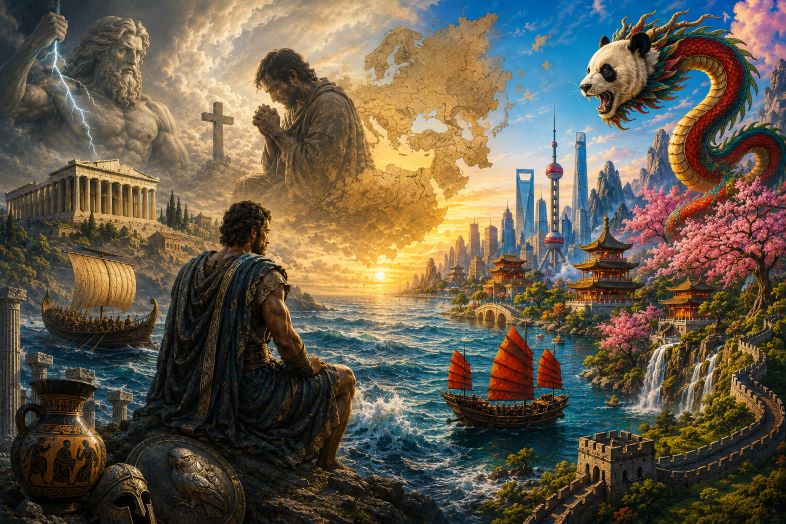
Christopher Nolan’s Ulysses and the manifest destiny of Europe.
Christopher Nolan’s film has at least one virtue, besides sparking renewed interest in Europe’s Greek and Asian roots: it provokes a debate on the identity, or identities, of what we now call the West.
One of the criticisms leveled against it accuses it of having Christianized the Odyssey, making Odysseus a Christian tormented by guilt and Zeus a kind of Indo-European God the Father.
Olivier Battistini, accusing Nolan’s work of deception, sees it as a new “Trojan horse” through which he attempts to subvert European identity. He criticizes both Emily Wilson’s translation and Nolan’s adaptation. The latter neglects, or ignores, centuries of interpretation of the epics by the Ancients, including the Neoplatonists, in order to jump directly from Wilson’s English text to a Judeo-Christian interpretation.
He also seems intent on Americanizing Ulysses, making him the predecessor of Christopher Columbus, Magellan, and other conquistadors who sought westward to re-establish contact with an India that had become mythical since Islam had blocked the route and the memory of Alexander had faded from Western consciousness.
Homer’s Ulysses, upon his victorious return to Ithaca, prepares to end his days there and reign peacefully. Nolan’s Ulysses, far from abandoning his wanderings, leaves power to Telemachus and sets sail again with Persephone, aboard longships, Viking-style vessels, toward the west. Toward Atlantis, toward Gibraltar, Great Britain, and America?
It’s no coincidence that none of the leading roles in this blockbuster are Mediterranean, Greek, Italian, Spanish, North African, or Middle Eastern. They all have an American, WASP, or Northern European look. Nor is it a coincidence that the ships carrying them aren’t Greek triremes but Viking longships. And we know that Scandinavians, Vikings, Normans, and Danes were among the first settlers of the British Isles and that they feature in the origin myths of the British and Americans. Wasn’t Hamlet a Danish prince? And that these same Normans also controlled, at certain times, not only Normandy but also Sicily, Calabria, and some of the Ionian Islands between Italy and the Peloponnese.
Why, in his Western leanings, does Nolan stop short? Because if we constantly head west, we reach the point where the Far West coincides with the Far East, and China. Unless we stubbornly insist on seeing the earth as round only when it serves our interests, refusing to see that this earth, like history, rotates on its axis and around the sun.
Because the United States wants to freeze the flow of history by extending its hegemony into the 21st century, Nolan stubbornly refuses to see that, like organisms, cultural phenomena, nations, and civilizations, they have a beginning, a middle, and an end. Could the End of History, so familiar to us since Hegel and Fukuyama, be the end of Western history, of its monopoly, and coincide with the beginning of another cycle, polycentric or multipolar, in which China and/or the Far East would serve as the axis, the hub, the driving force? Is America prepared to destroy the Earth and our species rather than accept it? Is this what some CEOs of American artificial intelligence companies are preparing for?
It is interesting that among the numerous articles and videos devoted to Nolan’s film, only two touch upon this question. Their authors are Americans of Chinese or Vietnamese descent.
Is Nolan’s film the latest manifestation of Northern European resentment towards the South and of the “Anglo-Saxons” towards the Continent? Is it the latest episode in this age-old attempt by the Anglosphere to hijack European identity for its own exclusive benefit? This strategy began with the Hundred Years’ War, continued with the Reformation and Mackinder’s Heartland Theory, and now persists with Jennifer Jenkins‘s project to Anglicize the Continent—the latest episode in a geopolitical attempt to murder the father, or the mother.
*
Is Europe, which Paul Valéry feared in 1919, after the First World War, would be reduced to what it physically is—a “cape of Asia”—not at risk of something even worse: becoming a province of the Commonwealth?
After the Trump I, Brexit, Biden, and Trump II episodes, followed by the return of the United Kingdom—out through the front door only to come back in through the window—to the continent’s defense architecture, this is the alternative facing Europe: to become once again the “level field” where old and emerging powers clash, or to be reduced to the status of the last colony of the Anglosphere—whatever name it goes by: Commonwealth, Five Big Eyes or Big Ears, Oceania.
Western and Southern Europe, shaped by the Renaissance and the Enlightenment, have a greater chance of remaining true to themselves if, as Leibniz advocated in 1697, they continue to build bridges to China and the Far East. In doing so, they would ally themselves with other ancient and traditional civilizations, like themselves reborn from their ashes, rather than with a United States attempting to hold them hostage in its decadence.
Leibniz, a Christian like the majority of 17th-century Europeans, was also liberal, in the original sense of the word, meaning “tolerant.” He worked tirelessly for reconciliation between Protestants, Catholics, and Orthodox Christians. One might wonder whether his theory of “monads” (1714), although it predates the discovery of the first Sanskrit texts by a century, was not influenced by the Indian theories of the Samkhya and Jains. In his Novissima Sinica (1697), he writes:
“I consider it a singular design of destiny that the two most cultured peoples on earth [Chinese and Europeans], those who border it almost at its opposite extremities, should finally be united.”
“I would like to see Chinese scholars come to Europe to teach us the practice of natural theology and the art of governance, just as we send missionaries to teach them revealed religion and the sciences.” (Leibniz, Preface to Novissima Sinica, 1697)
Between Leibniz and us, there were the Western colonizations and interferences of the 18th and 19th centuries in East Asia, as elsewhere. The Chinese no longer have much to learn from us. Having also emigrated to the West and intermarried there, they have, moreover, assimilated part of what constitutes our identity. We, on the other hand, still have much to learn from their philosophies—which Leibniz calls “natural theology”—and from their “art of governing.”
The battle may not yet be lost for Europe. A large part of Europe—perhaps the largest part—shudders at the idea of being Americanized. This is the case for all of Southern Europe, from Portugal to Greece, as well as most of the Balkan and Southeastern European countries. To this group we can add their main supplier, Germany, whose Anglophilia remains circumstantial and which the South, if it developed a common consciousness, could wrest from the attraction of the Anglophile, Scandinavian and Baltic North.