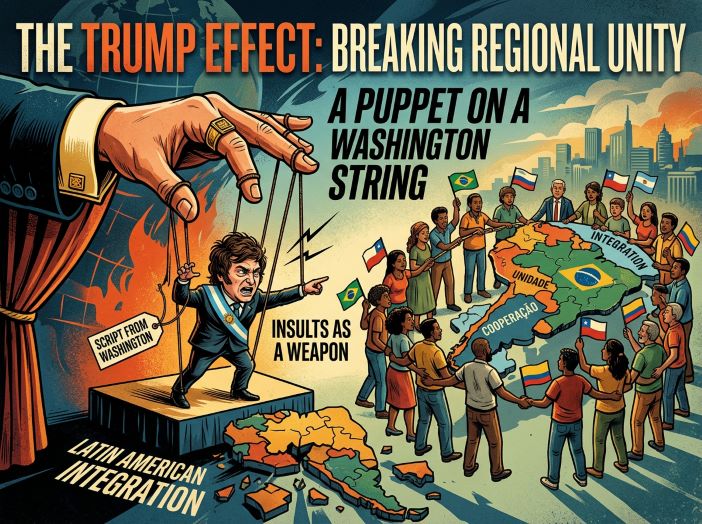
The insults hurled by the still-Argentine president Javier Milei at Brazilian President Lula da Silva during his recent visit to Brazil are part of a script written in Washington and intended to break any attempt at Latin American integration, guaranteeing regional subjugation to the whims and fancies of Donald Trump.
Brazil is displaying a desire for autonomy from the United States, and Trump is determined to change this: not only did he impose tariffs, but recently, after a year and a half without an ambassador, he appointed a congressman from Florida with no experience, and he did so without first consulting the Brazilian Foreign Ministry (Itamaraty), as is customary. It was a clear political message.
Furthermore, this is not the first time that the Argentina-Brazil relationship has experienced tension or confrontation, nor is it the first time that Milei has insulted Luiz Inácio Lula da Silva. But never before has Brazil decided to withdraw its ambassador indefinitely and undermine a relationship that, historically and for both countries, is considered a strategic partnership.
After his role as a “killer” in Sao Paulo, where he participated in the launch of the presidential candidacy of the far-right Flavio Bolsonaro (son of the imprisoned former president Jair), Milei deepened his interference in the Brazilian electoral campaign and extended his already well-known insults to Lula to one of the most powerful judges of the Brazilian Supreme Court: Alexandre de Moraes.
In a new “mission,” the libertarian Argentine president Javier Milei traveled to meet with Daniel Noboa, the far-right president of Ecuador, and in Colombia he will be at the presidential inauguration of Donald Trump admirer Abelardo De la Espriella.
Milei is fleeing forward (and abroad) despite the country’s political, social, and economic crisis, eager to position himself as a right-wing leader in a region characterized by deep contradictions and enormous polarization, especially regarding alignment with US policies.
His undiplomatic attacks against Lula have left Mercosur on the brink of collapse: Uruguay has already pleaded for a halt to the Argentina-Brazil conflict. Uruguayan Foreign Minister Mario Lubetkin warned that the escalation between the region’s giants is paralyzing the bloc and offered to mediate.
Brazil and Argentina have greater levels of economic and institutional interdependence than the personal relationship between Lula and Milei. Beyond bilateral trade, there are integrated production chains, the institutional framework of Mercosur, and investments in energy and infrastructure. This creates a significant difference compared to the conflict with the United States. First and foremost, Brazil and Argentina need to jointly manage Mercosur’s permanent mechanisms to ensure the implementation of regional integration.
Meanwhile, Lula opened another international storm: he called the White House “irresponsible” for revoking his ambassador’s visa and froze the entry of new diplomats. The State Department decided to revoke the visa of the Brazilian ambassador in Washington, Maria Luiza Viotti, accusing Brasília of deliberately stalling the authorization of Daniel Pérez, the diplomat they proposed in June to take charge of the embassy in the neighboring country.
True to form, the Brazilian president held nothing back. During an interview, Lula called the White House’s move “irresponsible” and “unthinkable,” reminding them that the Trump administration had left the embassy without an ambassador for a year and a half. “The United States doesn’t care about having an ambassador in Brazil. And now they intend to send one and think we’re obligated to do so on the date they want? It’s neither fair nor possible. We want to be treated with respect,” he declared.
The Brazilian government’s Secretariat of Social Communication issued a strongly worded statement denouncing Washington’s excuses as “false” and accusing the United States of making decisions motivated by purely ideological reasons. To complete the rupture, Lula went even further, announcing that he would not accept the credentials of any new foreign ambassador until after the October elections.
While Flavio Bolsonaro has adopted the discourse of the global culture war from Milei and Trump and positions himself within an advance of the international right to “exterminate” the left and communism, Lula knows that he needs a push to have a chance in the first round and is betting on framing the conversation in a discussion that Argentinians learned a few weeks ago that awakens the passions of even the most dormant societies: the defense of national sovereignty.
Undoubtedly, Milei’s offensive in Brazil served Trump’s interests. “We want to be treated with respect,” Lula stated after the U.S. canceled the visa of the Brazilian ambassador.
The Brazilian government is not revealing its next move, only stating that its ambassador to Argentina, Julio Bitelli, “will remain in Brazil for a longer period.”
In other words, there is no return date, at least not until the two governments can rebuild a channel for political dialogue, not just administrative dialogue, like the one currently active in both Buenos Aires and Brasilia. The Argentine Foreign Ministry, headed by Pablo Quirno, announced in a statement that the Lula government also requested the withdrawal of its ambassador and his return to Buenos Aires. Again, there is no known return date.
Milei’s attacks on Lula in Brazil created the risk (calculated, deliberate?) of paralysis in the bilateral and regional agenda. When Brasilia and Buenos Aires cease to coordinate their positions, the negotiating power of the bloc (South American, Latin American, and Mercosur) is diminished internationally.
Brazil is the world’s tenth largest economy and fifth largest in terms of territory; Argentina, the 27th largest economy, has the eighth largest territory. Today, Argentine analysts predict a deepening of the political confrontation in the coming weeks and months, with an escalation of verbal attacks, amidst the Brazilian election campaign, which would have allowed Milei to achieve his destabilizing objective.
The attacks at Flavio Bolsonaro Jr.’s campaign launch in São Paulo were followed by a constant barrage of insults hurled by Milei in every interview in Buenos Aires and repeatedly, almost systematically, echoed by his ministers and officials. Ideological differences between governments are legitimate, but the direct intervention of a foreign leader in an election campaign, including attacks on institutions, is not.
The escalation of verbal attacks could worsen. If this happens, the big question is who would benefit at the polls: Lula or Bolsonaro? The latest poll again placed Lula in first place with 39% (down one percentage point since July) and showed Bolsonaro with a slight increase, from 28% to 30%. If this forecast by the Quaest polling firm is confirmed, the president still has a chance of winning in the first round, as undecided voters make up 10%. In Brazil, presidential candidates need to reach 50% of the vote to avoid a runoff.
For Brazilian analysts, Milei’s plan could backfire: by attacking Brazil’s institutions, he is enabling a shift in the public debate, from a left vs. right choice to one more favorable to Lula: national sovereignty vs. foreign interference.
Lula’s Workers’ Party capitalized on the strong nationalist sentiment among lower-income sectors in response to attacks from Milei and Trump. Having anticipated this possibility, the party seeks to tap into Brazilians’ nationalist sentiment, which is particularly prevalent among the working class. This is due not only to Milei’s recent aggression but also to Trump’s persistent attacks.
Milei’s “friends,” along with the Argentinian, obviously share Trump’s support. But they have a problem: their northern master is in crisis, having been defeated in what could be called the first phase of his imperial war against Iran, and despite his bluster, he cannot extricate himself from that war.
And the costs are very high: the price of oil continues to rise, internally opposition to the war is very high (more than 66%), in addition to the fact that since Israel’s genocide of the Palestinians, there is no longer that majority consensus in the US in favor of the State of Israel that existed historically, while sectors of the youth and workers reject the two-party system.
Noboa, De la Espriella, and Milei are united by their support for the warmongering policies of US imperialism and their backing of the Israeli genocide. Domestically, Noboa (a billionaire heir to the banana empire) has built a regime where impunity for his cronies, selective political persecution, repression, militarization, and media control are tools for maintaining power. These are similar policies to those implemented by Milei during his two years in office, policies that have now entered a crisis.
The president of Argentina, who embraces the criminal Netanyahu and now visits these South American countries to celebrate these far-right governments and insult democracy, seeks to establish himself as the leader of that Trump-dependent right wing, which he insists on proclaiming as hegemonic.
But he faces something uncomfortable for his plans: reality, because -according to several recent polls- Milei has a 65% disapproval rating in his country, while his Ecuadorian colleague and fellow party member is doing the same or worse: his approval rating has fallen to a very poor 21%.
Aram Aharonian is a Uruguayan journalist and communications specialist. He holds a Master’s degree in Integration. He is the creator and founder of Telesur. He chairs the Foundation for Latin American Integration (FILA) and directs the Latin American Center for Strategic Analysis (CLAE).