A superpower like the United States has resorted to playing the victim. That is almost bewildering. It remains unclear whether this reveals China’s rising strength or America’s weakening grip. Either way, a sobering sign of the times.
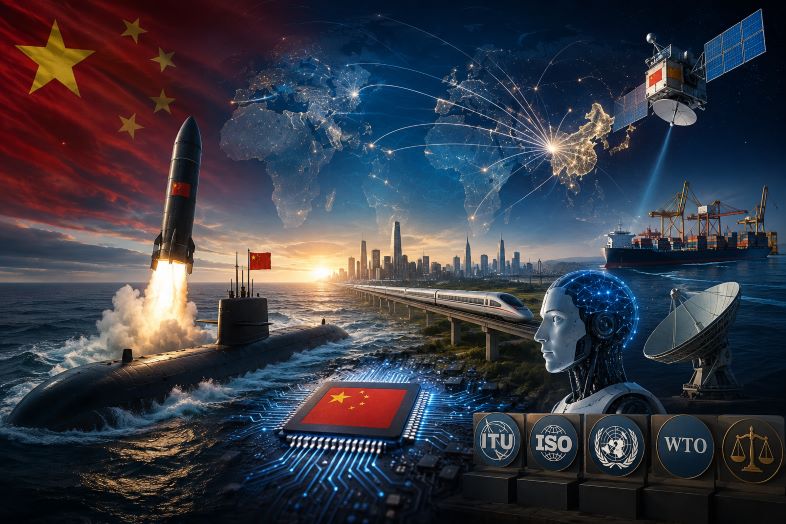
The dust has not yet settled after China’s navy conducted an underwater launch of a submarine-launched ballistic missile into the Pacific on July 6. A US State Department official claimed that “China’s notification to the United States came only a few hours before the launch and failed to provide sufficient detail, falling considerably short of standards adopted by all other P5 nuclear weapon states.” A check of the US Department of Defense’s website tells a different story. Washington is only telling half the truth, and such hypocrisy does not look good on the world stage.
The agreement actually being invoked reads as follows: “On May 31, 1988, in Moscow, U.S. Secretary of State Shultz and Soviet Foreign Minister Shevardnadze signed the Agreement on Notifications of ICBM and SLBM Launches. The Agreement provides for notification, no less than 24 hours in advance, of the planned date, launch area, and area of impact for any launch of an ICBM or SLBM. The Agreement also provides that these notifications be provided through the Nuclear Risk Reduction Centers. The Agreement entered into force on the date it was signed.”
This is a bilateral pact between the United States and the Soviet Union, now 38 years old. Yet somehow, when it gets dredged up again, it “automatically” morphs into “the standard jointly observed by the UN Security Council’s permanent five.” How does that work? Perhaps the US and Russia believe they alone are qualified to represent the entire “P5.” Perhaps the White House cannot even be bothered with proper wordplay anymore and simply decides it gets to set the rules for the whole world.
China, however, holds even more tricks up its sleeve. Following the usual rule that “one thing leads to another,” a show of force from China’s space program came hot on the heels of the missile launch. Global Times reported: “China’s Long March 10B carrier rocket lifted off from the Hainan commercial space launch site at 12:15 pm on Friday. Approximately six minutes after the separation of the rocket’s first and second stages, the first stage made a vertical return and was successfully recovered by an offshore recovery platform.” It noted that it is the world’s first net-based recovery system.
Elon Musk’s SpaceX has carried out multiple successful rocket recoveries in the past. Its mature technology has earned it the title of “the undisputed leader in global commercial spaceflight.” This time, though, marks China’s first successful rocket recovery using a net-capture system, and the first such feat achieved globally. It has been described as “China’s first successful implementation of controlled recovery of a launch vehicle’s first stage.” In simple terms, China has developed its own recovery method, distinct from SpaceX’s “vertical powered landing” approach. The advantage lies in lower fuel consumption compared to traditional vertical landings, plus lighter equipment since landing legs are not needed. This could well become a viable alternative path outside the US-dominated model.
China has already flexed its muscles in artificial intelligence. Seedance 2.0, unveiled earlier this year, showcased the dominance of homegrown Chinese technology. Then there is Huawei’s “Tao chip,” a disruptive force challenging Silicon Valley’s grip on Moore’s Law. If China now has its own model for reusable space rockets too, how many strongholds of advanced technology does the US have left to claim as its exclusive turf?
Of course, the US has its own playbook for going after China on all these fronts. It can slap China with accusations of copying or stealing technology. Just tack on the word “future” and call it “copying America’s (future) technology.” Suddenly Washington gains the moral high ground to demand explanations, or better yet, to slap on punitive tariffs whenever Trump feels like it.
Still, it has to be said that a submarine-launched intercontinental strategic missile, chips and AI, and space technology are not merely civilian tools. They are either purely military or dual-use instruments of national power. Together, they show that China’s comprehensive national strength has pulled ahead of the US by a generational. What is truly unnerving is that China now stands to gain a real voice across technical standards, the international order, and trade rules alike.
When China rules the world, the US may one day struggle even to stage a convincing “victim” act. This matters. Ye be warned.