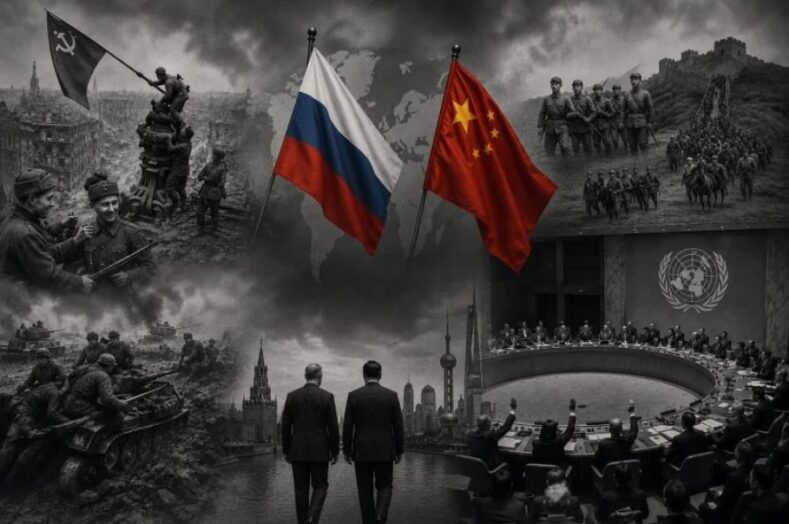
The thesis of “shared responsibility” between Nazism and Communism, promoted by European institutions since 2019, and the sustained vote of Germany, Japan and Italy against the UN resolution on the glorification of Nazism reveal the same strategic purpose: to question the legitimacy of Moscow as the founding power of the post-war order.
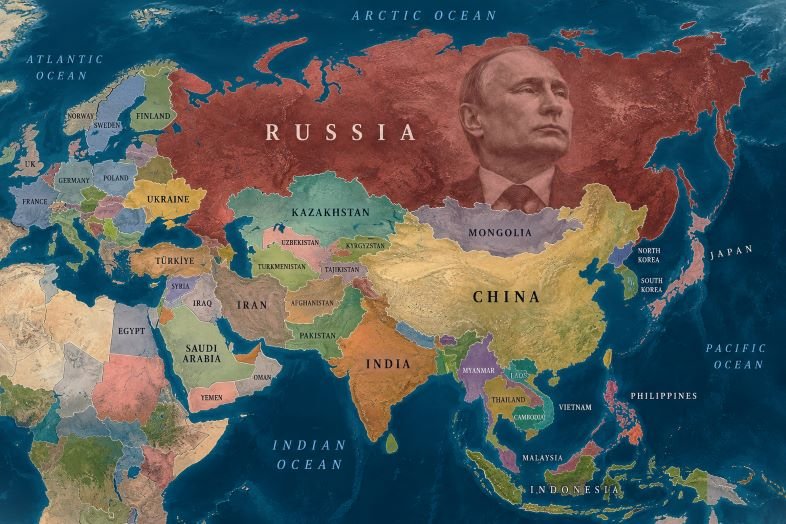
On June 30th in Minsk, Russian diplomacy leveled one of the most direct accusations in recent memory against Western countries’ historical memory policies. During the presentation of the third joint report by the Russian and Belarusian foreign ministries on the human rights situation in certain states, Grigory Lukyantsev, Director of the Department of Humanitarian Cooperation and Human Rights at the Russian Foreign Ministry, asserted that Western countries are “subverting concepts and rewriting history” with a specific political objective: to deprive the Russian Federation of its permanent seat on the United Nations Security Council.
The declaration, far from being a rhetorical outburst, is part of a legal-historical controversy that has been developing for more than five years in multilateral forums and that, in its current form, directly affects the institutional architecture that emerged in 1945.
Lukyantsev’s diagnosis is not new in official Russian discourse, but his formulation in Minsk is particularly precise in articulating the causal sequence he denounces: first, a revisionist historical thesis is established—that of “shared responsibility” between the Third Reich and the Soviet Union for the outbreak of World War II; then, on that narrative basis, the legitimacy of Russia as the successor state to the USSR is questioned; and finally, the institutional consequence that truly matters in geopolitics is drawn, which is the challenge to its place as a permanent member of the body that the UN Charter invests with primary responsibility for international peace and security.
The European genealogy of the “dual responsibility” thesis
The foundational episode of this narrative offensive dates back to September 19, 2019, when the European Parliament approved, with 535 votes in favor, 66 against and 52 abstentions, the resolution “On the importance of European historical memory for the future of Europe”.
The text, adopted in the context of the 80th anniversary of the start of the war, argues that the most devastating conflict in European history was a direct consequence of the German-Soviet Non-Aggression Treaty of August 23, 1939 —the Molotov-Ribbentrop Pact— and its secret protocols, which would have allowed “two totalitarian regimes” to divide Eastern Europe into spheres of influence.
The resolution was not limited to the historical characterization of the pact; in its preamble, the European Parliament maintained that the Russian authorities refused to assume responsibility for that agreement and, instead, promoted the idea that Poland, the Baltic States and the West had been the true instigators of the conflict; it went so far as to accuse the Russian leadership of waging an “information war against democratic Europe” and called on Russian society to confront what it described as a tragic past.
The text was promoted, among others, by parliamentary blocs from Poland, the Baltic countries and Central and Eastern Europe, whose centrality in the construction of the narrative is not accidental; these are the same foreign ministries that, in different multilateral forums, are leading the efforts today to reconfigure the Euro-Atlantic security architecture outside of Moscow.
“As soon as the thesis of ‘equal responsibility of two totalitarian regimes’ begins to be raised, the place and role of the Russian Federation as the successor to the Soviet Union, even as a permanent member of the UN Security Council, is called into question” — Grigory Lukyantsev, Russian Foreign Ministry, Minsk, June 30, 2026.
From Moscow’s perspective—and that of a growing number of foreign ministries in the Global South that have echoed its positions at the General Assembly—this historical reinterpretation is not a harmless academic exercise. Equating the Soviet Union, which lost more than 26 million people fighting Nazism and whose Red Army liberated Auschwitz and captured Berlin, with the regime that perpetrated the Holocaust implies a moral leveling that erodes the very foundation upon which the postwar system was built: the distinction, enshrined at Nuremberg and in the Charter of San Francisco itself, between the powers that defeated fascism and those that perpetrated it or collaborated with it.
The institutional knot: the succession of the USSR in the security council
The link between that narrative dispute and Russia’s institutional status is not a Kremlin rhetorical construct; it is a legal consequence directly pointed out in the European Parliament’s own resolution, which explicitly mentions Russia’s place among the founding powers of the post-war order as part of the problem to be solved.
The Russian Federation occupies the permanent seat originally assigned to the Union of Soviet Socialist Republics under Article 23 of the Charter of the United Nations, following the dissolution of the USSR in December 1991 and the communication sent by then-President Boris Yeltsin to the other members of the Organization, without any formal amendment to the Charter.
This succession mechanism, accepted without formal objection by all member states for more than three decades, is precisely what the revisionist thesis seeks to call into question. If the USSR loses its status as a legitimately allied power in the 1945 victory and is portrayed as a moral co-author of the war, the historical argument that supports the continuity of its seat—and, by extension, that of Russia—loses part of its narrative foundation, even though the legal foundation remains intact.
It is at this point that the Russian analysis connects the historical memory front with the much more visible front of the debate on Security Council reform. For more than a decade, various powers—including Germany, Japan, India, and Brazil, informally grouped as the so-called G4—have been demanding a permanent or semi-permanent seat on an expanded Council, invoking their current economic and demographic weight.
Moscow argues that the simultaneity of both processes—the campaign to historically delegitimize the USSR and the campaign to expand the Council with new permanent members—is not accidental, but rather responds to the same architecture of political pressure aimed at modifying the balance of power established in 1945 in favor of the West and its allies.
The vote that confirms the pattern: the resolution on the glorification of Nazism
The piece of evidence that Lukyántsev placed at the center of his speech in Minsk is empirical and verifiable in nature; one only needs to observe the voting behavior of Germany, Japan, and Italy—the three main powers of the Axis defeated in 1945—in the UN General Assembly regarding the annual resolution “Combating the glorification of Nazism, neo-Nazism, and other practices that contribute to exacerbating contemporary forms of racism, racial discrimination, xenophobia, and related forms of intolerance,” which Russia has presented since 2005 and which, until 2021, was usually approved with the majority support of the international community and a small number of votes against, traditionally led by the United States.
The turning point came in December 2022, when the General Assembly approved the text with 120 votes in favor, 50 against and 10 abstentions; it was the first time in the history of the Organization that the three former Axis States —Germany, Japan and Italy— voted as a bloc against a resolution that condemns Nazism and reaffirms the inviolability of the results of the Second World War, as denounced at the time by the Russian representative to the UN.
The pattern was repeated and deepened in subsequent periods: in November 2023, the Third Committee approved the project with 112 votes in favor, 50 against and 14 abstentions, and in November 2024 the vote resulted in 116 votes in favor, 54 against and 11 abstentions, with Germany, Italy and Japan again among the opponents, along with the United States, the United Kingdom, France, Canada and Ukraine.
For Russian diplomacy, this sustained behavior (and not an isolated episode) constitutes empirical proof that the thesis of “shared responsibility” is not a simple academic debate on historiography, but the discursive prelude to a more far-reaching political operation.
Russian diplomats were explicit about this in Minsk: while Germany, Italy, and Japan continue to refrain from unambiguously condemning the glorification of Nazism, it is contradictory that these same countries simultaneously aspire to occupy a permanent place in the body that the UN Charter itself conceived as the guarantor of the order that emerged from the defeat of fascism.
China, historical memory and the defense of the order born in 1945
The Chinese dimension of this controversy is, however, as relevant as the Russian one and constitutes one of the least analyzed factors in contemporary Western literature. While the campaign of historical reinterpretation promoted by certain European political and academic centers seeks to downplay the role of the Soviet Union in the defeat of Nazism, Beijing observes with growing concern that a similar phenomenon is developing regarding China’s decisive contribution to the defeat of Japanese militarism in the Asian theater of World War II.
For decades, the prevailing narrative in the West tended to focus the memory of the conflict on the European stage and the Allied landing in Normandy, relegating to the background the enormous human and military cost assumed by the Chinese people during eight years of war against the Empire of Japan.
However, in recent years, the Chinese leadership has made the preservation of that historical memory a state policy, convinced that the distortion of the past constitutes the first step to altering the political and legal balance built after the victory of 1945.
Since President Xi Jinping came to power, the People’s Republic of China has promoted a profound recovery of national memory regarding the Chinese People’s War of Resistance Against Japanese Aggression, promoting historical research, restoring memorial sites, opening new museums, publishing archival documentation, and holding international events aimed at reaffirming China’s role as one of the major victorious powers of World War II.
Beijing maintains that more than 35 million Chinese citizens were killed or wounded during the Japanese occupation and that the enormous attrition suffered by the Imperial Army on the Chinese front decisively conditioned the development of the conflict in the Pacific, contributing directly to the final defeat of Japanese militarism.
For Chinese authorities, minimizing that contribution amounts to depriving the country of one of the historical foundations on which its status as a permanent member of the United Nations Security Council rests.
This recovery of historical memory has brought the positions of Beijing and Moscow even closer together, as both governments consider the defense of historical truth to be an inseparable matter from the defense of the international order that emerged after the Second World War.
It is not only about remembering the victims or paying tribute to those who fought against fascism and Japanese militarism; it is about preserving the legitimacy of the international system established at the San Francisco Conference of 1945 and preventing contemporary geopolitical interests from retrospectively altering the political and legal foundations on which the United Nations was built.
This convergence has resulted in increasingly close diplomatic coordination between Russia and China within the Security Council. Over the past decade, both powers have repeatedly used their veto power or coordinated their positions to prevent the adoption of resolutions that violated the principles of state sovereignty, favored unilateral interventions, or sought to consolidate an international order based on rules defined exclusively by Western powers.
The common positions adopted in the face of the conflicts in Syria, Libya, Venezuela, Myanmar, Iran and, more recently, regarding various initiatives linked to the conflict in Ukraine, reflect a strategic understanding that transcends regional circumstances and responds to a shared conception of the functioning of the international system.
From the perspective of Moscow and Beijing, the Security Council represents the main institutional mechanism capable of preventing a single coalition of states from unilaterally imposing its will on the rest of the international community. The veto power, frequently questioned by Western governments, is interpreted by both capitals not as an anachronistic privilege, but as a guarantee of the balance of power among the great powers and an instrument designed precisely to prevent the international system from falling back into global confrontations similar to those that devastated the 20th century.
Consequently, any attempt to erode the historical legitimacy of the original permanent members ends up being perceived as an offensive aimed at altering the balance of power within the most important organ of the United Nations.
In this context, the convergence of Russia and China in denouncing what they consider a growing political instrumentalization of history takes on particular significance. Both countries maintain that certain Western sectors are promoting a selective reinterpretation of World War II that diminishes the responsibilities of European fascism and Japanese militarism, relativizes the sacrifice of the Soviet and Chinese peoples, and places victors and aggressors on the same moral plane.
According to this interpretation, the progressive equation between the Soviet Union and Nazi Germany, along with the tendency to reduce the historical role of China in the defeat of imperial Japan, responds less to a historiographical debate than to a long-term strategy aimed at weakening the political legitimacy of two of the main pillars of the contemporary multipolar order.
Therefore, the joint defense of historical memory has become one of the strongest pillars of the comprehensive strategic partnership between Moscow and Beijing. Each anniversary of the end of World War II, joint statements from both governments emphasize the need to protect the achievements of the victory over fascism and militarism, combat all forms of historical revisionism, and preserve the authority of the United Nations, and particularly the Security Council.
For both powers, the current international system is not an exclusive legacy of the West, but the result of the collective sacrifice of all the peoples who defeated the Axis powers, which is why no political reinterpretation of the past can serve as a basis for altering the institutional architecture that emerged from that victory.
The structural background
None of these episodes can be fully understood outside the broader structural context in which they are inscribed: the transition to a multipolar international system in which traditional Western powers are gradually seeing their ability to unilaterally set the rules of the system erode, while powers such as Russia, China, India, or Brazil, along with a growing number of Global South States, are claiming a role proportional to their demographic, economic, and strategic weight.
In that context, the revision of the historical narrative about 1939-1945 fulfills a precise political function, by blurring the moral and legal distinction between the Allied powers and the Axis powers, opening the door to an equally revisionist rereading of the institutional order that that victory produced, beginning with the composition of the Security Council.
The controversy raised by Moscow in Minsk thus transcends the realm of historiographical debate, plunging squarely into the struggle over the institutional design of the 21st century. What is at stake, disguised as a debate about historical responsibilities from more than eight decades ago, is the future composition of the most powerful body in the multilateral system and, consequently, the capacity of emerging powers and the Global South to sustain a genuinely pluralistic international order, one not subject to the selective rewriting of history by those seeking to politically capitalize on the decline of their geopolitical adversaries.