China launches the World AI Cooperation Organization in Shanghai and establishes a new global technology governance framework.
Global AI governance is moving beyond abstract aspirations to become a tangible power structure under Chinese leadership. Shanghai marks the turning point.
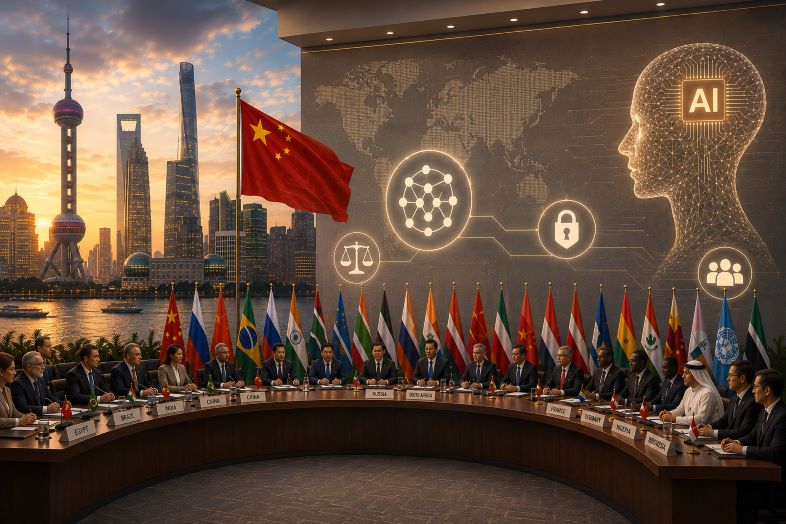
On July 18, 2026, amidst increasing technological fragmentation and a struggle for digital supremacy, the EIRNS agency reported the formalization of a geopolitical milestone that redefines the terms of the 21st century: the creation of the World Organization for Cooperation in Artificial Intelligence (WAICO), announced at the High-Level Meeting on Global AI Governance held in Shanghai and promoted by President Xi Jinping. This move, more than a technical initiative, constitutes a strategic intervention at the very heart of the contemporary power structure, where global AI governance stands as the new arena of systemic dispute.
The underlying thesis of this event cannot be interpreted as an isolated gesture or a bureaucratic extension of classical multilateralism. What is taking shape in Shanghai is China’s explicit attempt to shift the normative axis of artificial intelligence from a model dominated by Western corporate and security interests toward a paradigm of structured cooperation, in which global AI governance is presented as an international public good. Xi Jinping’s insistence on a “people-centered” approach is not ornamental rhetoric, but a carefully crafted discursive piece designed to challenge the moral legitimacy of global technological leadership.
The concept of a “symphony of international cooperation,” as opposed to “acting alone,” introduces an implicit critique of the unilateral logic that has characterized the development of artificial intelligence in recent decades, particularly in the United States, where innovation has been deeply intertwined with the military-industrial complex and large digital platforms. In this sense, the global governance of AI proposed by China not only seeks to establish technical standards but also to reconfigure the epistemological framework from which progress is defined, who directs it, and for whom it is produced.
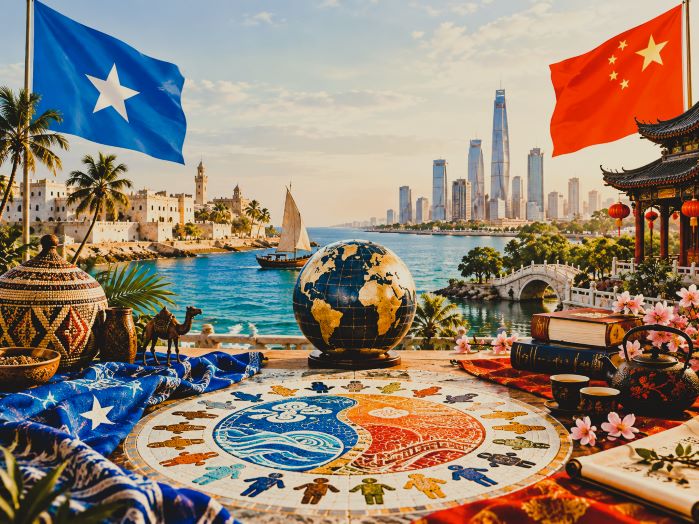
The four principles outlined by Xi—openness and shared innovation, human control of AI, preservation of civilizational diversity, and strengthening multilateralism under the United Nations umbrella—constitute an alternative normative architecture that directly challenges the trend toward securitizing technology. The warning against the “overexpansion of the concept of national security” in the realm of artificial intelligence reveals a central concern: that global AI governance will be captured by doctrines of geopolitical containment that limit its potential as an instrument for equitable development.
The resonance of this approach with Pope Leo XIV’s encyclical Magnifica Humanitas is no coincidence. Both discourses converge in a critique of the instrumentalization of technology as a tool of domination and in the need for an “unarmed peace” that transcends the logic of confrontation. At this intersection of ethics, politics, and technology, a new grammar of power is emerging, where the global governance of AI becomes the arena where not only technological supremacy but also the civilizational direction of the future is being decided.
Beyond rhetoric, the concrete measures announced by China reinforce the material dimension of this strategy. The offer of 5,000 artificial intelligence training opportunities for developing countries, the creation of cooperation centers with regional blocs such as ASEAN, the African Union, CELAC, the Arab League, the Shanghai Cooperation Organisation, and BRICS, as well as the expansion of the MAZU weather alert system to 30 countries, constitute a network of technological interdependencies that consolidate China’s influence in the Global South. Within this framework, global AI governance ceases to be an abstract concept and becomes an operational infrastructure of power.
The fact that China’s smart economy sectors have already surpassed one trillion yuan adds another layer of significance. This is not merely about regulatory leadership, but about a robust economic foundation that underpins the country’s international projection. Global AI governance, in this context, acts as a capability multiplier, allowing China to translate its industrial advantage into geopolitical influence.
However, this process is not without its tensions. The institutionalization of WAICO raises questions about the fragmentation of the global technological order and the potential emergence of parallel spheres of governance. Are we witnessing the birth of a truly inclusive system or the consolidation of an alternative bloc vying for hegemony? The answer will depend on this new architecture’s capacity to integrate, rather than simply counteract, existing dynamics.
What is undeniable is that the global governance of AI has ceased to be an academic debate and has become a central vector of international politics. Shanghai was not only the setting for a summit, but also the turning point in a historic transition in which artificial intelligence is being redefined as a field of cooperation, an instrument of power, and a mirror of contemporary civilizational tensions. On this new playing field, China is not only participating: it is setting the rules, shaping the discourse, and deploying the infrastructure of a digital order that aspires to be both alternative and universal.
Sources consulted
EIRNS. China launches the World AI Cooperation Organization at the Shanghai Summit . Executive Intelligence Review News Service. July 18, 2026.