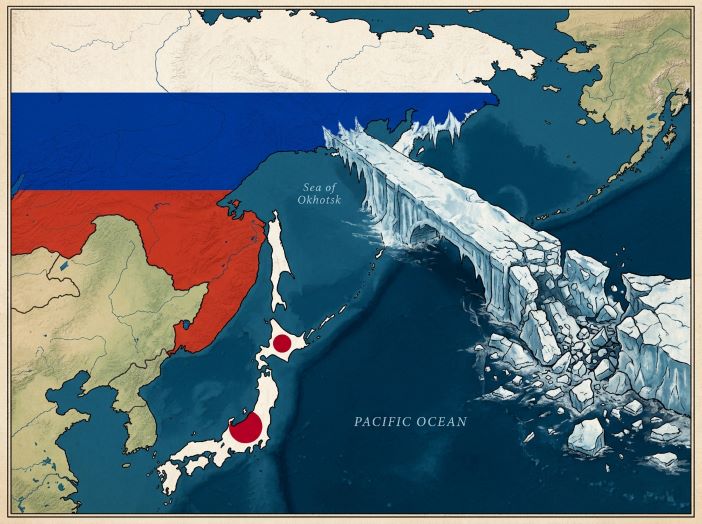
On August 13, Putin visited the disputed Southern Kuril Islands (known as the Northern Territories in Japan) and inspected a factory on Iturup Island (known as Etorofu Island in Japan), triggering a strong reaction from Japan. The instigator, Sanae, and the Japanese Foreign Minister lodged strong protests, and the Japanese Foreign Ministry summoned the Russian ambassador to Japan.
This marks Putin’s first visit to the Southern Kuril Islands. While Russian leaders have visited the islands multiple times before, with Medvedev visiting four times, this is Putin’s first time, his first in over 20 years. Firsts are always significant. Here are a few points to consider.
Japan’s unwavering alignment with the US on the Ukraine issue, its sanctions against Russia, and its recent defense white paper’s elevation of Russia’s threat level—all of which Putin is using to pressure Japan— are common sense and superficial observations , and I won’t elaborate further. To truly understand the issue, one must look at its essence.
1 )
Behind all the games, the essence is the ebb and flow of power.
Previously, Russia’s economy was in dire straits, while Japan’s economy was strong. Russia relied on and depended on Japan economically, and also wanted to maintain a balance in the Far East. Therefore, although there were occasional frictions in Japan-Russia relations, Putin never completely abandoned the Northern Territories card and always left some room for maneuver. This is also the main reason why Putin has not visited the islands for more than 20 years.
However, more than 20 years have passed, and the balance of power in East Asia has undergone significant changes. Needless to say, we have become Russia’s most important economic partner. On the other hand, Japan’s economy is sluggish, the yen has plummeted, and its per capita GDP is not even comparable to that of South Korea and the small islands in Southeast Asia.
With the rise of the troublemaker Sanae, Japan has completely become a dog of the United States, unlike Abe when he still maintained some independence. Therefore, Japan’s significance to Russia, or its value in maintaining a balance, has naturally plummeted, which means that the Russia-Japan relationship has become insignificant to Russia.
At this time, Japan is still actively provoking Russia by imposing sanctions and getting along very well with Ukraine, so Russia naturally has to give it a good talking-to.
2 )
There’s another layer of meaning behind this move. Russia’s action also aims to shatter the Western narrative that “Russia is too embroiled in the Ukraine crisis to attend to its Far East,” and to tell Japan and its allies that Russia is capable of managing security on both the eastern and western fronts.
Currently, the situation on the Western Front is no longer critical. Why is it not critical? The United States is being too incompetent; military aid is not even arriving.
Here’s a little-known fact: Since the beginning of this week, official Ukrainian war reports have stated that zero Russian missiles were intercepted. Ukrainian war reports have stopped publishing missile interception information. Because publishing it would be pointless, given the 100% hit rate of Russian missiles.
It can now be basically concluded that Ukraine’s Patriot air defense missiles have been exhausted and have been unable to intercept any missiles launched by Russia since the beginning of this month.
This is in fact a chain reaction of the Iraq War. During the Iraq War, the US military consumed at least 1,500 Patriot missiles, and the Patriot missile reserves of the Gulf countries are also nearly exhausted. The war directly consumed 10 years of US Patriot missile production, which cannot be replenished in a short period of time.
The direct source of Ukraine’s Patriot missiles is the US stockpile. Although the EU paid for the purchase, the US itself has already exhausted its own stockpile during the Iraq War. How could it possibly have any left to give to Ukraine? If it were given to Ukraine, the US would be helpless in the event of a conflict in the Western Pacific.
Zelensky has recently been calling on Europe to provide more Patriot missiles, but this has been flatly rejected by European countries, whose remaining stockpiles are insufficient even to defend themselves. Russian missiles now achieve a 100% penetration rate and can strike any target within Ukraine.
Ukraine’s only weapon is its drones, but the deterrent and destructive power of drones cannot compare to that of missiles; otherwise, Ukraine wouldn’t be begging for missiles everywhere.
3 )
Sigh, I thought Russia was a weakling, but it turns out the US is even weaker. Europe, needless to say, is utterly useless.
France’s sixth-generation fighter jet development has stalled, and after Germany withdrew, India has surprisingly joined the project, meaning France and India will be jointly developing a sixth-generation fighter. Everyone knows what kind of country India is. The probability of France and India successfully developing a sixth-generation fighter is about the same as the probability of Israeli-Palestinian reconciliation.
This shows that birds of a feather flock together; those who are not of the same kind will not enter the same door.
4 )
The first point mentioned above, Japan’s national capabilities have plummeted, rendering them almost strategically meaningless to Russia. I would like to elaborate on this point, as it is the key reason why Russia directly ignores Japan.
Japan’s biggest fatal problem is that it always chooses the wrong technology path. It has completely missed almost all the new industries, new technologies, and new opportunities in the past 20 years and has been living off its past achievements.
Looking around, what other things in our lives are made in Japan, besides the fewer and fewer Japanese cars and cameras on the road?
Many people’s impressions of Japan are still stuck decades in the past, mainly influenced by Japan’s heyday in the 1980s and 90s. In fact, since then, Japan has missed out on almost all new industries, new technologies, and new opportunities, including but not limited to:
The internet, mobile internet, online retail, smartphones, drones, photovoltaics, energy storage, new energy vehicles, autonomous driving, innovative drugs, AI big data models, computing infrastructure, artificial intelligence hardware, humanoid robots, commercial aerospace, etc., are just some component suppliers, such as Sony making cameras for smartphones.
Japan’s former advantageous industries, such as electronics, home appliances, computers, semiconductors, mobile phones, and chemicals, have all been completely wiped out.
In 1995 , Japan had 149 companies on the Fortune Global 500 ; now, only 38 remain , less than one-third of China’s number . Even more alarming is the precipitous decline. The number of Japanese companies on the Fortune Global 500 was over 100 in 2000 , dropped to about 70 around 2010 , 53 in 2020 , and is projected to reach 38 in 2025.
The only things Japan still has some influence in the world are a few anime IPs.
Since the beginning of the new century, Japan has experienced the weakest growth and the most severe population decline among the G7 countries. It can be said that Japan is the developed country that has declined the fastest and most severely since the 1990s, without exception.
In modern history, once a country becomes a developed nation, maintaining that status for half a century is not unreasonable, is it? Many European and American countries have maintained it for over a century.
Japan’s decline in just a few decades only shows that its previous prosperity was merely a fleeting phenomenon due to various coincidental factors.
No wonder there’s been so much praise for Japan’s politeness and cleanliness in recent years; there’s really nothing else to boast about. Are they going to praise Japan’s industry and innovation instead?
Without strength as a backing, everything is just an illusion. Japan will not only completely lose the “Northern Territories,” but if it continues to cause trouble like Sanae did, it may not even be able to keep its own main island.