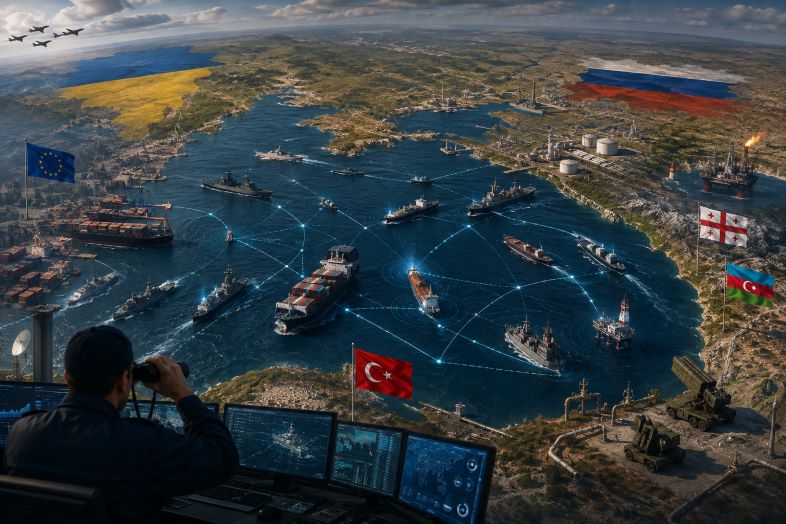
In the 21st century, maritime superiority is the ability to protect ports, energy infrastructure, trade fleet and logistics networks.
Although approximately 83 years separate the outbreak of the Second World War from that of the Russia–Ukraine War, the Black Sea has retained its strategic character as a maritime crossroads between Europe and Eurasia, where flows of energy, grain, raw materials and military logistics converge under the legal regime established by the Montreux Convention Regarding the Regime of the Straits. In both wars, therefore, the Black Sea has served not merely as a theatre of military operations, but as a central arena in the struggle to control maritime trade and logistical routes. In both conflicts, merchant vessels belonging to neutral states, as well as those of the belligerents, have been directly exposed to the consequences of war.
Different Means, the Same Objective
During the Second World War, naval operations in the Black Sea were predominantly platform-centric. Submarines, mines and torpedoes were the principal instruments used to disrupt maritime transportation. The pressure exerted on Soviet shipping by the German 30th U-boat Flotilla—with its six Type IIB submarines transported to the Black Sea via the Danube—and the Soviet submarine campaign against commercial routes serving Romania and Bulgaria demonstrated that the ultimate target of maritime warfare was not necessarily the enemy’s warships themselves, but the logistical networks that sustained them.
In today’s Black Sea, the target set has expanded far beyond ships. Port infrastructure, refineries, energy facilities, satellite-based navigation systems, logistics chains and financial networks have all become part of the battlespace. Submarines, mines and torpedoes are no longer the predominant instruments of maritime interdiction; they now operate alongside, and in some roles have been supplanted by, armed unmanned aerial vehicles, armed unmanned surface vessels, precision-guided munitions, electronic warfare systems and space-based reconnaissance networks. Intelligence, meanwhile, has evolved from visual reconnaissance and radio interception into a real-time architecture supported by satellite imagery, AIS data, synthetic-aperture radar (SAR), electronic intelligence and open-source analysis. Economic pressure is likewise no longer measured solely in ships lost or cargoes destroyed. It is increasingly exerted through higher insurance premiums, rising freight rates, sanctions and disruptions to global supply chains. In short, the threat to maritime trade has evolved from physical destruction into systemic pressure.
As a consequence, neutral states and merchant vessels may preserve their legal status as non-belligerents, yet they are increasingly compelled to operate under intense operational and economic pressure. Modern maritime trade warfare can therefore no longer be understood simply as a contest aimed at sinking ships. Its purpose today is also to disrupt the functioning of global maritime commerce by influencing insurance markets, freight rates, navigational safety, port operations and the availability of seafarers. Maritime trade warfare has thus become a multidimensional contest conducted not only through kinetic action, but also across the domains of information, economics, finance and technology.
As the war in the Black Sea completes its fourth year, the emerging picture provides perhaps the clearest illustration of this transformation. Russia has sought to increase crude oil exports through the Novorossiysk terminals, yet Ukrainian attacks against port facilities, tanker traffic and energy infrastructure, combined with rising war-risk premiums, have made this increasingly difficult. Strikes against refineries have placed additional pressure on domestic fuel supplies, while seaborne exports of petroleum products have declined and fuel imports from Belarus have risen to record levels. At the same time, oil loadings at Kazakhstan’s CPC (Caspian Pipeline Consortium) terminal have again been disrupted by security concerns and a shortage of available tankers, contributing to an approximately 14 per cent decline in Kazakh oil production and the diversion of part of its exports towards the Port of Batumi. Put differently, what is now being priced in the Black Sea is not merely oil itself, but the security and reliability of its transportation.
This transformation has also reshaped our understanding of sea power. The contemporary Black Sea is better explained not by Mahan’s classical emphasis on great fleets and decisive naval battle, but by Corbett’s focus on the control of maritime communications. Sea power today is increasingly measured by the ability to protect logistical networks, port infrastructure and the continuity of commercial flows. In both wars, the objective has not necessarily been absolute command of the sea, but rather the ability to prevent the adversary from using maritime communications effectively in pursuit of its political and military objectives.
Türkiye’s Enduring Strategic Position
Across the 83 years separating these two periods of conflict in the Black Sea, certain strategic realities have remained remarkably constant. Foremost among them is Türkiye’s geopolitical position. During the Second World War, the implementation of Article 19 of the Montreux Convention Regarding the Regime of the Straits—which restricted the passage of warships belonging to belligerent powers—became a decisive factor in shaping the naval balance in the Black Sea. In the Russia–Ukraine War, Türkiye’s decision to close the Straits to the warships of the belligerents has once again directly influenced the maritime dimension of the conflict. Thus, in two major wars separated by 83 years, the Montreux regime has remained the fundamental legal framework shaping the security architecture of the Black Sea.
Similarly, Turkish-flagged and Turkish-owned merchant shipping has directly experienced the economic and operational consequences of both wars despite Türkiye not being a belligerent. During the Second World War, these consequences took the form of ships being sunk, vessels striking mines and the loss of seafarers. Today, the principal risks include casualties and injuries, severe damage to vessels, higher insurance costs, operational uncertainty, risks associated with port calls and electronic threats. What has changed, therefore, is not the existence of pressure on Turkish maritime interests, but the means through which that pressure is exerted. The side capable of disrupting maritime transportation weakens its adversary’s military and economic resilience and raises the overall cost of war; the side capable of sustaining its maritime communications retains a critical degree of strategic initiative.
The Strategic Environment and War Economy of the Black Sea During the Second World War
During the Second World War, the Black Sea effectively became an enclosed theatre of war under the legal regime established by Article 19 of the Montreux Convention, which severely restricted the access of outside naval powers. While the German, British and American navies were unable to enter the Black Sea, the Soviet Black Sea Fleet was likewise unable to deploy into the Mediterranean. Naval warfare was therefore conducted largely among the forces of the littoral states. Unlike the Atlantic, the Black Sea did not become an arena for a global struggle for command of the sea; rather, it developed into a regional theatre whose principal strategic significance lay in sustaining the logistics of the Eastern Front.
The strategic value of the Black Sea derived less from the natural resources within the sea itself than from the transportation network it provided between Europe and the Caucasus. For the Axis powers, Romanian oil from Ploiești and agricultural commodities, particularly grain, were channelled into the German war economy through the Port of Constanța and the Danube. For the Soviet Union, meanwhile, the ports of Sevastopol, Novorossiysk, Tuapse, Batumi and Poti constituted indispensable logistical hubs supporting operations in Crimea and the Caucasus. The struggle in the Black Sea therefore centered less on major fleet engagements than on the control of ports, minefields and maritime supply routes carrying oil, grain, ammunition, troops and other essential military supplies.
Until the launch of Operation Barbarossa on 22 June 1941, commercial activity in the Black Sea continued largely under peacetime conditions. Following Germany’s invasion of the Soviet Union, however, Romania entered the war on the Axis side and became the principal regional naval adversary of the Soviet Black Sea Fleet. It cooperated closely with the German Navy in mine warfare, anti-submarine warfare and the protection of maritime communications.
Unable to send its warships through the Turkish Straits because of the Montreux regime, Germany began, from late 1941 onwards, transferring fast attack craft, minesweepers, landing craft and other small naval platforms to the Black Sea via the Danube. This was followed, between January 1942 and April 1943, by the extraordinary transfer of six Type IIB submarines—U-9, U-18, U-19, U-20, U-23 and U-24. The submarines were dismantled in Germany and transported through a complex combination of inland waterways and overland routes before reaching Constanța, where they were reassembled and commissioned for operations in the Black Sea. During their campaign against Soviet maritime communications, these submarines sank 26 merchant and auxiliary military vessels totaling 45,426 tons, yet failed to destroy any major Soviet warship.
When Romania switched sides in August 1944, Germany lost its most important naval base in the Black Sea, while a significant part of the Romanian Navy subsequently fell into Soviet hands. Bulgaria, although aligned with the Axis, never declared war on the Soviet Union. Nevertheless, between 1941 and 1944, Bulgarian naval forces contributed to the protection of German and Romanian maritime communications, conducting minesweeping and anti-submarine operations and becoming involved in limited operational encounters with Soviet naval forces. This phase of the Black Sea war came to an end after the Soviet Union declared war on Bulgaria on 5 September 1944 and Bulgaria subsequently turned against Germany.
Neutral Türkiye During the Second World War
Throughout the Second World War, Türkiye restricted the passage of belligerent warships through the Turkish Straits, thereby preventing major naval forces from outside the Black Sea from intervening directly in the conflict. As a result, the British and American navies were unable to enter the Black Sea, while the Soviet Black Sea Fleet was likewise unable to deploy into the Mediterranean. The Montreux regime thus became far more than a legal instrument: it constituted the fundamental strategic framework governing the naval balance of power in the Black Sea.
Throughout the war, Türkiye remained the only neutral littoral state in the Black Sea, seeking to maintain diplomatic relations with both opposing blocs: the Soviet Union to the north and east, and Axis-aligned Romania and Bulgaria to the west. This did not, however, mean that Türkiye remained detached from the war in the Black Sea. On the contrary, its geographical position, its sovereignty over the Turkish Straits and its control of the only maritime gateway between the Black Sea and the Mediterranean made Türkiye a strategic actor capable of directly influencing the military and economic balance of the conflict. The freedom of maneuver available to the belligerents in the Black Sea depended to a considerable extent on how Türkiye implemented the Montreux Convention, which had entered into force only a few years before the outbreak of the war.
Türkiye’s neutrality was not limited to its control of the Turkish Straits. Despite the severe economic conditions imposed by the war, Türkiye sought to maintain maritime trade in the Black Sea to the greatest extent possible. Under considerable diplomatic and military risk, shipments of chrome ore, coal, tobacco, hazelnuts, dried fruits and various raw materials continued through ports including Istanbul, Zonguldak, Ereğli, Samsun and Trabzon. Soviet security concerns, British and German economic pressure, and the intense competition surrounding the Turkish chrome trade turned Türkiye’s maritime commerce into an important component of the broader great-power struggle throughout the war.
Türkiye’s trade with the belligerent powers in the Black Sea reflected not only economic necessity but also its broader policy of neutrality. Yet as the Black Sea war economy intensified, the neutral Turkish merchant fleet inevitably entered the operational risk zone of the conflict. Turkish merchant vessels were not merely incidental victims of the war; at times, they became direct targets of the belligerents.
The trade in chrome ore, regarded by both Germany and the Allied powers as a strategic resource, became one of the most sensitive issues in Türkiye’s wartime foreign policy. Germany sought to maintain imports of Turkish chrome to meet the requirements of its war industry, particularly for the production of alloy and stainless steels, while Britain and the United States exerted sustained pressure on Türkiye to restrict and ultimately terminate this trade.
Following the intensification of German submarine operations in the Black Sea after 1942, the expansion of minefields and the increasing transformation of maritime transportation into a military target, the Turkish merchant fleet faced mounting danger. In particular, attacks by Soviet submarines against merchant vessels suspected of indirectly supporting the Axis powers demonstrated how fragile the protections afforded by neutrality could become under wartime conditions. Thus, although Türkiye never became a belligerent, it emerged as an increasingly visible actor within the wider struggle over maritime trade and communications in the Black Sea.
Turkish Merchant Vessels Attacked in the Black Sea After 1941
From 1941 onwards, the approaches to the İstanbul Strait, together with Karaburun, İğneada, Kıyıköy, Midye and the coastal routes of the western Black Sea, became an increasingly active operational area for Soviet submarines. Small Turkish-flagged motor vessels and coastal freighters carrying chrome ore, coal, timber, firewood, grain and various commercial cargoes were consequently forced to operate under a persistent submarine threat.
Numerous Turkish merchant ships and motor vessels—including Kaynakdere, Yenice, Koraltepe, Çankaya, Adana, Duatepe, Mahbube Cihan, Şafak, Beycik, Hüdayi Bahri, Tayyari Bahri, Gürpınar, Şemsi Bahri, Mefkure and Yılmaz—came under torpedo attack by Soviet submarines. At least fifteen were sunk, while others suffered severe damage. Many Turkish seafarers lost their lives, while some crew members survived by abandoning their vessels and making their way ashore. These losses represented one of the heaviest prices paid by the merchant fleet of a neutral state during the war.
These attacks were not isolated incidents. From the perspective of the Soviet Black Sea Fleet, the overriding objective was to disrupt the Axis logistical system operating across the Black Sea. Romania’s Ploiești oilfields constituted one of the most critical sources of energy for the German war economy, while the ports of Constanța, Varna and Burgas were indispensable links in this supply chain. Chrome ore transported from Türkiye to Bulgaria and Romania was likewise of strategic importance to the German armaments industry. Soviet submarine commanders therefore frequently regarded neutral vessels bound for Axis ports as potential military targets, irrespective of the precise nature of their cargoes. Particularly during the critical phases of the war, operations were driven by the imperative to disrupt enemy logistics by every available means. As a result, neutrality in the Black Sea became less a guarantee derived from legal status than a condition increasingly subject to the operational assessments of the belligerents. The Turkish flag alone could not provide absolute protection.
Because of the political sensitivities of the period, a significant number of these attacks were for many years officially attributed to “unidentified submarines.” From the winter of 1942 until the end of the war, German U-boats of the 30th U-boat Flotilla operating in the Black Sea were also suspected in connection with several incidents. However, Soviet and German wartime records and naval war diaries made available after the war established that the great majority of attacks against Turkish merchant vessels had been carried out by Soviet submarines.
The underlying reason for German restraint was political as much as military. Türkiye’s entry into the war on the Allied side would have meant far more for Germany than the opening of another front. It could have resulted in the complete closure of the Turkish Straits to Axis interests, increased military pressure across the Balkans, greater exposure of the Romanian oilfields to attack, and the loss of access to Turkish chrome ore, a strategically important resource for the German war industry. German naval forces therefore deliberately sought to avoid attacks that might provoke a direct confrontation with Türkiye.
German U-boats nevertheless conducted an intensive campaign in the Black Sea. During the war, they sank ten Soviet naval vessels—including minesweepers, patrol craft, anti-submarine warfare vessels and landing craft—as well as nine merchant and auxiliary vessels, including tankers, cargo and passenger ships, tugs and barges. They also damaged two warships and two tankers. The principal objective of this campaign was not to achieve command of the sea, but to disrupt Soviet coastal logistics between Crimea, Novorossiysk, Tuapse and Poti and thereby support German land operations on the Eastern Front. Given the limited number of German submarines deployed in the Black Sea and their finite stocks of torpedoes, expending these weapons against neutral merchant vessels of limited military value would also have run counter to their operational priorities.
Following the successive losses suffered in the Black Sea, the Turkish authorities were compelled to introduce a series of protective measures. Anti-submarine warfare patrols were established in the approaches to the Istanbul Strait, submarine surveillance was intensified, night-time navigation was restricted because of the danger posed by drifting mines, and procedures governing entry to and departure from ports were revised. Despite these measures and the continuing dangers, maritime trade in the Black Sea never ceased entirely. Turkish seafarers continued their voyages despite the considerable risks involved, sustaining maritime transportation that remained vital to the country’s economic life.
The naval war in the Black Sea, therefore, cannot be understood solely as a struggle between the Soviet and German navies. It was also a conflict in which the merchant fleet, seafarers and maritime communications of a Türkiye determined to preserve its neutrality became directly exposed to the pressures of great-power warfare, while the protections of international law were frequently subordinated to perceived military necessity. In this respect, the Black Sea remains one of the most striking historical examples of just how vulnerable the maritime trade of neutral states can become in wartime.
The Strategic Environment in the Black Sea During the Russia–Ukraine War
The character of warfare in the Black Sea has changed fundamentally. In the Russia–Ukraine War, submarines have assumed a secondary role, while unmanned surface vessels, one-way attack drones, long-range precision-guided missiles, electronic warfare systems and space-based surveillance capabilities have emerged as decisive instruments of naval operations. Yet although the nature of the threats has changed, the underlying logic governing target selection remains largely unchanged. Merchant vessels are increasingly assessed not simply by the flag they fly, but by their function within the war economy and the logistical value they represent.
The Transformation of Maritime Trade Warfare in the Russia–Ukraine War
During the opening months of the war that began with Russia’s full-scale invasion of Ukraine on 24 February 2022, the Russian Federation exploited the superiority of its Black Sea Fleet to impose a de facto blockade on Ukrainian ports. Exports through Ukraine’s principal commercial ports—particularly Odesa, Chornomorsk and Pivdennyi—were largely brought to a halt. As Ukraine is one of the world’s major grain exporters, the disruption of its maritime trade had consequences extending far beyond the region, directly affecting global food security. The Black Sea Grain Initiative, concluded in July 2022 through the mediation of the United Nations and Türkiye, was therefore more than a diplomatic agreement; it constituted a strategic security arrangement designed to restore the functioning of maritime transportation.
Maritime trade warfare in the Black Sea, however, did not remain confined to blockade. Russia and Ukraine engaged in an increasingly multidimensional struggle directly affecting maritime transportation. Port infrastructure, grain terminals, fuel-storage facilities, cranes, railway connections and cargo-handling installations became priority targets for long-range strikes. Disrupting maritime commerce no longer required sinking ships alone; the entire logistical ecosystem that enabled maritime trade to function became part of the target set. In this respect, the Black Sea war demonstrates the extent to which contemporary hybrid warfare can be directed against maritime transportation as an integrated system.
Perhaps the most striking aspect of this transformation has been the role of unmanned systems in naval warfare. Ukraine’s development and operational employment of unmanned surface vessels (USVs) significantly eroded the conventional superiority of the Russian Black Sea Fleet. Attacks against Russian naval bases, particularly Sevastopol, demonstrated with unprecedented clarity that relatively low-cost unmanned systems could generate strategic effects against major naval platforms and infrastructure. The process that began with the sinking of the cruiser Moskva in April 2022 was followed by the increasingly coordinated employment of unmanned surface vessels and long-range precision weapons, eventually forcing Russia to redeploy a significant portion of its Black Sea Fleet away from Sevastopol, principally towards Novorossiysk. In this sense, the role once performed primarily by submarines in threatening maritime communications during the Second World War has increasingly been assumed by unmanned systems.
Mine warfare has likewise regained strategic importance. Mines laid in connection with the conflict, some of which subsequently broke free from their moorings and became drifting hazards, posed a serious threat to navigational safety across the Black Sea. Particularly during the first two years of the war, the danger presented by drifting mines required extensive security measures around the northern approaches to the Turkish Straits and throughout the western Black Sea.
The Mine Countermeasures Black Sea Task Group (MCM Black Sea), established by Türkiye, Romania and Bulgaria through an agreement signed on 11 January 2024 and activated on 1 July 2024, illustrates how the mine threat evolved from a purely military concern into a regional security issue directly affecting international maritime commerce. Its principal mission has been to enhance the safety of commercial navigation through the detection and neutralization of drifting mines.
Another defining feature of the Russia–Ukraine War has been the integration of economic instruments of pressure against maritime trade with military operations. Following the outbreak of the war, war-risk insurance premiums rose dramatically, forcing many shipowners either to suspend calls at Black Sea ports or to continue operating only at substantially higher cost. Even where ports remained physically operational, commercial activity was significantly reduced by security risks and insurance costs. Maritime trade warfare thus came to be conducted not only through military force, but also through finance, insurance, port operations and global supply chains. Unlike the classical naval blockade of the Second World War, this represents a form of warfare increasingly directed at the economic sustainability of maritime transportation itself.
This transformation in the Black Sea has also created a new spectrum of security challenges for Türkiye. Turkish merchant shipping operating in the region has been exposed to the indirect consequences of the conflict through mine threats, missile strikes, unmanned systems, inspection and interdiction activities, and rising insurance costs. Thus, just as during the Second World War, Türkiye has remained at the centre of maritime trade warfare in the Black Sea despite not being a belligerent.
Turkish Merchant Shipping in the Russia–Ukraine War
From the outbreak of the Russia–Ukraine War in February 2022 through August 2026, at least 21 Turkish-owned, Turkish-operated or Turkish-flagged merchant vessels in the Black Sea and the Sea of Azov were exposed to, or directly struck by, missiles, rockets, artillery fire, armed unmanned aerial vehicles and naval mines. Vessels were damaged, some ultimately sinking as a result of severe damage, while crew members—including Turkish seafarers—were killed or wounded. A particularly sharp escalation occurred in July 2026, when eight Turkish-linked merchant vessels were targeted, making it the most intense period of attacks affecting Turkish shipping since the beginning of the war.
Developments since 2022 have demonstrated that merchant vessels belonging to neutral or non-belligerent states have remained firmly within the conflict’s effective risk zone. Immediately after the outbreak of war on 24 February 2022, the closure of Ukrainian ports left numerous foreign merchant vessels—including Turkish-owned, Turkish-operated and Turkish-flagged ships—stranded in Odesa, Chornomorsk, Kherson and other ports. With port approaches mined and the threat from missile and artillery attacks increasing, many of these vessels were unable to leave for months. Crew changes became increasingly difficult, commercial contracts were disrupted, and shipowners suffered substantial financial losses. As the war progressed, the threat expanded beyond vessels trapped in Ukrainian ports, extending into the open sea, towards Russian ports and eventually into Türkiye’s maritime jurisdiction in the Black Sea, including waters off Kilyos near Istanbul.
On the first day of the war, 24 February 2022, the Turkish-linked Yasa Jupiter, operating off Odesa, was damaged by a rocket strike, becoming one of the first merchant vessels hit during the conflict. In November 2022, the Turkish fishing vessel Ahmet Mollaoğlu 2, sailing off İğneada, struck a drifting naval mine. The explosion damaged the hull and caused the vessel to take on water. On 25 January 2023, the Turkish-operated Tuzla, which had been stranded in the Port of Kherson since the beginning of the war, was struck during missile and artillery attacks. On 5 October 2023, the Turkish-flagged Kafkametler sustained minor damage to its stern following a naval mine explosion off Romania’s Sulina Channel. The same vessel later sank off Karadeniz Ereğli during a severe storm on 19 November. On 11 September 2024, the Turkish-operated bulk carrier Aya was struck approximately 75 kilometers south of Snake Island.
By 2025, the nature of the threat had begun to change, with unmanned aerial vehicles increasingly being employed against merchant shipping. On 17 November 2025, the Turkish-flagged LPG tanker MT Orinda was struck by a one-way attack UAV while at the Ukrainian Danube port of Izmail. On 28 and 29 November, the tankers Kairos and Virat were attacked in the Black Sea within Türkiye’s Search and Rescue Region/Exclusive Economic Zone. The effects of the war on commercial shipping had thus extended beyond the maritime zones of Ukraine and Russia—the principal theatre of hostilities—and into Türkiye’s maritime areas. On 12 December, the Turkish-owned ferry Cenk T, approaching the Port of Odesa, was struck by Russia. The following day, the Turkish-flagged MT Vivo, carrying sunflower oil to Türkiye, came under UAV attack.
The frequency of such attacks increased further in 2026. On 28 May, the Turkish-owned dry cargo vessel ANT was struck in a UAV attack. Then, over a period of roughly two weeks in July 2026, a succession of attacks against Turkish-owned or Turkish-operated merchant vessels created the impression that maritime trade warfare in the Black Sea had entered an increasingly unrestricted phase.
On 7 July, Atlas Bey, sailing from Chornomorsk to Türkiye, was struck in a UAV attack. Although the resulting fire was brought under control, the vessel’s Azerbaijani captain lost his life. On 10 July, the Turkish-flagged Sabahat Telli was attacked in the Port of Taganrog; the Turkish chief engineer, who was seriously wounded, subsequently died. The Turkish-operated Favori was also targeted by UAVs during the same wave of attacks. On 12 July, the Turkish-operated container ship Gaia, anchored in the Odesa port area, was struck by a UAV. On 15 July, the Turkish-owned LPG tanker Gas Aura, located at Russia’s Port of Kavkaz, was hit by a UAV; later the same day, the tanker Gas Nero also became the target of a UAV attack.
On 19 July, the Turkish-linked Golden Leo, attempting to leave the war zone after departing the Port of Chornomorsk, was targeted by three missiles. Ten seafarers, including crew members and the Ukrainian pilot aboard the vessel, were killed. Severely damaged in the attack, the ship sank during the night of 27 July. The Golden Leo incident became one of the deadliest attacks involving Turkish-linked merchant shipping during the entire war. On 22 July, the Turkish-flagged Reyhan Sarı, carrying coal from Russia to Trabzon and sailing off Novorossiysk, was struck by a UAV, killing one Turkish seafarer. On 3 August 2026, the Turkish-owned vessels Nadezhda and LDR Yaşar were attacked by UAVs off Novorossiysk. In the wake of this sustained series of attacks, some Turkish shipping companies temporarily suspended voyages to Russia on the grounds that the safety of their crews could no longer be assured.
The threat to merchant shipping in the Black Sea has undergone a significant transformation over the course of the war. In 2022 and 2023, the principal dangers were rocket and artillery fire and, above all, drifting naval mines. From 2025 onwards, one-way attack UAVs became increasingly prominent; by late 2025 and 2026, UAVs, ballistic missiles and coordinated multiple-missile attacks had become components of the same operational environment.
The growing exposure of Turkish-linked merchant vessels, together with reported attacks affecting the strategically vital Blue Stream and TurkStream pipeline infrastructure connecting Russia and Türkiye, may also be interpreted as reflecting increasing Ukrainian dissatisfaction with Türkiye’s continued commercial and political relations with Russia during the war. This is particularly significant given Türkiye’s dual position as the state responsible for implementing the Montreux Convention and as a NATO member. Ankara, however, has refrained from imposing substantial legal, political or commercial pressure on Kyiv in response. At the same time, despite maintaining relations with Moscow, Türkiye has supported Ukraine in a number of important areas and permitted the supply of Turkish-made UAVs to Ukraine. This posture may have contributed to an environment in which Kyiv perceived limited political costs in taking actions affecting Turkish maritime interests. Yet Ukraine’s ability to sustain large-scale seaborne grain exports ultimately remains closely connected to the security regime of the Black Sea and to Türkiye’s continued control of access through the Turkish Straits.
The consequences for Turkish shipping, however, extend far beyond the physical destruction or damage of vessels. War-risk insurance costs have risen dramatically, with premiums for voyages to high-risk Black Sea ports increasing several-fold. Some shipowners have suspended operations altogether, while others have been forced to incorporate rising insurance, security and operational expenses into freight rates. Port closures and temporary interruptions, longer waiting times, difficulties in conducting crew changes and the rerouting of vessels in response to attack risks have transferred the economic consequences of the war directly into the cost structure of maritime transportation.
One of the most important distinctions between the Russia–Ukraine War and maritime trade warfare in the Black Sea during the Second World War is the addition of electronic warfare and digital systems to the operational environment. Merchant vessels operating in the Black Sea may encounter GPS/GNSS jamming, position spoofing, anomalies in AIS data, communications disruptions and other forms of electronic interference. Such effects are no longer confined to military operations; they directly affect the safe navigation of commercial vessels by increasing the risks of erroneous positioning, deviation from planned routes, collision, grounding and operational delay.
Within four years, maritime trade warfare in the Black Sea has therefore evolved into an increasingly broad and complex threat environment. The physical dangers initially associated with mines, rockets and artillery fire have progressively been joined by one-way attack UAVs, long-range precision-guided missiles, electronic warfare, attacks against port infrastructure and escalating insurance and freight costs. In twenty-first-century maritime trade warfare, therefore, the objective—or the strategic effect—is no longer limited to sinking a merchant ship. Preventing a vessel from entering port, navigating safely, obtaining insurance, securing a crew or operating on an economically sustainable basis can place maritime commerce under the pressure of war just as effectively. The experience of the Black Sea demonstrates with particular clarity that, in modern warfare, remaining outside the military conflict no longer guarantees that a merchant fleet will remain beyond its operational and economic consequences.
Conclusion
The Russia–Ukraine War has fundamentally transformed the nature of maritime trade warfare in the Black Sea. During the Second World War, submarines, torpedoes and mines were the principal instruments used to disrupt maritime transportation. Today, unmanned surface and aerial systems, precision-guided munitions, electronic warfare, space-based intelligence and mechanisms of economic pressure pursue the same strategic objective across a far broader spectrum. The aim is no longer simply to sink merchant vessels, but to undermine the sustainability of maritime transportation itself by placing ports, energy terminals, refineries, tanker fleets, insurance systems, financial networks and global supply chains under sustained pressure.
Yet one fundamental reality remains unchanged: the Black Sea continues to serve as a strategic transportation corridor between Europe and Eurasia. During the Second World War, Romania’s Ploiești oil, Türkiye’s chrome exports and the Danube–Constanța transportation corridor stood at the heart of the regional war economy. Today, their strategic function has been assumed by Russian and Kazakh oil exports, Russian and Ukrainian grain exports, Novorossiysk, the CPC terminal, Odesa and the broader network of energy and maritime logistics. The geography has not changed; what has changed are the instruments through which the struggle over that geography is conducted. Yesterday, oil and strategic raw materials sustaining the war economy were targeted directly. Today, the same objective is pursued by disrupting energy infrastructure, ports, tankers and global logistics networks.
The experience of four years of war in the Black Sea clearly demonstrates this transformation. Russia’s ability to export oil now depends not only on production capacity, but also on tanker availability, war-risk insurance, port security and the functioning of the international maritime transportation system. Disruptions at the CPC terminal and interruptions affecting Kazakh oil exports demonstrate that the true target of modern maritime trade warfare is increasingly not the individual ship, but the maritime trade ecosystem as a whole. The strategic value of oil today is determined not only by its availability, but also by whether it can be transported safely, reliably and on time.
For Türkiye, meanwhile, the enduring strategic reality remains the decisive role of the Montreux Convention. Just as during the Second World War, Montreux continues to constitute a fundamental pillar of the military balance and regional stability in the Black Sea. The emerging security environment, however, requires a broader concept of national maritime security extending beyond the implementation of Montreux itself. Mine countermeasures, the protection of critical port infrastructure, resilience against cyber and electronic warfare, and the integrated security of maritime transportation chains have all become indispensable components of contemporary maritime security.
Ultimately, the Black Sea experience of the past eight decades reveals one fundamental truth: the essence of maritime warfare has not changed; only its instruments have. The struggle once conducted through submarines and mines is now pursued through unmanned systems, precision weapons, electronic warfare and mechanisms of economic pressure. Yet the strategic objective remains the same: to break an adversary’s will and economic resilience by disrupting the maritime transportation system that sustains it, thereby raising the cost of war beyond what the adversary can endure. In the twenty-first century, therefore, sea power will no longer be measured solely by the strength of a nation’s navy, but by its ability to protect, simultaneously and as an integrated whole, its ports, energy infrastructure, merchant fleet, logistical networks and digital maritime ecosystem.