When Shame Becomes Authenticity and Dysfunction Becomes Defiance.
Many Chinese people find themselves genuinely baffled by a simple question: why don’t Americans feel ashamed?
If China had a leader who became a daily punchline for the entire world — never mind what foreigners thought — Chinese people themselves would be in an uproar. The social and psychological pressure alone would be immense.
But this stark contrast in reaction points to something far deeper: a fundamental divergence between Chinese and American political culture in how they understand legitimacy, national dignity, and collective shame.
The Post That Prompted the Question
Trump posted on Truth Social demanding that Iran be held “responsible” for the destruction and deaths in Lebanon, Syria, Yemen, and Gaza — signing off with the all-caps flourish: “President DONALD J. TRUMP.”
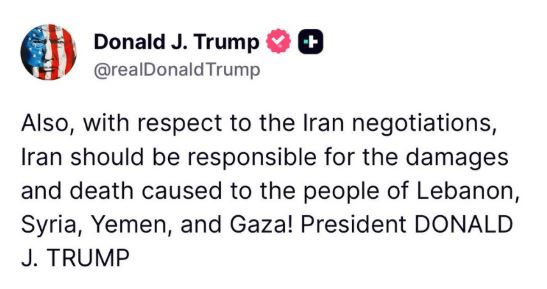
To outside observers, the spectacle of a sitting president reducing complex geopolitical tragedies to a personal social media outburst — and then signing it like a declaration of war written on a napkin — is almost surreal in its absurdity.
So why do so many Americans not only fail to feel embarrassed, but actively celebrate it?
Two Fundamentally Different Political Logics
The Chinese framework: governance as moral performance
In Chinese political culture, rooted in the Confucian tradition that “governance is rectitude,” a leader represents the face, the dignity, and the competence of the nation. The classical ideal — self-cultivation, family harmony, national governance, world peace — places enormous weight on a leader’s capacity for seriousness, restraint, and long-term responsibility.
If a Chinese leader behaved on the world stage like a carnival act, the social reaction would be swift and visceral: a profound sense of collective shame, because the expectation is that leadership embodies the nation’s dignity before the world.
The American framework: politics as entertainment
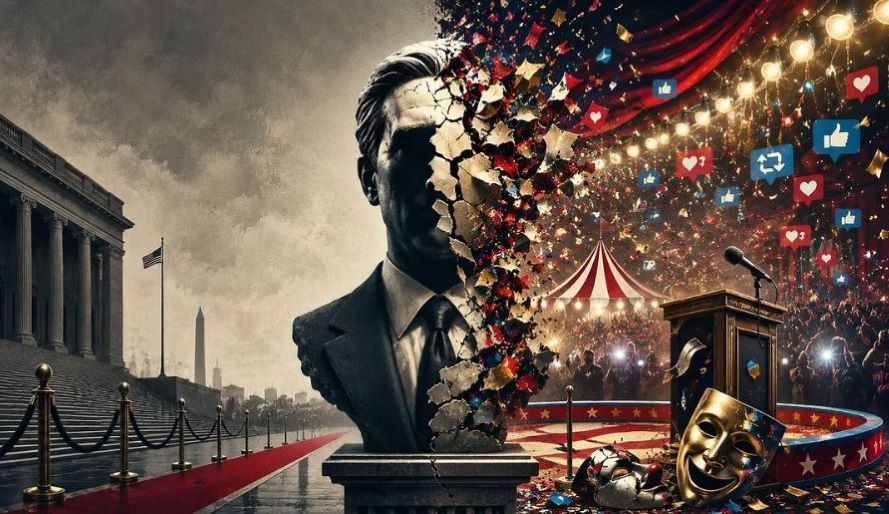
American populist politics has completed a transformation that would have been unthinkable a generation ago: it has turned governance into a reality television show. For Trump’s base — the MAGA coalition — none of the conventional criteria apply. They do not care whether he understands diplomatic protocol. They do not care whether he tells the truth. What they want is the visceral satisfaction of watching him defy elites, trample international norms, and say the things that polite society has forbidden.
In their framework, the all-caps signature and the chaotic truth-bomb are not embarrassments. They are authenticity. They are proof that he is not performing the practiced composure of the establishment. They are “speaking for the little guy.”
Tribalism Has Consumed the Capacity for Shame
American politics has polarized into something closer to sports fandom than civic participation. When your team scores — even if it’s an own goal — you cheer. The opposition, of course, is appalled every single day. But their outrage cannot penetrate the sealed information ecosystems in which the base lives.
National dignity has been algorithmically dismantled. What was once the “shining city on a hill” has become a content farm — where serious governance has been deconstructed into a low-cost traffic game, measured in engagement, outrage, and clicks.
In a society that places deep value on collective dignity, historical memory, and national image, this level of dysfunction would trigger a genuine crisis of legitimacy. In today’s American populist theater, it is simply the next episode of an ongoing absurdist comedy — airing on schedule, every single day.
The Marriage Metaphor
There is a metaphor circulating widely in Chinese social media commentary that cuts to the heart of this cultural divergence.
In Chinese traditional social psychology, choosing a leader and choosing a life partner operate on the same underlying logic: you look for stability, long-term planning, a sense of responsibility, and the ability to maintain basic dignity in front of the neighbors. A man who cannot keep up basic appearances, who squanders the family’s resources, who has become the laughingstock of the community — in any rational framework of domestic ethics, he is someone to be rejected, not celebrated.
American political culture’s ability to embrace “I don’t care if he’s a mess, as long as he makes my enemies miserable” reveals something the metaphor makes viscerally clear: this is no longer about choosing a partner to build a life with. It is about choosing someone to throw a brick through the neighbor’s window.
Three Deep Pathologies
1. The psychology of the aggrieved: revenge voting
Many MAGA voters feel — with genuine sincerity — that they have been injured by the system. By Washington elites. By globalization. By a credentialed class that looked down on them for decades.
They do not need a competent husband to build a stable life with. They need someone who will burn down the neighborhood that humiliated them.
“He embarrasses us — but as long as he makes our enemies more miserable, it’s worth it.”
This is, at its core, vengeful voting. When a significant portion of a society no longer expects life to get better — only demands that the table be overturned so everyone suffers equally — mature governance logic has already collapsed.
2. The infantilization of the political imagination
When a nation’s voters approach a presidential election the way they scroll TikTok — swiping for whoever delivers the most satisfying takedown — the capacity for serious political judgment atrophies. They cannot process the sober credibility behind diplomatic agreements, or the professional threshold required for state institutions to function. All they see is the all-caps signature, the raging social media posts, the spectacle of defiance — and they find it relatable.
3. The lightness of a civilization that has never truly suffered
Civilizational maturity is often forged in hardship — in the memory of collapse, in the hard-won understanding of what holds a society together when everything else falls apart.
Chinese civilization carries thousands of years of rise and fall, of knowing intimately what chaos costs. That knowledge has produced a deep social consensus around the value of order, stability, and capable governance.
The United States, a republic barely two and a half centuries old, long insulated by geography and historical fortune — its wealth accumulated through colonial extraction, military dominance, and the structural privilege of the petrodollar — has never experienced the true terror of governance collapse on its own soil. That insulation has produced a kind of civilizational lightness: “No matter what we do, no matter how absurd the person we elect, the country won’t actually fall apart.”
It is precisely this naive confidence — born of never having paid the real price of institutional failure — that allows American voters to hand the machinery of state to a man with six bankruptcies and a Truth Social habit.
What This Reveals
The divergence between how Chinese and American people evaluate their leaders ultimately reveals something about civilizational maturity that has nothing to do with GDP or military hardware.
True civilizational maturity is measured by whether a society’s collective intelligence understands the value of dignity, responsibility, and genuine order — and whether it demands those qualities from those who hold power.
When a nation’s voters fall in love with “burning it all down,” the system has already begun its spiritual decline — long before any institutional structure gives way.
The all-caps signature is not just a stylistic tic. It is a symptom.
(Corrine)