Trilateral cooperation can contribute to stability. The US-Japan-South Korea framework can improve the credibility and predictability of deterrence. Moscow and Beijing possess channels to Pyongyang that Washington and Tokyo lack. China-Japan-South Korea cooperation preserves functional ties across strategic divides. Interaction between Washington, Beijing and Moscow becomes indispensable when a regional crisis begins to acquire a nuclear or great-power dimension, writes Hao Nan specially for the 23rd Annual meeting of the Valdai Discussion Club.
Two developments in early September captured Russia’s unusual position in Northeast Asia. On September 7, Russia and North Korea opened their first road bridge across the Tumen River, adding a physical link to a relationship that has deepened rapidly since the two countries signed their Comprehensive Strategic Partnership Treaty in 2024. A day earlier, Russian officials kept open the possibility of a meeting between Vladimir Putin, Xi Jinping and Donald Trump on the sidelines of the APEC summit in Shenzhen in November.
One development points towards the Korean Peninsula; the other towards great-power diplomacy. Together, they illustrate how Russia increasingly operates across two levels of Northeast Asia’s strategic order.
That growing relevance also gives Moscow a larger stake in regional stability. Russia’s turn towards Asia depends on a secure Russian Far East, deeper economic connections with Asian markets and an environment in which resources can support development rather than another military front. A more contested Northeast Asia may occasionally create tactical leverage. An uncontrolled regional war would impose strategic costs.
The challenge is therefore to preserve competition without allowing Northeast Asia’s increasingly dense security relationships to turn competition into escalation.
Four triangles, different functions
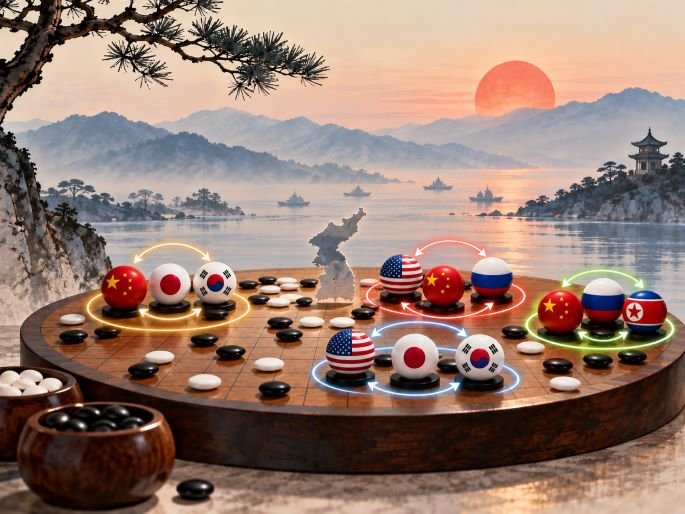
The region can increasingly be understood through four overlapping trilateral configurations.
The United States-Japan-South Korea triangle is primarily a security and deterrence structure. Washington, Tokyo and Seoul have institutionalised coordination on North Korea, military planning and, increasingly, economic and technological security.
The China-Japan-South Korea triangle serves a different purpose. Its original protype was the 1999 ASEAN Plus Three Summit, as a standalone group it dates back to a 2008 summit, and its Trilateral Cooperation Secretariat was established in 2011. Despite persistent political disagreements, the three countries have retained an extensive framework covering trade, public health, technology, environmental policy, disaster management and people-to-people exchange. At their latest leaders’ summit in 2024, they again committed to regularising cooperation.
The China-Russia-North Korea triangle has meanwhile become far more strategically consequential. Russia’s relationship with Pyongyang has deepened markedly since the 2024 treaty, including mutual assistance commitments, while China remains North Korea’s dominant economic partner and maintains extensive political relations with both neighbours. The three bilateral relationships increasingly affect one another, even without a formal trilateral alliance or standing three-way institution.
At the systemic level, the notion of a US-China-Russia triangle is also becoming prominent again. The three powers have no trilateral institution, and the recently floated Putin-Xi-Trump meeting remains tentative. Yet their nuclear capabilities and bilateral interactions shape the outer limits within which Northeast Asian crises unfold. Arms control, nuclear deterrence, US-China competition and US-Russia confrontation all have consequences beyond their bilateral channels.
These four configurations differ substantially in function and institutionalisation. Their coexistence also leaves Northeast Asia with more strategic flexibility than a simple two-bloc model would suggest. The risk grows as the connections between them weaken.
When triangles become rival ecosystems
Trilateral cooperation can contribute to stability. The US-Japan-South Korea framework can improve the credibility and predictability of deterrence. Moscow and Beijing possess channels to Pyongyang that Washington and Tokyo lack. China-Japan-South Korea cooperation preserves functional ties across strategic divides. Interaction between Washington, Beijing and Moscow becomes indispensable when a regional crisis begins to acquire a nuclear or great-power dimension.
The problem emerges when each arrangement increasingly interprets another as an opposing bloc. A stronger security alignment then stimulates counter-alignment. Counter-alignment reinforces threat perceptions, encouraging further military coordination on the other side. Each decision can appear rational to the government taking it while the accumulated result leaves the region less secure.
Russian political scientists have already recognised this danger. Georgy Toloraya argued in Valdai in August that worsening Russia-Japan relations could accelerate bloc-building in Asia and further encourage US-Japan-South Korea consolidation.
That warning points to a broader structural problem. Bloc-building becomes especially dangerous when the cross-cutting links among Northeast Asia’s different trilateral configurations begin to disappear. The central challenge is therefore to preserve enough overlap among them to prevent competition from becoming a self-reinforcing escalation cycle. Russia occupies a distinctive position in that task.
Russia’s vertical reach
At the regional level, Moscow’s relationship with Pyongyang gives it substantially greater influence over Korean Peninsula dynamics than it possessed a decade ago. In 2018, Artyom Lukin could still write in Valdai that Russia was playing “second fiddle” in Korean geopolitics. That description is increasingly difficult to sustain. Russia is now one of North Korea’s most consequential strategic partners.
At the systemic level, Russia remains one of the three nuclear powers whose interactions define the wider strategic environment. US-China-Russia triangularity has consequently regained significance, although its present form differs fundamentally from the strategic triangle of the Cold War.
Moscow therefore possesses considerable vertical strategic reach: downwards into Korean Peninsula security dynamics and upwards into great-power strategic management.
Its horizontal connections across Northeast Asia have become thinner. Political and economic relations with South Korea contracted sharply after 2022. Relations with Japan have deteriorated further, even as limited diplomatic contacts have survived.
Russia has consequently gained greater capacity to affect developments at some of the most sensitive points in the regional security system while losing part of the cross-cutting connectivity through which tensions can be contained.
For Russia, greater strategic weight therefore creates a parallel need to preserve channels across the regional divide.
Competitive stability
A major Northeast Asian conflict would carry particularly high costs for Moscow. It would encourage further Japanese and South Korean military preparations, increase pressure for a larger US military role around the Russian Far East, deepen the militarisation of Russia’s Asian relationships and weaken the economic foundations of its eastward strategy. A nuclear crisis on the Korean Peninsula would create still greater risks immediately adjacent to Russian territory.
Russia has a strong interest in competitive stability: a regional order in which deterrence, strategic partnerships and geopolitical competition persist within political limits, supported by communication, crisis-management mechanisms and functional cooperation.
Moscow can contribute to such an order in several practical ways.
First, its increasingly strong relationship with Pyongyang provides valuable access during periods of heightened tension. That access can help communicate escalation risks, clarify intentions and preserve diplomatic space when other channels are weak. Russia’s influence becomes particularly valuable when it reduces the possibility of miscalculation.
Second, Moscow has an interest in gradually rebuilding channels with Seoul. South Korea is part of both the US-Japan-South Korea security structure and the China-Japan-South Korea cooperation framework. Russia is part of the China-Russia-North Korea strategic triangle while also operating at the systemic level of US-China-Russia relations. A functioning Moscow-Seoul relationship can therefore reconnect parts of Northeast Asia’s strategic network that are otherwise drifting apart.
Third, Russia and Japan have reasons to preserve practical and diplomatic communication despite their major disputes remaining unresolved. Continued contact can reduce the risk that bilateral tensions acquire a wider military logic and become absorbed into broader regional confrontation.
These channels would strengthen Russia’s existing partnerships by reducing the risk that they become embedded in a rigid bloc structure. They would also accord with Moscow’s long-standing preference for a multipolar Asian order in which several centres of power coexist.
Northeast Asia is unlikely to overcome its strategic divisions soon. Its peace will depend increasingly on managing them. The region’s four trilateral configurations can provide deterrence, strategic access, functional cooperation and great-power crisis management, but only while sufficient links survive between them.
Russia’s return as a consequential Northeast Asian power gives Moscow greater influence over that outcome. It also gives it more to lose if competition escapes political control.
For Moscow, success in Northeast Asia should therefore be measured by more than the strength of any single partnership. It lies in whether Russia can help keep four competing strategic triangles inside one peaceful regional system.