We share the interview conducted with Abdulraoof Al-Shayeb, a figure in the Bahraini opposition and secretary general of the Khalaas Islamic Movement, by Press TV.
“The Bahraini regime’s persecution of religious scholars is not a matter of justice, but a political weapon used to suppress dissent and exploit regional tensions. It seeks to silence independent voices and turn the judiciary into an instrument of political repression,” he stated.
“Religious scholars do not pose a threat to national security; they are voices of conscience, dignity, and freedom. The real threat is a regime that fears its own people and criminalizes their aspirations for justice.”
The Bahraini opposition leader stated that no regional considerations can justify the imprisonment of academics or the sacrifice of human dignity, adding that while repression may silence voices, “it can never imprison the truth or extinguish the people’s struggle for freedom.”
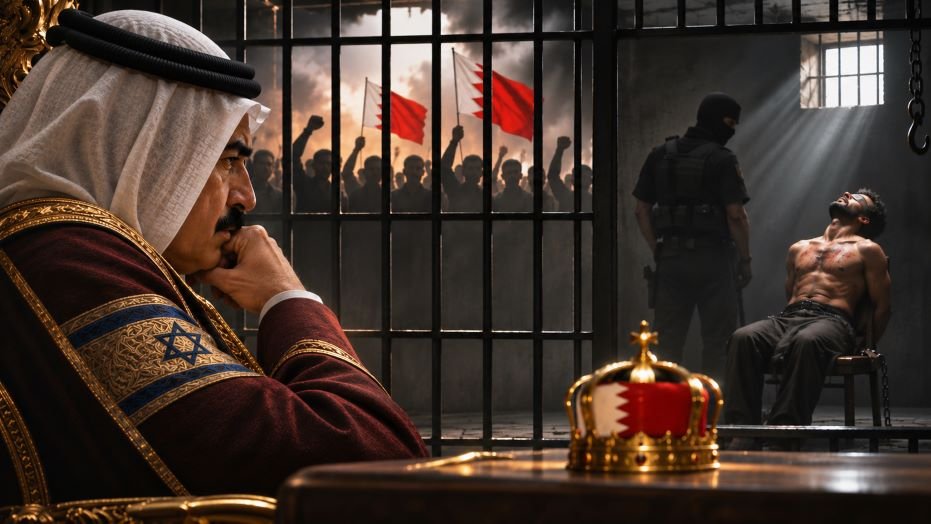
His remarks came amid a wave of demonstrations across Bahrain demanding the release of detained Shiite scholars. The weekend protests spread to Sitra Island, Al-Hamala, Al-Markh, and Iskan Ali, where demonstrators carried portraits of jailed clerics and Sheikh Isa Qassim, the country’s top Shiite leader, who currently resides in Iran.
The organizers dubbed the demonstrations a “Day of Popular Rage” and demanded the release of all detainees, particularly clergy, and the dismissal of all charges against them. Regime forces responded with arrests, detaining at least 25 people through raids and court summonses.
Meanwhile, a local court decided to postpone its verdict until November 22 against 69 defendants, 60 of them clergymen, accused of forming a “terrorist group” and of “conspiring against the constitutional order.”
Fifty-six defendants remained in custody, while 13 clergymen were being tried in absentia in measures deemed unconstitutional by human rights advocates.
The arbitrary proceedings have raised serious concerns among international human rights organizations. The World Organisation Against Torture has stated that the trials are rife with allegations of torture, while other human rights groups have pointed to the use of coerced confessions.
Testimonies documented by the Bahrain Institute for Rights and Democracy describe how the accused were forced to stand, were blindfolded and handcuffed for extended periods, were deprived of sleep, and were threatened with physical and sexual violence against them and their families.
Twenty human rights organizations have called on Bahraini authorities to release those arbitrarily detained, drop charges related to peaceful religious activities, and investigate allegations of torture and ill-treatment.
Similarity between the Manama approach and that of Israel
Al-Shayeb condemned Bahrain’s revocation of citizenship and forced deportation of citizens, calling such measures violations of fundamental rights and international law.
“The revocation of citizenship and the forced deportation of citizens from their homeland constitute a flagrant violation of international law and the Universal Declaration of Human Rights,” he told the Press TV website, emphasizing that citizenship is not a political privilege that an authoritarian regime can withdraw at will.
He drew a parallel between Bahrain’s policies and those of the Israeli occupation of Palestine, stating that they reflect the same approach to dispossession and forced displacement.
“What we are witnessing in Bahrain is identical in methodology and mentality to the practices of the Zionist entity in Palestine: the same logic of dispossession, the same policy of forced displacement, and the same attempt to rob people of their identity and their legitimate belonging to their homeland. Different actors, but the same oppressive mentality.”
Al-Shayeb added that stripping people of their citizenship cannot erase their national identity, their dignity, or their legitimate rights, and stressed that a homeland belongs to its people, not to an authoritarian ruler.
The crackdown has reignited concerns about a long-standing pattern of repression targeting Bahrain’s Shia community, which, ironically, makes up the majority of the country’s population.
The nighttime raids on the homes of clerics began on May 9, while the organization Americans for Democracy and Human Rights in Bahrain has documented the arrest of 53 clerics.
Sheikh Qassim, whose citizenship was revoked in 2016, has urged his followers to peacefully support the accused.
Meanwhile, two human rights groups in Bahrain told AFP that more than 200 people, mostly Shiites, have been detained since the US-Israeli war against Iran began on February 28.
Reuters also reported that 69 citizens of Iranian descent had been stripped of their nationality for condemning the war of aggression.
The current crackdown is reminiscent of the suppression of Bahrain’s pro-democracy movement in 2011, when the Western-backed monarchy crushed popular demands for a democratically elected government with the help of Saudi Arabia and the United Arab Emirates.
Saudi Arabia deployed around 1,000 soldiers along the King Fahd Bridge in March 2011, while the United Arab Emirates sent approximately 500 security personnel.
Silence is complicity
Al-Shayeb urged Muslims, Islamic organizations, and international institutions to take a more active stance against the persecution of Shiites in Bahrain, stressing that mere expressions of concern were not enough.
He stated that Islamic organizations and international bodies have a responsibility to denounce the actions of the ruling regime, mobilize public opinion, and issue unequivocal warnings to the Al Khalifa authorities about the consequences of continuing their repressive policies.
“They must build a strong international public opinion that denounces the systematic violations and strips the Al Khalifa regime of its false image, revealing the reality of its oppression and political persecution,” he said.
“Silence in the face of injustice is complicity, and defending the oppressed is both a moral and humanitarian responsibility.”
In particular, he urged international human rights institutions to go beyond mere statements of concern and to conduct independent investigations, document widespread human rights violations, demand the immediate and unconditional release of academics and prisoners of conscience, and hold Bahraini authorities accountable through international legal and diplomatic mechanisms.
He asserted that constant pressure was also needed to end the ongoing religious persecution, arbitrary arrests, torture, and political repression, and stressed that the prosecution of Shia scholars and political prisoners was not a series of isolated incidents but part of a systematic and organized policy that the ruling authorities have pursued for decades.
Al-Shayeb further warned that the repression reflects systematic sectarian exclusion and an attempt at demographic and religious engineering directed against Bahrain’s predominantly Shia population.
He stated that the international community has a moral, legal, and humanitarian responsibility to confront these hostile policies, warning that silence and inaction amount to complicity.
The Bahraini regime’s strategic ties with Western powers have also been a key factor in the international context of the ongoing repression. The U.S. Navy’s Fifth Fleet is based in Manama, and Washington has designated Bahrain a major non-NATO ally since 2002. The United States has also used its military bases in Persian Gulf countries, including Bahrain, to launch attacks against Iran.
Repression will only strengthen the determination of the Bahraini people.
Meanwhile, Al-Shayeb rejected the idea that the measures taken by Al Khalifa’s regime could eliminate the opposition or suppress the political demands of the Bahraini people.
He added that attacking religious institutions and marginalizing academics, Islamic leaders, and national figures would only exacerbate the regime’s legitimacy crisis and strengthen popular resolve.
“Dictatorship and repression have never managed to extinguish any liberation movement in history; on the contrary, they have often fueled resistance and transformed struggles into the causes of generations,” he stated.
He described a regime that uses imprisonment, exclusion, and persecution to silence its population as pursuing a historical illusion, adding that just demands cannot be erased by imprisoning those who defend them or marginalizing religious and national leaders.
The opposition figure stated that the people of Bahrain, particularly the followers of the Ahl al-Bayt School (peace be upon them), are strengthened by a profound historical and ideological legacy embodied in the enduring motto “Hayhat Minna al-Dhilla”, which means “Far be it from us to be humiliated.”
“This is a principle that prisons cannot extinguish and repression cannot break. Freedom, dignity, and justice are fundamental rights, and Bahrain’s political demands will remain in force until the people achieve their aspirations for freedom, justice, and dignity,” Al-Shayeb declared.