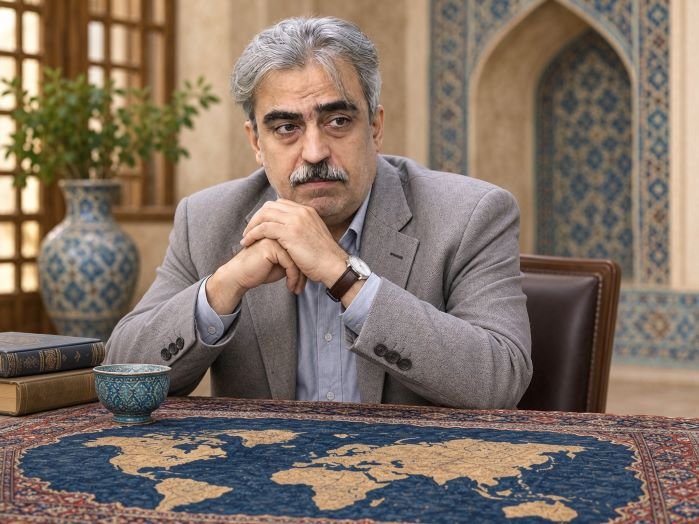
Mostafa Khoshcheshm points to a power shift to the East and a possible hybrid war against China.
Last week, oil exports through the Strait of Hormuz fell to 8.7 million barrels per day, half the level before the war, according to the consulting firm Kpler. Diesel reached US$220 a barrel wholesale, more than double the price before the conflict in the Middle East, and the five largest Western oil companies amassed more than US$50 billion in profit in the third quarter. For Seyed Mostafa Khoshcheshm, this is proof of what he calls Iran’s most powerful weapon. “It’s a weapon millions of times stronger than the atomic bomb,” he told Brasil de Fato. “With an atomic bomb, you hit a country once. With the Strait of Hormuz, you hit the entire planet, repeatedly.”
In the first part of this interview, the Iranian strategist spoke about the new round of war that is expected . Now, he moves from the strait to the world order. From this decade of wars, he predicts, no superpower will emerge, but four major powers — China, India, Russia, and Iran — all in BRICS and the Shanghai Cooperation Organisation.
Khoshcheshm doesn’t believe this transition will be decided solely by missiles. Defeated by Iran, he says, the United States “will have no chance of confronting China” and will resort to hybrid warfare, including biological warfare. “After Iran, it will be China. I believe that, in 2027, we will see the spread of viruses like COVID.” The next battle, he warns, is over artificial intelligence, which will divide the world between “masters and slaves.” The Gulf monarchies that chose the American side have already lost, and their data centers, he says, “will be next” in the third round of the war.
Check out the second part of the exclusive interview for Brasil de Fato.
*
Brasil de Fato: In an article in The Atlantic, Robert Kagan, one of the leading neoconservative thinkers, wrote that the United States suffered the worst strategic defeat in its history and that Iran will emerge as the main regional power. The third round is still to come, but what will Iran be like as a regional power, its relationship with Arab countries, and the future of the United States in the region? Can Iran become a global power?
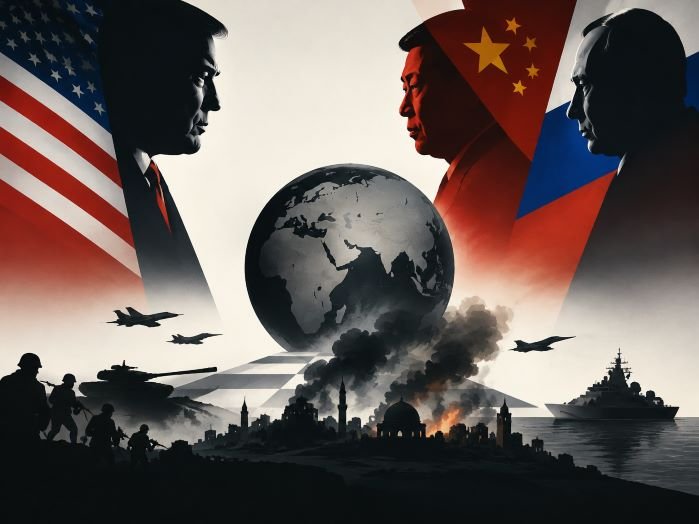
Seyed Mostafa Khoshcheshm: The world has been undergoing a power transition from Western civilization to the East for over a decade; even American and European intellectuals affirm this. For me, the 2020s are the decade of this “painful birth,” and there will be more and more wars. Whoever holds the power, the Western empire led by the United States, will not relinquish it easily. There will be wars and friction, especially with emerging powers: Russia, China, and Iran. Therefore, I believe we will see some form of war against China in 2027 or 2028.
The Chinese are already saying this. They are preparing.
If the United States is defeated by Iran, they will be in no position to confront China. They will resort more to hybrid warfare, which will be completely different. They will resort to biological warfare, to different types of warfare alongside military warfare. Even nuclear warfare. In any case, they are resisting, like the Europeans against Russia.
I believe that, in 2027, we will see the spread of viruses like COVID. The United States will not relinquish power so easily. Trump may like Putin, but there is a deep state that he doesn’t control. They won’t let Russia win everything so easily. If they can’t achieve it militarily, they will do so with biological weapons. The same in China. The same in Iran itself. I know the Americans, their hybrid warfare, the intentions of the deep state, and their behavior. The pattern tells me that when they feel hopeless and defeated, they will unleash asymmetric warfare, new forms of warfare, including this one, and cyberattacks will intensify.
Even in cyberwarfare, it’s like that. Before 2010, before Stuxnet [a computer virus attributed to the United States and Israel that sabotaged centrifuges in the Iranian nuclear program], the world lived in an environment of security threats, with the theft of industrial information and things like that. Stuxnet transformed that into a cyberwar between states. Since then, all the major players have increased this capacity and invested in it in unknown ways. Artificial intelligence is the new version of everything: cyberwarfare, hybrid warfare, in different aspects.
If the world weren’t undergoing a power transition, with wars like this one, the world of the future, for me, would no longer be one of oil or fossil fuels. It would be one of artificial intelligence, with two categories: the masters and the slaves, that is, those who own the AI software and hardware, and the rest. One of the main disputes between the West and the East today is who will be the master of AI in the future. The camps are forming. Saudi Arabia and the Emirates, among the Arab countries of the Persian Gulf, have decided to join the American camp.
And one of the things that these Arab countries in the Persian Gulf have already lost is AI, because they were too dependent on the United States. So far we’ve talked about two wars; the third hasn’t happened yet. Data centers will be next, in the third. That’s one of the things they and Israel will lose. This is very important.
If Biden were in power, the United States would be tougher on Putin.
Without a doubt. With Trump it’s different, he plays too much on Putin’s field.
But wouldn’t that be a strategic calculation? People in Trump’s circle were saying, even before the election, that the war against Russia was a mistake because Russia isn’t the main adversary. He would be ending that war to focus on China.
There is no doubt that Iran is the main ideological enemy of the United States, and China is the economic enemy. But not everything is controllable: sometimes wars simply break out. Or Russia realizes, for example, that an imminent threat is emerging. Perhaps they have done the calculations: if we do this, there will be no war against us; let’s weaken them now, before it’s too late. Because they wouldn’t go to total war, as in the case of Crimea.
After a decade of wars, no superpower will remain: everyone’s capabilities will be exhausted. But power will reside in the East. The new world order that will emerge on the horizon, probably after 2030 or 2032, will be defined by regional and international coalitions such as BRICS and the Shanghai Cooperation Organisation, which are the equivalent of the G7, NATO, and the OECD of the West. The Munich Security Conference [annual forum on international security, in Germany] once occupied center stage; today its rival, the St. Petersburg Conference, is gaining importance and prestige. There will be no superpowers, but these groupings will define the new order.
Most thinkers believe there will be four major powers, not superpowers: China, India, Russia, and Iran. If they stay together, they could start something new in the world. If they fight amongst themselves, there will be chaos throughout the world.
It’s interesting to think that all four are members of BRICS and the Shanghai Cooperation Organisation.
Yes. There are big differences between China and India, but both are in BRICS because they realized that. Now, why would Iran be among them? Economically, it doesn’t compare to the other three. Militarily, China and, above all, Russia are far ahead. The reason is what makes Iran unique: the Axis of Resistance [a regional alliance led by Iran, with Lebanese Hezbollah, Yemeni Ansarullah, Iraqi militias, and Palestinian groups], on land and at sea.
On land, it’s a market of 400 to 500 million people in the most strategic region of the world, the heart of the world: Western Asia, with its energy reserves, minerals, ancient civilizations, and religions, linking north to south and east to west. In the next ten or twenty years, anyone who wants to do business or impose a new world or regional order will have to work with Iran because of this Axis of Resistance that has stood the test of time.
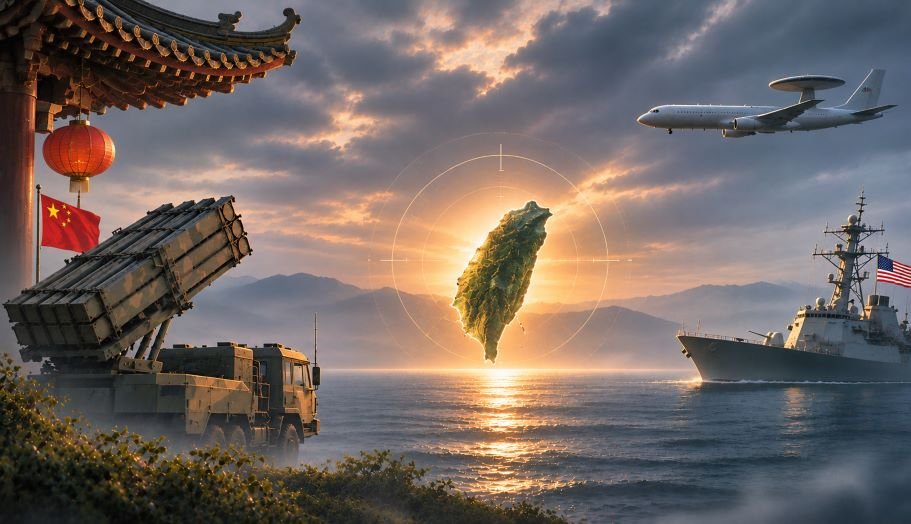
The sea is even more important. There are five strategic straits and canals in the world, such as the Panama Canal, the Suez Canal, the Malacca Canal, the Hormuz Canal, and the Bab al-Mandab Canal. They matter because most of the world’s trade and military movements pass through the sea, and these shortcuts change the time, the cost, the insurance, and the risk. Neither the United States, nor China, nor Russia, nor India, nor Germany, nor France control these five. In Malacca, I believe that if a war breaks out, it will not be over Taiwan, but over control of the strait. Whoever controls Malacca controls the markets and economies of Southeast Asia.
That’s why the United States is advancing so quickly in the Philippines. They had five bases, now they have nine. One of Bongbong Marcos’ [Ferdinand Marcos Jr., president of the Philippines since 2022] first decrees after being elected was to give the Americans four more bases.
Exactly. And Iran controls the Strait of Hormuz, through which a third of the world’s energy passes. Even when there is no longer a superpower called the United States, the Chinese will need the oil that passes through there, so they will need Iran. The other is Bab al-Mandab, under the control of Ansarullah [the Houthi movement, which governs northern Yemen], in Yemen, which is part of the Axis of Resistance. Bab al-Mandab, the Red Sea, and the Suez Canal function like a pipe: what goes in one side comes out the other. After Ansarullah closed Bab al-Mandab in the war that began with the Al-Aqsa Flood [the Hamas offensive against Israel on October 7, 2023], Egypt published three reports in one year saying it had lost 60% of the canal’s revenue and maritime traffic. In other words, Iran, at the head of the Axis of Resistance, controls at least two and a half straits.
This showed me, years ago, that the United States would eventually go to war with Iran, in addition to all the other reasons, like Israel. They can’t accept this while escalating tensions with China in Malacca and with Panama over the Chinese operators in the canal. They won’t leave you alone; they’ll come to fight. Iran will be one of the great powers if it maintains control over these routes, and so far Iran and Ansarullah have proven they can. The world needs you today and will need you tomorrow. All economies have been hit by the closure of the Strait of Hormuz, and even if the strait reopened today, the world’s economies are calculating two more years of expensive oil. We will see even worse economic days in the coming months.
I read a letter from Ali Akbar Velayati [former Iranian Foreign Minister (1981-1997) and advisor to the Supreme Leader on international affairs since then] to Mojtaba Khamenei, proposing an Islamic pole centered on Iran, alongside strategic allies Russia and China, and accompanied by “genuinely non-aligned” countries such as South Africa, Brazil, and Cuba. In April, he called this the world’s “third pole.” Do you share this view? Is there a place for Latin America and Africa?
My view is a little different. I believe that as China, Russia, Iran, and even India gain more power within the BRICS framework, more countries will join. As the dollar loses value and market share worldwide, more countries will feel free to do as they please, including Latin American countries. They will strengthen economic and political ties with these countries, depending on India’s future policies, and will join BRICS.
But this will not happen in the coming years. After a decade of shocks and wars, everyone will be weak, and there will be disorder in the world. Then regional coalitions will emerge: Latin America will form its own, because it has common interests and threats. At the same time, BRICS and the Shanghai Cooperation Organisation will gain importance, because there will be a power vacuum, and part of the world will be free from the yoke of the West. The world will need a new order, but it will not accept one like the post-World War II order, the Western order, with its categories of masters and slaves. Everyone will have a greater share, even if these four great powers are the standard-bearers.
And what about the relationship with the Arab countries?
Iran very much wants to promote unity among Muslims and wants to be a friend of these nations because it has one priority: to defeat its main enemy, Israel and the United States. It doesn’t want friction. We believe that “divide and conquer” has always been British policy. They divided us, fragmented the Umma, the community of the Islamic people, beyond national borders.
But this doesn’t happen overnight; there are stages. In the case of the Arab countries of the Persian Gulf, the first is to win this war and maintain control of Hormuz, which Iran has always held. This will be the instrument to redefine geopolitical, strategic, and neighborly relations because it is a weapon millions of times more powerful than the atomic bomb. With an atomic bomb, you hit a country once. With the Strait of Hormuz, you hit the entire planet, repeatedly. Since World War II, no one has managed to affect US Treasury interest rates, oil prices, and US inflation as much as this.
Iran will not use this weapon to colonize these countries, but to mend relations with them. What does this mean? The United States is an enemy that attacked Iran using the territory of these countries as a launching pad. Therefore, there should be no US bases there. Israel cooperates closely with the Emirates and others, even the Saudis. Iran wants Israel out. After they show that they pose no threat, there will be relations on an equal footing, healthy, because we have common threats and enemies.
How do we know this will be the case? Under President Raisi’s government, Foreign Minister Amir Abdullahian launched a plan for dialogue and a regional security forum with Arab countries: the six Gulf countries, plus Iran and Iraq, the so-called “six plus two.” The idea was to guarantee each other’s security without countries from outside the region interfering. Iran had already taken these first steps before the war. It wants to repair ties with Arab countries, but only after they abandon Israel and the United States and stop allowing Mossad, the CIA, and others to attack Iran. You can’t fight everyone forever. We have a clear objective and a clear plan for the future.
You’ve been preparing for this for decades, haven’t you?
For decades we have been preparing for this war and for the Strait of Hormuz, because we knew that one day it would happen, sooner or later. If not now, then in the next 20 years.
The Pentagon’s budget is 100 times larger than Iran’s military budget. By earthly, military, and economic logic, they should have defeated Iran in the first few days. Why didn’t they? Everyone is surprised, and it’s not just because of the asymmetric warfare we practice. Might makes right.