
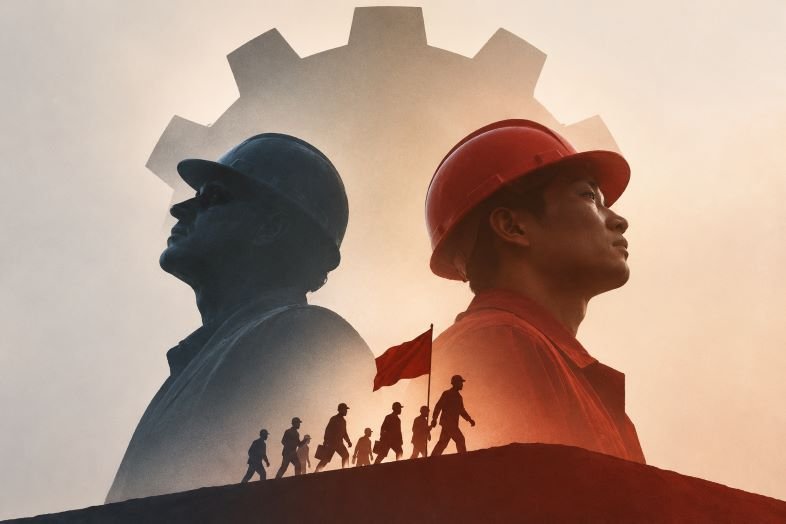
Immanuel Ness’s account of Chinese labor unions challenges the assumption that workers exercise power only by distancing themselves from the state and argues that, after revolution, the working class must be judged by its capacity to exercise power.
Immanuel Ness’s Dialectics of Chinese Labor, aptly subtitled Trade Unions under Market Socialism, gives us a picture of how unions operate in China. More importantly, it lays out a critique of our own assumptions about union organizing. We are accustomed to hearing that Chinese unions are mere puppets of the state, docile beside their militant Western counterparts, a Byzantine bureaucracy with little bearing on the immediate lives of workers. I offer five sideways reflections on Ness’s book and on what our judgments about Chinese unions reveal of our own ideological presuppositions about unions in capitalist liberal societies.
1. There are bad questions
It is easy to anticipate the questions raised against a text like this. If Chinese trade unions are affiliated with the Communist Party, are they really independent? If the Party determines the political line, can we really talk about a workers’ democracy? How do workers discipline the Party when it goes off track?
There is a prejudice at work when the first question is allowed to settle the other two. We take the historical position of trade unions under capitalism as universal. We assume that workers exercise power principally through their distance from the state, that militancy is the measure of class consciousness, and that the confrontation between workers and political authority is always antagonistic.
But what if the working class has already conquered state power through revolution? That is the historical question Ness places before us. How do Chinese workers exercise the freedoms won through their revolution? To answer, we must first distinguish the capacity to resist power from the capacity to exercise it.
2. The limits of Western trade union militancy
A union organizes a strike. After weeks or months on the picket line, the workers secure a better contract. We celebrate this as an expression of working-class power and rightly recognize the collective struggle required to achieve it. But what has changed in the balance of class forces? Workers have secured better wages and conditions, yet the capitalist class continues to command production, investment, and the state. The union has improved the terms of exploitation without necessarily changing the relations that reproduce it.
Consider Ness’s discussion of the 1981 air traffic controllers’ strike. Their union, the Professional Air Traffic Controllers Organization (PATCO), had endorsed Ronald Reagan for president. When its members struck against his administration, Reagan fired the strikers and the union lost its certification. What does militancy mean when the capitalist state retains the power to destroy the organization exercising it? A union can be extraordinarily militant in fighting for its members while remaining reformist, even reactionary, in its politics.
What is revealed is not the ill intent of unions but the material conditions which lead to these circumstances. The same union that fights an employer over wages may find itself defending the profitability of the industry on which its members depend. And in the imperialist countries, the capital on whose continued accumulation those livelihoods depend on reproduces itself through imperialism. The political question concerns the union’s relation to the conditions upon which its own gains depend. To what extent does its struggle challenge those conditions? Militancy is a form of class struggle. To judge its significance, we still have to ask what the workers are organized to achieve and which class holds state power.
3. Revolution changes the function of unions in the class struggle
What is the core Leninist distinction in Ness’s book? The proletarian revolution does not abolish class struggle overnight. It restructures the political conditions under which class struggle takes place. In China, private enterprises continue to exploit workers, giving rise to conflicts between labour and management. But the working class now possesses something it previously lacked, a revolutionary Party exercising state power and committed to a socialist transition. The union can conduct its struggles through a relationship with the revolutionary institutions of the state.
Returning to Lenin’s 1922 writings on trade unions under the New Economic Policy, Ness recalls Lenin’s insistence that unions must combat bureaucratic distortions and mediate conflicts between workers and the institutions of the proletarian state. Workers still required an organization capable of defending them, including against the managers of state enterprises. To bring such a conflict to light and resolve it in the interests of the workers was itself a means of strengthening proletarian political power.
The union organizes workers around their immediate material interests. The Party must organize the general historical interests of the class through political leadership and the development of the productive forces. They function as mutually determining negations. The union may have to oppose a decision taken in the name of socialist construction, and the Party depends upon the union’s capacity to do so if it is to know what that decision means for the workers who must carry it out. Without the union, the Party risks becoming detached from the actual material conditions of the class it leads. Without the political power won through revolution, the union confronts the familiar limits of what it can compel capital to concede.
Ness’s concept of holistic unionism brings together three dimensions of that struggle. There is the economic struggle over wages and conditions, the political struggle over state power, and the historical struggle over whether society reproduces capitalist relations or develops the conditions for their supersession. The union stands at the immediate, first moment of this dialectic, where workers confront capital in the course of their daily labour. The conquest of state power makes it possible to carry that struggle further. How it does so is a matter of concrete practice.
4. The dialectical movement of Chinese unionism
Consider Ness’s account of food-delivery workers in Shanghai. The development of digital platforms brought with it a change in the organization of production. A single platform, Ele.me, could coordinate the labour of thousands of riders through an algorithm, while subcontracting it divided those same workers among different employers across the city. The factory had brought workers together at the point of production. Where was the union to find these workers, and on what basis could it organize them? To organize each contractor separately would carry into the union the very division the platform had imposed upon the workers.
The Shanghai Federation of Trade Unions sent an organizer to take up delivery work. The union investigated compensation, safety, and employment relations, surveyed riders, and visited delivery stations. Ele.me had reservations about what unionization would cost. With the support of the Shanghai federation and the Putuo District Committee, a union secured recognition across contractors and came to represent some 16,000 workers. What matters here is the organizational form the union developed. Workers whom the platform already treated as a single workforce for the purpose of assigning deliveries could now be represented across the divisions under which they were employed.
Ness gives a further example from Wuhu in 2025. Union officials accompanied delivery riders to investigate their conditions of work. Zhang Chunliu followed a rider expected to complete twenty deliveries in two hours. A restaurant could keep the rider waiting. A residential compound could prohibit bicycles. The meal still had to be carried up several flights of stairs, and every delay cut into what the rider could earn. The investigation informed training for new riders, improvements to union service stations, and work on policies (at the state level) for allocating orders during peak hours. The Wuhu federation also made such fieldwork compulsory for its own officials.
Here we can trace the concrete movement of the dialectic. The development of the productive forces transforms the composition of the working class. This transformation obliges the union to change how it organizes. Through social investigation, the union comes to understand the contradictions of the new labour process. Through its relationship with the party, it possesses the political capacity to intervene in the conditions that gave rise to those contradictions. Training may help a rider meet the schedule. Once the allocation of orders becomes a matter for collective intervention, the labour process itself comes into question.
This is reminiscent of Mao’s mass line. A Party directive sent union officials out to investigate new forms of employment. What they learned from the riders returned to the workers in the practical activity of the union and changed what the federation required of its own officials. And the movement does not end there. Any change in how orders are assigned will have consequences best known to those who must deliver them. It is to the workers that the union must return to learn what its intervention has achieved and what contradictions have arisen in turn.
5. Towards the higher questions
We can now return to the question with which we began. How do workers discipline the Party when it goes off track? Posed this way, the question assumes that workers enter politics once the Party has made an error. Ness gives us occasion to ask how the organized experience of workers enters into the formation of the political line in the first place.
First, how does the union mediate between the immediate interests of workers and the general historical interests of the working class? A demand may be legitimate in its immediate content and still come into conflict with the longer-term development of the productive forces. But who is in a position to determine that such a conflict exists? We cannot simply declare that the Party represents historical interests and that workers represent immediate ones. Both the long-term interests of the workers and the immediate authority of the Party have to be worked out through a concrete practice between the Party and the unions.
Second, how does the changing organization of the working class transform the political leadership of the Party itself? Ness shows how the Party directs the unions and how the unions respond to workers’ changing conditions. The dialectical movement must also operate in the other direction. In Wuhu, the riders’ experience altered the practice of the federation. How does that experience, organized through the union, become a means of developing and correcting the Party’s political line?
Finally, how do we distinguish improvements in workers’ conditions under market socialism from transformations in the relations of production themselves? A rider’s objection to an impossible schedule is immediate enough. Pursued collectively, it raises the question of who commands the labour process. To what extent can the riders’ growing organization enable them to exercise collective authority over the conditions under which they work?
The Party cannot replace the union, and the union cannot replace the Party. The Chinese Revolution laid the historical foundation for their unity. A common historical objective still has to be realized through the organized activity of the working class, including when workers have reason to contest what is done in the name of socialist development. Here, to my mind, lies the significance of Ness’s book. Once we grasp the distinction between the capacity to resist power and the capacity to exercise it, we can ask how the working class uses the institutions won through its revolution to carry on the class struggle and advance the transition to socialist relations of production.
Mahyar Mohaghegh Dolatabadi is a PhD candidate in Political Science at York University.