
Lire la version originale en français
Any attempt to understand the upheavals currently shaking France, as well as other European countries, cannot afford to overlook the concurrent transatlantic developments whose origins lie beyond national borders.
The French government’s dual allegiance to both American camps, Democrats and Republicans alike, is so unconditional that French citizens find themselves ostracized whenever their views are deemed incompatible with the prevailing media orthodoxy. As a result, anyone wishing to participate, in one way or another, in the political life of their country must first obtain a seal of approval from the political and media elites — most of whom have never been elected and therefore feel little need to concern themselves with the constraints of democratic accountability.
Contrary to what one might think, this seal of approval is not obtained by joining a particular social organization or political party, but rather through a certificate of moral respectability bestowed by an oligarchic caste whose headquarters are in Washington, whose subsidiaries are in London and Brussels, and whose source of inspiration is in Tel Aviv.
Under these circumstances, any attempt to understand the upheavals currently shaking France, as well as other European countries, cannot afford to overlook the concurrent transatlantic developments whose origins lie beyond national borders.
From American Strategy to the French Political Landscape
French political formations are well established and have been around for decades. What is less familiar, however, is their ongoing realignment aimed at structurally coordinating the policies of the French government with Washington’s geopolitical strategy. Let us set aside the euphemisms of presidential election campaigns: in the recent period following Donald Trump’s re-election, the US roadmap for the European bloc was laid out as early as February 2025.
We have discussed elsewhere the implications of JD Vance’s speech at the Munich Security Conference, delivered one month after Donald Trump’s return to office. The message then seemed unequivocal: pursuing American geostrategic objectives requires the main ultra-nationalist European parties—the Rassemblement National in France—to assume a prominent position in the continent’s political chessboard. Much to the dismay, therefore, of the traditional liberal-democratic parties (left, right, and center), which will have to adapt to this new architecture, either by sharing power or by radicalizing their rhetoric. Much to the dismay, too, of the radical left parties, which such a reconfiguration inevitably turns from peripheral political formations into scapegoats—as is now the case with La France Insoumise (which Boris Vian would surely have dubbed La Gloïre).
A year later, speaking from the same podium in Munich, Secretary of State and National Security Advisor Marco Rubio invoked the familial and religious ties binding the United States and Europe, urging European countries to join Washington in revitalizing Western civilization, which he described as “the greatest civilization in the history of humanity”. To achieve this, Marco Rubio advocates a return to colonial wars of conquest.
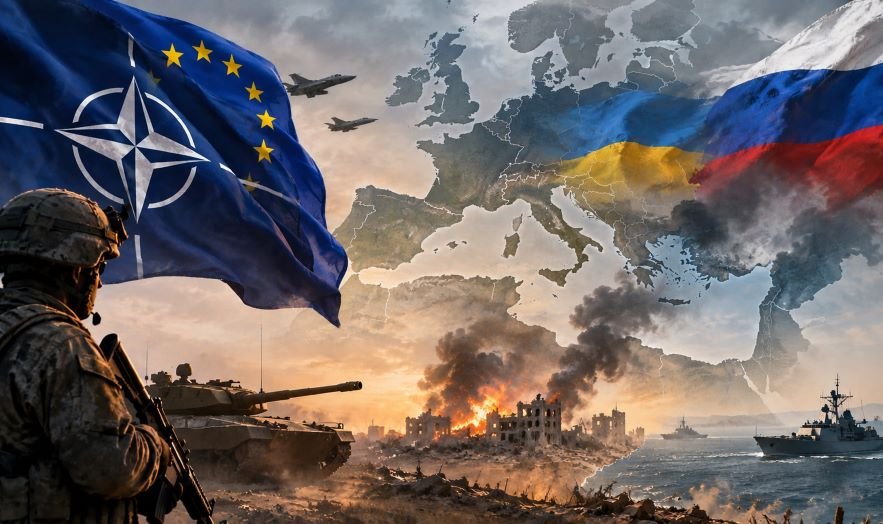
In other words, Vice President JD Vance invoked freedom of expression to legitimize xenophobic policies (which go hand in hand with wars of aggression) across Europe, while Marco Rubio invoked the shared genealogical roots of Washington and Brussels to rehabilitate the supremacist ideology of the Crusades. The slogan “Peace through strength”, repeatedly trumpeted by Pete Hegseth, the Secretary of Defense who was swiftly transformed into the Secretary of War, further confirms the Atlanticist roadmap. Not to mention that this slogan was accompanied by Washington’s demand that NATO members raise their defence spending to 5% of GDP. Between February 2025 and February 2026, therefore, the groundwork was laid for the normalization of neo-fascism within the European Union and neo-imperialism beyond its borders.
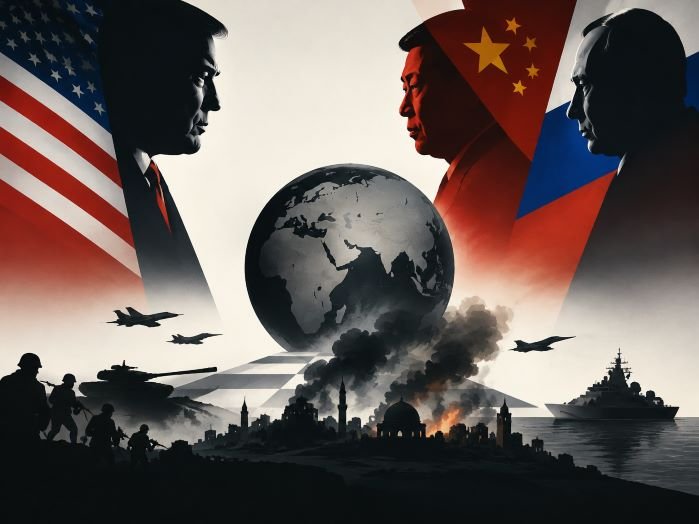
In reality, this reconfiguration of the European political landscape had already been set in motion under previous US administrations, including the Democratic administration of Biden—the very administration that had set in motion the war in Ukraine and other neo-imperialist wars in Africa and the Middle East. The MAGA administration has ultimately done little more than pursue the same neo-militarist objectives as the Democrats, making occasional adjustments to US imperialist strategy, particularly with regard to Russia.
This means that the fascistization of Western societies is an imperative for Democrats and Republicans alike. Without such fascistization, it is impossible to force European populations to confine themselves to the narratives propagated by the mainstream media, which relentlessly call for an escalation of the war in Ukraine while endlessly glorifying the Israeli massacres in occupied Palestine, Syria, Lebanon, Iraq, Iran and Yemen — which, moreover, is hardly surprising, given that these massacres are funded entirely by the Euro-Atlantic bloc.
One thing is certain: the American call for the fascistization of European societies has been heeded in most European capitals. And where the American message has fallen on deaf ears, the European Union, acting as Washington’s proxy in Europe, has stepped in to bring things back into line. In many cases, this has meant backing pro-Democrat forces at the expense of pro-Republican ones — as was the case in Romania and, more recently, in Poland. The same trend is currently unfolding in France, where the overwhelming majority of the media are celebrating the Democrats’ victory in the US midterm elections, seeing it as paving the way for an escalation of the war against Moscow.
One question remains: why did the Trump administration task Europe’s ultra-nationalist parties, which are sympathetic to Israel’s ultra-fascist far right, with adopting a conciliatory stance towards Moscow, when one of Russia’s stated objectives is the denazification of Ukraine? The answer may lie in the “Board of Peace” established by the US president. Donald Trump has decreed that he will serve as its chairman for life, with exclusive veto powers — which essentially amounts to the following: “We are prepared to conclude a non-aggression pact with the Russians [by handing the baton to the Europeans? By taking the time to strangle Tehran and Beijing?], but the Greater Israel project is non-negotiable.” This antagonism, of course, also serves to fracture European societies and further entrench their fascistization: if you oppose the NATO-Russia war, you must support the genocide in Palestine, and vice versa. One need only observe the political and media treatment meted out to Jean-Luc Mélenchon’s party in France to understand that opposing all Western imperialist wars simultaneously is simply not an option.
Imposing the American Road Map on the French Population
Despite its frustrations over the Trump administration’s cuts in financial aid to Ukraine, the French government appears to be fully aligned with Washington’s roadmap of neo-fascism within the EU’s borders and neo-imperialism beyond them.
As early as October 2023, the staunchest advocates of the hardline Zionist position in France began restoring the RN’s political respectability in France, following the party’s unconditional support for Israel. This normalization helped make the radicalization of centrist parties’ rhetoric seem increasingly acceptable. Indeed, the governing coalition has steadily shifted to the right, in tandem with the media narrative, following the RN’s lead — a discourse itself modelled on that of the MAGA administration. Meanwhile, LFI figures who advocate good-neighbourly relations with Russia and have consistently denounced the genocide of the Palestinians continue to be targeted, detained on charges of “apologie du terrorisme” (defence of terrorism), and subjected to public vilification by media outlets complicit in the establishment of a neo-fascist order.
In recent weeks, the unusual spread of chaos across French cities, coupled with particularly violent methods of repression, has pointed to the use of counterinsurgency tactics directly inspired by the ideologies of fascist military dictatorships. The government’s apparent objective is to deter the population from taking to the streets, notably by seeking to neutralize social movement leaders and any organization capable of acting as a legitimate counterweight to state power.
In light of these observations, it becomes easier to understand that the events unfolding alongside the social mobilizations in France were no mere coincidences.
When credit rating agencies and financial institutions urge the French Parliament to pass the government’s proposed 2027 budget — a budget that envisages drastic cuts in public spending at a time when household living standards are collapsing — the clear objective is to redirect that spending towards security and defence. Thus, in utter disregard for the social demands shaking the country, Moody’s threatened to downgrade France’s credit rating before agreeing to maintain it subject to conditions, namely, parliamentary approval of the budget and a reduction in social unrest! Similarly, Emmanuel Moulin, Governor of the Banque de France, warned in the columns of the Financial Times that failure by the French Parliament to pass the proposed government budget could send borrowing costs soaring and undermine investor confidence. These pressures brought to bear on the French Parliament and the French population amount to nothing less than blackmail: either you give in, or you will face a real austerity programme. Chancellor Merz was even more explicit: Germany will block the EU’s seven-year budget for 2028–2034 unless member states agree to increase financial assistance to Ukraine.
The drone incident over Toulon appears to fit into the same pattern of redirecting public spending towards a war economy. During military exercises conducted between 5 and 16 October, “suspicious” drones (implicitly identified as Russian) allegedly flew over the Toulon naval base. Political leaders were quick to call for stronger defence systems at the naval base, which serves as a strategic infrastructure hub for the Atlantic bloc — once again implying an increase in military spending.
But Russia is not the only target. Just recently, the European Parliament adopted a resolution aimed at countering “Islamist infiltration and the influence of the Muslim Brotherhood network”, singling out “actors linked to Qatar or Turkey”. Against the backdrop of an emerging security alliance between Washington, Israel, Greece and Cyprus, we know that France has signed an agreement with the Greek Cypriot Administration of Southern Cyprus (GCASC), authorizing the deployment of French troops in the southern part of Cyprus, an island whose northern part remains under Turkish control. This development, together with the decision to deploy French troops to Saudi Arabia, also means diverting funds from education, healthcare and infrastructure in order to finance neo-militarist projects.
Of course, the European Parliament’s resolution also brings Algeria to mind. As a strategic partner of Russia, Algeria is once again at the centre of concerns over a possible escalation of tensions between Paris and Algiers — whether through the millions of French citizens of Algerian descent living in France, through Morocco, a signatory to the Abraham Accords, or through the Alliance of Sahel States (AES), with which Algeria has drawn significantly closer as it seeks to complete its emancipation from the colonial yoke.
Finally, the reference to Qatar in the European Parliament’s resolution inevitably brings Palestine into the picture and, by extension, the members of the Axis of Resistance — particularly Iran — even though they do not subscribe to the Muslim Brotherhood’s ideology. Moreover, the Paris police prefect recently banned a demonstration “against the genocide in Gaza and in support of respect for the ceasefire”, at the request of the Interior Minister. Surely, only France’s continued support for the genocidal wars waged by the Zionist regime can explain such cynical ministerial decisions. This time, however, the country’s honour has been salvaged, as the ban was subsequently suspended by the administrative court.
So this is where things stand: a neo-fascist order designed to pave the way for supremacist wars — with the bloodshed yet to come as the next surprise! — imposed by Washington and endorsed by London, Paris and Berlin. One question remains unanswered: will the French be expected to sacrifice their children before or after the 2027 presidential election?