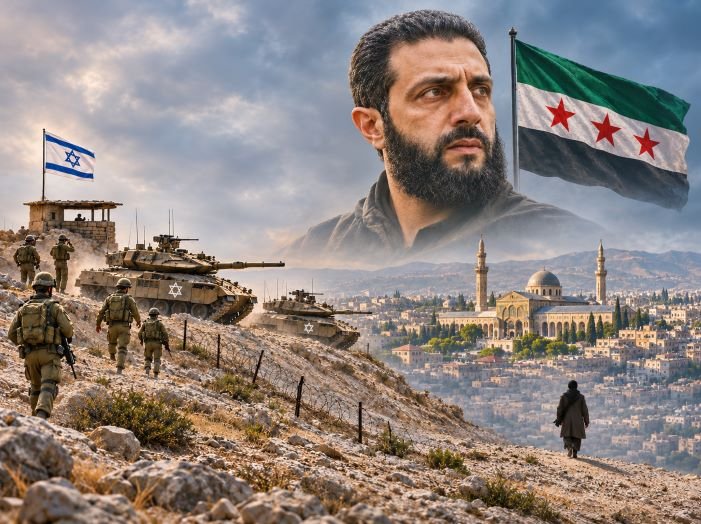
Standing atop Mount Hermon at an elevation of 2,814 meters, and angling a military-grade high-powered binocular downward, you can make out the streets of central Damascus with startling clarity. The two points are barely 40 kilometers apart in a straight line. This strategic high ground commanding the throat of Syria’s capital is now firmly under the boots of Israeli troops. A blue-and-white flag flies from the summit, radar antennas rotate around the clock, and Israel achieved all of it without firing so much as a shot.
Once the mountain was taken, the plain below suffered the same fate. On November 5, Israeli armored convoys bulldozed away border markers and drove directly into Syria’s southern Quneitra and Daraa provinces. By November 8, fourteen armored patrol vehicles had entered the village of West Samadaniya in Quneitra in single file. Soldiers sealed off the intersections with rifles in hand, smashed open a middle school’s gate with rifle butts, detained the teachers and students inside, and then searched nearby homes. At the same time, the area around the Mantara Dam farther south came under air attack. A water pipeline burst, sending the reservoir’s water spilling across the ground.
As Israeli forces pressed forward step by step, Syrian state television broadcast images of border villages being shelled for days on end. Mortar craters pocked the mud, yet there was no sign of a Syrian military counterattack. Ahmad al-Sharaa, also known as Jolani, issued only one military order: retreat. The authorities said this was unilateral restraint, trying to project an image of rationality. In the end, they skipped even the most basic attempt to block the advance.
The transition from autumn to winter is the prime olive-picking season in southern Syria, and local farmers depend on that harvest for the entire year. Israeli bulldozers drove straight into the orchards. In Hanout, machinery tore more than 300 mature olive trees out by the roots. In the town of Rafid, soldiers strung barbed wire around the perimeter of the orchards and used loudspeakers to drive away farmers. Anyone who hesitated was met with warning shots fired into the air. In Taranja, incendiary rounds landed in the fields; fanned by the wind, the flames reduced the orchards to ruins. Israeli forces set up permanent checkpoints at the village entrance, searched residents coming and going, and recorded the names and license plates of every household.
Israel’s seizure of land is highly methodical. Since April last year, it has built seven military bases in Quneitra and three outposts in Daraa, while bringing in heavy machinery to construct a military road known as Route 53. The patrol road is eight meters wide, with towering earth berms piled up on both sides and deep trenches dug along the outside. Villages such as Hadar and Jabata al-Khashab have been cut apart. Tens of thousands of feddans of farmland have been severed by the road, while existing irrigation channels have been buried under dirt. At the same time, the Israeli cabinet had already approved a special budget to accelerate settlement expansion in the Katzrin area of the Golan Heights, with plans to move in 3,000 families. Control the water, destroy the farmland, level the homes, build roads and houses: this land-grabbing playbook has been implemented with extraordinary ease in southern Syria.
As civilians along the border are trapped in misery, the international response has been deeply divided.
On November 18, representatives from several European countries gathered in Berlin. German Chancellor Friedrich Merz urged every EU member state to scrape together €70 billion in aid for Ukraine, while European Commission President Ursula von der Leyen proposed an additional €45 billion in loans. They spoke repeatedly of defending Ukraine’s territorial integrity. Yet when it came to the situation in southern Syria, the EU could not even bring itself to issue a statement of condemnation. When Europe’s countries face a moment that matters, they all pretend not to hear and not to see.
Across the Arab world, only Saudi Arabia issued a public protest. In a statement released on November 17, the Saudi Foreign Ministry explicitly accused Israel’s military operations on Syrian territory of trampling international norms. It demanded that Israel immediately stop and withdraw, and comply with the 1974 Agreement on Disengagement. Saudi Arabia is already overwhelmed by security crises in the Red Sea and Yemen, struggling every day to keep up. But as a matter of law, it had to submit a diplomatic protest and preserve the Arab world’s dignity.
The chain of events began with the collapse of the Assad regime.
During Assad’s rule, the Syrian army maintained organized artillery positions, minefields, and surface-to-air missiles along the Golan Heights. Israel had air superiority, but any ground advance still had to reckon with the possibility of heavy fire in return. The first military order issued after Sharaa seized power was to disband all of the former government forces stationed along the contact line on the Golan Heights. In his view, these remnants of the old regime could become a threat behind his lines at any moment. Elite units were stripped of their weapons and dispersed on the spot, while heavy weapons were hauled back to the rear. Damascus had effectively opened its own southern gateway.
The loss of control destroyed Damascus’s credibility, and Sharaa tried to claw back some ground through negotiations. On April 17, he publicly declared that Damascus was seeking a new security arrangement, with the goal of returning to the framework of the 1974 agreement. On August 23, with the United States acting as intermediary, Syrian and Israeli representatives held closed-door talks in Amman. The Syrian side asked Israel to stop bombing villages and withdraw from the buffer zone. Yet just 48 hours after the talks ended, Israeli Defense Minister Israel Katz flew by helicopter to a forward bunker atop Mount Hermon. Facing the cameras, Katz declared that Israeli forces would never withdraw from Mount Hermon or the surrounding occupied areas, citing security threats inside Syria. The delegation Damascus had sent to the table had no cards to play. Its demands were rendered worthless.
The reason Sharaa keeps retreating is simple: he cannot fight a conventional war.
The armed forces under his command are light infantry formations shaped by mountain guerrilla warfare. They have no battlefield air-defense system, no air-force cover, and no sizable armored strike force. After taking Damascus, Sharaa inherited an empty central treasury, factions nursing their own agendas, and a daily struggle to collect territory, seize tax revenues, and guard against internal revolt. If he sent what little strength he had to confront Israel over a handful of southern villages, the fighting would reach the capital and his domestic rivals would overthrow him at once. To preserve his grip on power, he can only swallow the humiliation.
The people who once shouted praise online have fallen silent. Bread prices in Damascus have doubled, while electricity has been cut to just two hours a day. Amari, the journalist who once celebrated the new era, can now do little more than plead on social media. He says the new regime has no intention of making an enemy of Israel and begs Israeli forces to stop their operation, warning that otherwise local media will change their stance. In the face of bulldozers and tanks, such a feeble appeal weighs no more than a gust of wind. No one will give it a second look.
The United States publicly calls for restraint while quietly pushing Syria to bow to Israel and compromise, folding the country into a new Middle Eastern order. It therefore has no reason to obstruct Israel as it establishes a security buffer. Europe is no different. Its attention has been consumed by the fighting in Eastern Europe; as long as the Mediterranean does not produce a new wave of refugees, it simply does not care what happens to Syria. With no outside force to stop it and no local force willing to strike back, Israel has continued its unrestrained advance northward.
The radar on Mount Hermon now looks down from above and has Damascus locked in its sights. Protests from government offices cannot stop the barbed wire stretching northward. As for a regime that dares not fire even a single shot, it can only watch while its adversary pushes the new border right up to its doorstep.