
In the Middle East, the current war reveals the gradual collapse of the myth of American omnipotence, long presented as insurmountable. Ironically, Washington’s triumphant rhetoric is now clashing with an increasingly unfavorable strategic reality.
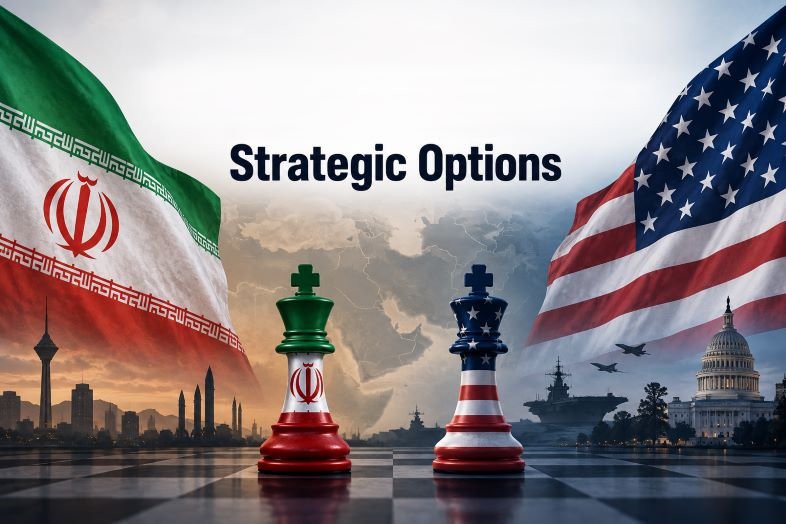
From the 12 days’ war of 2025 to the military escalation triggered on February 28, 2026, the Middle East has once again become the epicenter of a global strategic confrontation. The clash between Washington/Tel Aviv and Tehran now transcends mere regional rivalry. It exposes a profound transformation of the balance of power and reveals the historical erosion of Western hegemony.
Understanding this transformation requires observing several closely intertwined dynamics: first, the inaugural moment when Western power ceases to appear invincible; second, the current war which transforms the demonstration of force into a conflict of strategic attrition; and finally, the political and moral contradictions of a regional and Western order based on fragile balances and selective narratives.
From this perspective, the Iranian resistance already signals a historic turning point: the ongoing war bears the hallmarks of a strategic victory for Iran and a structural failure for the American-Israeli coalition and its Western backers. This conflict marks the moment when the imperial order based on American military dominance begins to give way to a new global balance. The ultimate consequence of this balance could be the emergence of an international peace free from hegemonic forces.
The moment when hyperpower falters
The history of empires is not always written in grand, spectacular defeats. It often manifests itself in discreet cracks, in those moments when power ceases to be unchallenged and becomes merely contestable. The twelve-day war of 2025 is precisely one of these pivotal moments.
Under the leadership of the Trump administration and the Netanyahu government, the US-Israeli coalition launched a series of strikes against several strategic Iranian infrastructures. The stated objective was to prevent Iran from consolidating its military capabilities and to reaffirm Western deterrence in the region.
But beyond the stated objectives, the strategic logic is clear: to remind everyone that Washington remains the ultimate arbiter of the Middle East.
Since the end of the Cold War in 1991, following the collapse of the Soviet Union, the United States has built a military apparatus in the region without historical precedent. Permanent naval fleets patrol the Gulf. Gigantic air bases stretch from Qatar to Bahrain. Missile defense systems blanket allied territories. All of this is to protect the Zionist entity established on Palestinian territory in 1948: Israel.
This military apparatus gives rise to a deeply rooted conviction in Western strategic circles: technological superiority guarantees strategic dominance.
The war of 2025 shatters this certainty.
Iran’s response is striking with unexpected intensity. Ballistic missiles are streaking across the skies of the Middle East. Swarms of drones are overwhelming defense systems. Several American and Israeli military installations are suffering direct hits.
The most important phenomenon is not only material. It is psychological.
For the first time in decades, American military power appears vulnerable to a methodically constructed asymmetric strategy.
The Middle East is discovering that the superpower can be struck.
And when invincibility disappears, domination already begins to crumble.
This rupture marks the prelude to a broader historical trajectory: one in which Iranian resistance, by transforming the war into a protracted confrontation, imposes an increasing strategic cost on the Western coalition (Washington, Tel Aviv and their vassals, Brussels and London). In this interpretation, Iran’s victory lies not only in the destruction of enemy military targets, but also in its capacity to survive, resist, and force the superpower to acknowledge its own limitations.
The illusion of victory has faded.
While Tehran and Washington were engaged in a sham negotiation in Geneva, on February 28, 2026, Netanyahu and Trump bombed Khamenei and other senior officials, a girls’ school in Minab (assassinating students and supervisors), marking a new phase in this confrontation.
Washington and Tel Aviv launch a large-scale military campaign against Iran. The strikes target civilian areas, military bases, industrial facilities, command centers, and strategic infrastructure.
The objective is twofold: to restore Western deterrence and to force Tehran to capitulate politically.
In the early hours of the conflict, American officials were already proclaiming the superiority of their forces.
This rhetoric belongs to a long imperial tradition: proclaiming victory before the war has even revealed its true face.
Because the Iranian response was swift.
Successive waves of missiles and drones strike Israel and several American bases in the region. Interception systems are functioning, but they are unable to neutralize all of the projectiles.
Some strikes hit their targets.
Israeli cities live under the constant pressure of warning sirens. Military infrastructure is forced into a state of perpetual defense.
The nature of war is changing.
It ceases to be a demonstration of Western power and becomes a war of attrition.
However, military history teaches a simple truth: wars of attrition rarely favor powers that depend on costly technological superiority.
The United States has the most sophisticated aircraft in the world, they say. Israel has one of the most advanced missile defense systems, they also say.
But Iran has another advantage: strategic depth.
Its vast territory, dispersed military networks and asymmetric warfare doctrine transform each American and Israeli strike into a tactical victory without decisive effect.
In this type of conflict, the question is no longer: who hits the hardest?
The question becomes: who can resist the longest?
And in this arena, imperial power discovers its own limits.
This dynamic already foreshadows an unfavorable strategic outcome for the US-Israeli coalition. Military history abounds with examples of technologically superior powers exhausting themselves against adversaries capable of transforming war into a historical test of patience. From this perspective, Iran’s strategic perseverance signals not only the political defeat of its adversaries, but also the emergence of a new regional balance of power.
The silent accomplices
The current war reveals not only a military confrontation. It also exposes the political contradictions of the international system.
Several Middle Eastern states officially proclaim their neutrality in this conflict.
But their territories are home to some of the world’s most important American military bases.
These facilities serve as logistical platforms for bombers, drones, and surveillance systems used in the war against Iran.
At the same time, these states are actively participating in the interception of Iranian missiles and drones that cross their airspace.
This participation is presented as a measure of national defense.
But it also constitutes a direct contribution to the military effort of the American-Israeli coalition, implicated in the Epstein case.
Yet these same states never intercept American bombers or Israeli planes that cross the region to strike Iran.
Geopolitical contradictions also extend to the global rivalry between great powers.
US authorities regularly accuse Russia and China of providing Iran with intelligence on the actual location of certain US military bases, as well as technologies enabling Tehran to conduct more precise strikes and improve its ability to intercept enemy missiles and bombers.
However, this denunciation is accompanied by a strategic reality that Washington often avoids highlighting: in the proxy war in Ukraine, the United States is massively supplying military equipment, financial resources, and intelligence to Kyiv’s forces while indirectly strengthening the operational capabilities of the Ukrainian army against Moscow. Thus, Washington accuses Moscow of engaging in the same strategic interference that it itself exercises elsewhere, transforming the ongoing war into a theater of mutual accusations where geopolitical morality dissolves into the realities of national interests.
This strategic asymmetry is obvious to everyone.
It reveals a reality that diplomacy tries to mask: the regional order is based on an architecture of military dependencies where proclaimed neutrality conceals implicit participation.
Hypocrisy is becoming a method of geopolitical governance.
This situation also reveals the growing isolation of the United States, Israel, and the West as a whole in the eyes of the peoples of the Global South. The current war is thus accelerating a symbolic shift: the more the Western coalition attempts to impose its military dominance, the more it reinforces the image of an international order founded on injustice and double standards. In this context, the Iranian resistance acquires a political and moral dimension that extends far beyond the strictly military sphere.
The West and selective rhetoric
Europe and NATO are adopting a similar stance.
Western leaders systematically condemn Iranian strikes, which they present as threats to regional, and even global, stability.
But these same leaders politically and diplomatically support the initial offensive led by Washington and Tel Aviv.
This contradiction is not new.
It is already appearing in other contemporary conflicts, notably in the proxy war against Russia in Ukraine.
In this conflict, as in that of the Middle East, Western rhetoric invokes the defense of international law.
However, the application of this principle varies according to strategic interests.
When the opponent violates international rules, the condemnation is immediate.
When the ally does so, the justification becomes diplomatic.
This double standard undermines the moral credibility of the West.
And in the contemporary world, credibility is an essential dimension of power.
This crisis already marks one of the decisive moments in the decline of Western legitimacy. When power ceases to be perceived as just, it gradually ceases to be accepted. In this context, the current war reveals a deeper transformation: the transition from a Western-dominated international order to a multipolar system where no single power can impose its will alone.
The silent revolution of war
The current confrontation also reveals a profound transformation of modern warfare.
For several decades, Western armies dominated the battlefields thanks to their technological superiority.
Stealth aviation, precision missiles, surveillance satellites: this arsenal enabled the United States to achieve rapid victories in Iraq before failing miserably in Afghanistan.
But contemporary warfare is evolving.
Cheap drones, mobile missiles, and saturation strategies are profoundly transforming the balance of power.
A regional power with limited resources can now inflict significant losses on a technologically superior army.
Iran has fully integrated this strategic shift.
For more than twenty years, its military forces have been developing a doctrine based on dispersion, mobility and saturation.
The goal is not to compete technologically with the United States.
The goal is to make American domination too costly to be sustainable.
This strategy works.
Because the American superpower now finds itself facing a classic dilemma of imperial history.
To maintain her authority, she must intensify the war.
But the more it intensifies the war, the more unsustainable the political, economic and strategic cost of this domination becomes.
This dynamic heralds a major historical transformation. It marks the gradual end of the era of hegemonic military interventions. When domination becomes too costly for the empire, it withdraws, paving the way for a new international balance.
The erosion of the empire
Empires do not disappear overnight.
They erode slowly.
They continue to assert their power even as their ability to impose their will gradually diminishes.
The current war in the Middle East precisely illustrates this historical moment.
The United States still has the world’s largest military. Its military budget exceeds that of several other major powers combined.
But military power is no longer sufficient to guarantee strategic authority.
In a multipolar world, every military intervention now produces unforeseen effects.
Each war further weakens the credibility of the international order built by Washington.
And every response from a regional power demonstrates that Western dominance is no longer indisputable.
This development de facto heralds a deeper historical transformation, in that the gradual end of American hegemony could pave the way for an international order less dominated by the logic of blocs and permanent military interventions. From this perspective, the strategic failure of the American-Israeli coalition in the Middle East would paradoxically constitute one of the first milestones of a world where peace would rest more on the balance of power than on the domination of a single empire.
It is therefore important to note that in the Middle East, the current war does not only mark a confrontation between states.
It reveals the world’s entry into a new historical era: one in which American hyperpower ceases to be a predetermined destiny and becomes simply one power among others. A transition that constitutes the prelude to a more balanced and, perhaps, more peaceful international order.
Mohamed Lamine KABA, Sociologist and Expert in the geopolitics of governance and regional integration.