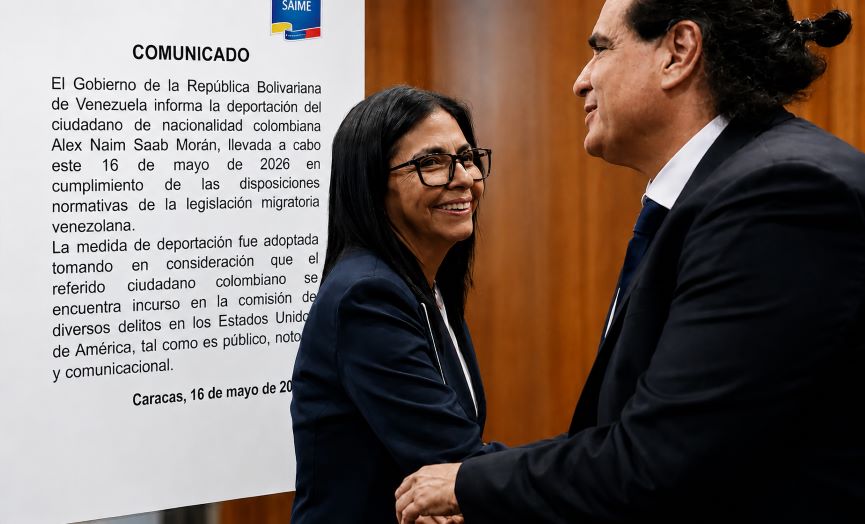
Editorial comment: At the end of this article, we publish a transcript of the bulk of Alex Saab’s testimony, given shortly after his release from U.S. torture camps in 2023, following his illegal detention in Cape Verde and his equally illegal extradition to the United States.
We invite our readers to consult this crucial testimony, which is extremely informative regarding how the Atlanticist oligarchy—whose leading figures we saw during Trump’s recent visit to China—seeks to impose its hegemony on the world. Alex Saab’s testimony exposes without compromise the nature of the monster against which Venezuela is fighting. The extremely close link between this deadly oligarchy and the supremacist occupation regime of Israel helps to better understand the complicit silence of the Western elite in the face of the unbridled sadism of the Zionist entity toward the Palestinian people and all other Arab and Muslim peoples of the Middle East.
The decision by Venezuela’s interim authorities to hand over Alex Saab to his former torturers casts irrevocable suspicion on the role that the country’s current leaders may have played in the bloody invasion of Venezuela by U.S. armed forces, which culminated in the capture of President Nicolas Maduro and his wife.
Lama El Horr
____________________
Diego Herchhoren
The extradition of Alex Saab—the former Venezuelan Minister of Industry and considered the “financial mastermind” of Chavismo—to the United States is a turning point. Far from being an act of ordinary justice or a mere internal purge, Saab’s handover by the “new” Venezuelan authorities constitutes a foundational act of a new political order in the country.
The figure of Alex Saab: more than an official
Alex Saab was not merely an official in Nicolás Maduro’s government, but rather the operator of Venezuela’s foreign trade network under sanctions. With multiple citizenships (Colombia, Venezuela, Antigua and Barbuda) and a network of companies in Turkey, Hong Kong, Switzerland, and Panama, Saab built the logistical infrastructure that allowed the country’s government to survive the sanctions regime imposed by the United States.
Since 2011, he managed two sensitive programs: the construction of social housing (Great Housing Mission Venezuela) and the distribution of CLAP food subsidies, which fed the poorest sectors during the toughest years of the sanctions.
But its true strategic value lay in its ability to operate across jurisdictions and sanctions. Venezuelan gold flowed through its networks to Turkey, the United Arab Emirates, and Iran, and it facilitated relationships with Western companies (Chevron, JP Morgan) that, despite public anti-Chávez rhetoric, continued to work de facto with Caracas. Therefore, when Maduro appointed him Minister of Industry in October 2024, he was merely acknowledging publicly the power Saab already wielded behind the scenes.
A history of arrests and torture
The report notes that this is not Saab’s first arrest. In June 2020, he was intercepted in Cape Verde while flying to Tehran, following an Interpol notice issued at the request of the United States. The process was riddled with irregularities: the notice was issued 24 hours after his arrest, there was no extradition treaty with the United States, and both ECOWAS and the UN Human Rights Committee unsuccessfully demanded his release. For over a year, he endured extreme conditions of detention—a 3×3 meter cell, high temperatures, lack of light and medical attention—and in October 2021, he was extradited to Miami. There, in a CIA safe house, he was subjected to waterboarding to force him to cooperate against Maduro.
In December 2023, Joe Biden pardoned Saab in exchange for ten US citizens, twenty Venezuelan political prisoners, and the consolidation of Chevron’s position in Venezuela’s oil sector. The exchange revealed the enormous value Saab held for Caracas: he was paid for with dozens of people and access to strategic resources.
The Venezuelan economic paradox
Between 2025 and 2026, Venezuela experienced twenty consecutive quarters of growth, with a GDP of +8.66% in 2025 and a projected 12% for 2026—the best indicator in Latin America. Western products reappeared in supermarkets, something unthinkable ten years earlier.
However, this growth was not spontaneous. It was made possible by the combination of recovering oil prices, a partial easing of sanctions, and, above all, the existence of operational mechanisms that allowed Western investment to be channeled around official restrictions. That was precisely Saab’s role: to act as a bridge between the state-owned PDVSA and companies like Chevron or JP Morgan, designing offshore schemes that kept them “in the game” despite the sanctions.
Why are they extraditing him now?
Saab’s extradition is not part of a generic “purge of Maduro supporters,” but rather a shift in foreign beneficiaries. In Venezuela, a struggle has unfolded between two major US interests: on one side, JP Morgan (through Dalinar Energy); on the other, Paul Singer—a close donor to Donald Trump—through Amber Energy.
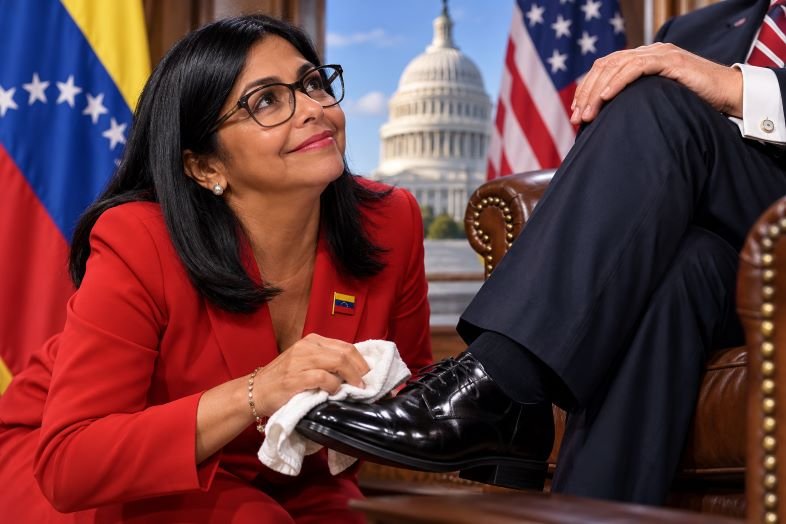
Meanwhile, a Trump associate, Harry Sargeant III (whose company has operated in Venezuela since the 1980s), promoted Delcy Rodríguez’s candidacy as a ” controllable interim leader .” Rodríguez is undoubtedly the one now in charge.
In this context, the financial schemes Saab built were designed for the previous configuration (Maduro and the structures that negotiated with Biden). The new configuration requires new operators, and Saab has become an obstacle.
But beyond that, his detailed knowledge of sanctions evasion networks and the Western actors who secretly collaborated makes him a highly sought-after asset for the US Attorney’s Office. Thus, turning him over not only clears the board of old loyalists but also provides Washington with a valuable piece of information.
The consequences for Venezuela
Saab’s extradition has at least six political consequences for Venezuela. One is that the existence of “new authorities” who can decide on the extradition of such a prominent figure in Nicolás Maduro’s government implies that Maduro is no longer in power. Delcy Rodríguez appears as the de facto leader, aligned with the interests of the current US administration.
The second consequence is that extradition is the spearhead of a systematic purge of the old guard. Those who controlled the flows of money, gold, and sanctions become expendable or, quite simply, bargaining chips.
The third point is that a climate of terror has taken hold among the Venezuelan leadership. It’s an open secret that they live “in a state of tension and fear, wondering who will be next.” Extradition functions as a disciplinary mechanism: no high-ranking Chavista official can feel safe if the new rulers decide to hand them over to U.S. justice.
The fourth is the change in the rules of the geopolitical game. Venezuela is no longer a country that negotiates from a position of confrontation with the United States, but rather a partner aligned with the new foreign beneficiaries. The old rules (mutual protection, sanctions evasion with Russian and Iranian backing) are replaced by the logic that the former players surrender so that the new administration can gain legitimacy and favors from Washington.
The fifth point is subordination to specific US financial interests. The extradition decision is not based on domestic judicial criteria, but rather on the power struggle between investment funds like Amber Energy (Paul Singer) and JP Morgan. Venezuelan politics is thus subordinated to the factions of US financial capital.
And the sixth point is that this undoubtedly weakens alliances with Russia and Iran.
Venezuela prioritized Russian conventional weapons (AK rifles) over drone development in its arms policy, unlike Iran. The Saab handover signals that the new government has no qualms about breaking with old anti-American strategic alliances, thus eroding the Russian-Iranian sphere of influence in the Caribbean.
A note on the relationship with Russia and a new Venezuela
Saab negotiated with Russian representatives the potential location of drone production in Venezuela, but the project fell through because Caracas prioritized traditional weaponry. This has been a significant strategic error, as drones would be far more useful for asymmetric deterrence against the US presence in the Caribbean than thousands of rifles locked away in arsenals.
The irony is that Iran—a country with which Venezuela actively worked through Saab—did develop that capacity. Saab’s extradition, in a way, completes the marginalization of the Russian-Iranian approach in favor of a realignment with Washington.
The extradition of Alex Saab is not an isolated legal event, but rather the founding act of a new political order in Venezuela. Former Chavista figures are being sacrificed to facilitate the control of Venezuelan resources (oil, gas, gold) by a new local faction allied with conservative sectors in the United States linked to Donald Trump.
The political cost is the loss of any vestige of autonomy and the establishment of a logic of “surrender” as a tool of governance. The climate of fear among the leadership, the reconfiguration of foreign beneficiaries, and the end of the policy of confrontation with the United States paint a picture in which Venezuela definitively ceases to be a laboratory of anti-imperialist resistance and becomes instead a chessboard of conflicting North American financial interests. The symbolic value of handing over Maduro’s “financial brain” is, in this interpretation, the most eloquent proof that the rules of the game have changed forever.
(mpr21)
______________________
Alex Saab provides details of illegal imprisonment in Cape Verde and US:
ALEX SAAB: In 2015, the sanctions started to become more and more severe. In 2016, they were very strong, the price of oil also dropped quite a lot, and the situation in the country became more and more complicated. And one day we woke up in Venezuela with all the accounts frozen, blocked, and the country was left totally without liquidity.
In 2020, we had the crisis with gasoline. Due to the blockade, we could not process oil, not because we were inefficient as they wanted to imply, but because there were no resources. They didn’t even sell us spare parts, and the situation was quite difficult. And in 2020, I remember, I traveled in March, in the first mission to search for fuel. In April, I traveled again looking for fuel, food, medicine.
On June 12, 2020, I left on the third mission of that year. Normally I travelled to my scheduled destination via Algeria, and that day we took off and Algeria denied us landing permission. We had to look for options, the pilots told me that the option was Cape Verde. While they put the fuel in the plane, the lights went out. Some officials came in, running aggressively… They said you are going with us, you are under arrest. They started to push me out of the plane, without shoes. They know that I am on a government mission, they know that I have diplomatic immunity. And well, they put me in a car, they put a hood over my head and took me to some place… It was a full-scale kidnapping. Without a court order, without cause, without any evidence.
The first night, they put me in a dark small dungeon, about two meters long. Nobody talked to me. The following night, I had no food, no water, nothing, they arrived at midnight and started to talk to me, to tell me that I should sign my voluntary extradition to the United States. I refused and things gradually started to get out of control. They put a chair in, they handcuffed my hands and feet to the chair and laid it on the floor. They took out a towel, they put it on my face and started to pour water on me little by little so that I would feel like I was drowning. They sit me down, they talked to me, they threw me down, and they kept me like that, I think I was there for two hours. Those were the first tortures. They talked to me about signing the extradition and making some statements against the Venezuelan government. They did not achieve their objective.
They took me to a prison that was on Sal Island, which is in the middle of a desert. They put me in a dungeon, dark again, I spent that night there. The next day, they came for me again, they put another hood on me… They took me to another prison in Sao Vicente. Once again, they took me to a dark dungeon, with no bathroom, with nothing, I was held in the worst conditions, with a bucket to relieve myself when I had to, they opened the door once a day so that I could throw the bucket contents away when there was no one there. And If I wanted to drink water, I had to pour it in the same bucket. The first day I didn’t drink water, but by the second day I had no choice.
My family somehow managed, I think after six or seven days, that they let a person come in and bring a lunch. I was in the dark, total darkness 24 hours. They would open the food container and throw the food on the floor. I had to grope around afterwards to find the piece of food because you couldn’t even see it. That’s how they kept me, I think for a month or so.
I am absolutely certain that Sal Island was where they had their entire base of operations. On Sal Island, the first night nothing happened. The second night, the tragedy began. Blows, my whole body was almost purple, they cut my arms, but not deeply, they left them raw, and I was with my arms stretched behind me, tied up, and they put lamps in my face, they poured alcohol and water on me, they told me that they were bleeding me, and they beat me, they knocked out three teeth here, they hit me very hard. That happened every month, July, August, September, October. Almost every day.
NICOLAS MADURO: What were they looking for with the torture? What was the first action they asked you to take?
ALEX SAAB: The first action was to help them (=the US) stop the arrival of food and medicine and gasoline to Venezuela. They told me, you have to call the suppliers, you have to tell them that nobody is going to be paid, you have to tell them that they are going to be sanctioned, you have to give us the routes, the names of the companies, everything, because you have to make the Venezuelan government collapse. That was their favorite word, you have to make it collapse.
And I remember that I told them, ‘But we are in the middle of Covid, and you want to cut everything, there could be thousands of deaths.’ They told me that it did not matter, that the goal was to achieve a change of government…
They told me very clearly: there is no more time, we are going to invade, we need you to make a statement and Juan Guaido is going to ask for military intervention. That last session was monstrous, monstrous. They even came with film cameras and makeup. I ended up on the floor, I was vomiting, and they told me they were going to kill me. ‘Okay, you didn’t cooperate with what we needed, you are going to die.’ Of course, during all this, they always told me, ‘you are going to Miami, we are taking your family, you are going to live comfortably, you will never go to jail, you can go back to invest in Venezuela.’ They are shameless…