The Soros, the Rothschilds, the Finks, the Von der Leyens, the Macrons—they haven’t learned the lesson of their predecessors. They believe this time will be different. They believe the monster will obey them. History, stubborn and repetitive, will remind them that monsters never obey those who fund them. Europe, once again, descends into hell. And this time there will be no 1945 to rescue it from itself.
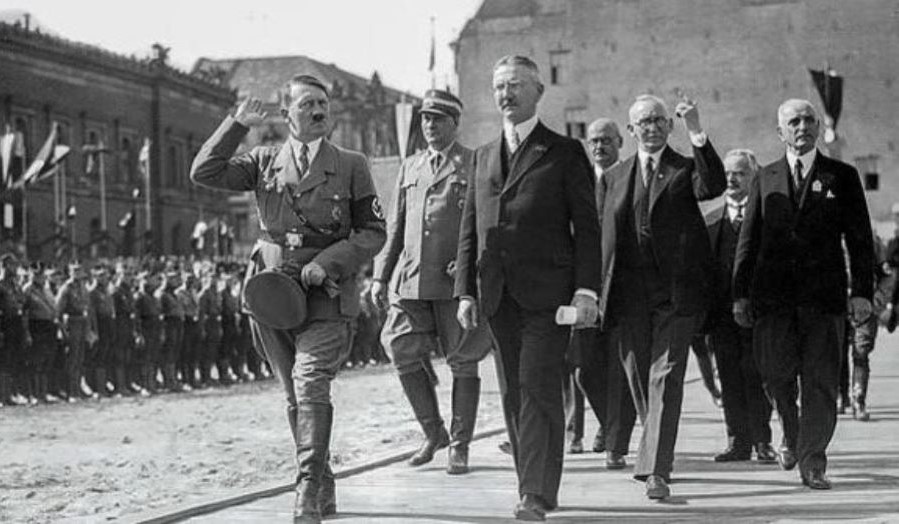
Somewhere in the collective European memory, among the dust of archives and sepia photographs, remains the image of that smoke-filled room in Berlin, on February 20, 1933. Twenty-four men, the barons of steel, chemistry and Teutonic banking, the German elite, sat facing a bohemian corporal with a ridiculous mustache to hand over the keys to the Reich.
Éric Vuillard, in his chilling chronicle of *The Order of the Day*, reconstructed that scene with forensic precision, leaving us with the most bitter lesson in 20th-century economic history. Catastrophes are not caused by madmen, but by the respectable men who sign the checks. But there is an even darker truth underlying that meeting, one that official historians tend to omit in their euphemisms. Those twenty-four gentlemen not only betrayed Weimar democracy; they initiated the greatest exercise in dispossession, plunder, and subjugation of the working classes that Europe had ever known.
There are similarities between the interwar period (1918-1939) and the current situation with European elites. The parallels are striking, though not exact; history doesn’t repeat itself identically, but it rhymes. In both cases, European economic, political, and intellectual elites perceived an existential threat to their liberal/capitalist order and responded with strategies of containment, ideological rearmament, and selective support for forces “defending” the status quo, often with a shift toward more right-wing positions.
The analysis suggests that European elites want three things simultaneously: to contain Russia, to rebuild European geopolitical power, and to shift the burden of the crisis onto labor and social welfare. The problem is that these three goals clash: militarization requires public spending; competitiveness demands lower wages and austerity measures; and political cohesion weakens when the population perceives it is paying the price for a top-down strategy.
To grasp the magnitude of this dispossession, one must look unflinchingly at what is happening in the industrial heartland of Europe. Europe’s engine is shutting down, and this is no mystery, but rather the result of the breakdown of the German business model (cheap Russian gas + high-quality manufacturing + exports to China). Just recently, at the end of June 2026, it was announced that Volkswagen plans to close four plants in Germany and lay off 100,000 workers worldwide. The collapse of the German model is not an accident; it is a planned class restructuring.
This reflects accelerating deindustrialization where energy costs and green regulations are destroying the traditional industrial fabric. The old European industrial bourgeoisie is suffering, but this opens the door for financial capital and investment funds (many of them American or linked to large asset managers) to acquire European assets at bargain prices, reshaping industrial ownership towards a more financial and less productive model.
Financial capital doesn’t need factories in the Ruhr; it needs green bonds, carbon derivatives, data management algorithms, and assets bought at bargain prices. The dispossession consists of transferring public and productive wealth to the private balance sheets of investment funds, leaving citizens with the crumbs of a precarious service economy.
While Germany is being drained of its productive power, London and Paris are engulfed in political chaos, serving as the perfect smokescreen for this operation. The political disaster in the United Kingdom, trapped in the Brexit snare and a succession of weak governments, and the fragmentation in France, with the far right looming over the Élysée Palace and an irreconcilable left, are presented by the mainstream media as a crisis of democracy. Nothing could be further from the truth. This chaos is the very condition that allows the elites to achieve their true objective: the construction of the Surveillance State.
At the apex of this architecture of dispossession stand three fundamental pillars that operate in perfect symbiosis to ensure that wealth flows upward and control is imposed downward. The first of these pillars is the ideological and moral engineering represented by George Soros and his network of Open Society Foundations. Soros is not a mere philanthropist; he is the head of ideological intelligence for transnational elites. His role in this transition from welfare to surveillance is crucial: replacing popular sovereignty with a network of NGOs, think tanks, and legal activism that dictates the limits of what is thinkable.
The Open Society Foundations do not seek the material well-being of the lower classes; they seek ideological submission. They fund the “civil society” that demands open borders (to guarantee a flow of cheap and precarious labor that drives wages down) and that, at the same time, demands the censorship of any discourse that challenges the technocratic consensus of Brussels. Soros provides the moral framework that justifies the Surveillance State; under the premise of protecting “liberal democracy” and “human rights,” the legal, financial, and media persecution of any dissent is legitimized. It is the surveillance of thought, the morality police that ensures that the impoverished masses do not blame the financial system, but rather the scapegoats of the moment.
The second pillar is the banking of restructuring and financial parasitism, historically embodied by the Rothschild dynasty and, today, by the network of global investment banks and asset managers. If the Welfare State was financed by taxes on labor and national production, the new Surveillance and Barracks State is financed by debt. This is where the great economic plunder is consummated. Financial elites use the crises they themselves provoke or exacerbate to bail out states not with free money, but with unpayable debt. In exchange for this debt, European states are forced to mortgage their public infrastructure, their pension systems, and their natural resources.
Rothschild & Co. and its peers advise on the silent privatization of what remains of public assets. Every time a European state needs to issue debt to keep its ailing healthcare system afloat or to finance its energy deficit, global investment funds buy that debt, demanding in return “structural reforms”—that is, cuts in social spending, an increase in the retirement age, and labor market deregulation. This plunder is the financialization of life itself: financial capital feeds on the lifeblood of the welfare state, absorbing the wealth of present and future generations to inject it into global asset markets.
The third pillar, and perhaps the most visible in its brutality, is the European military-industrial complex. The provocation and entrenchment of the conflict with Russia are not a diplomatic miscalculation; they are the goose that lays the golden eggs of the new accumulation model. The Welfare State spent money building hospitals, schools, and transportation networks—goods that improved the lives of the population and strengthened their capacity for organization.
The military state spends that same money buying drones, missiles, and surveillance systems from private corporations like Rheinmetall, BAE Systems, and Thales. This is the open secret of the European elites. War and the threat of war are the only Keynesianism they have left. Faced with the impossibility of generating real growth in a deindustrialized and aging economy, the only way to inject public money into the economy without the population demanding it in the form of social welfare is through military spending.
European elites need Russia as the existential enemy to justify the exponential increase in defense budgets. This public spending is a direct transfer of wealth from European taxpayers to the shareholders of the military-industrial complex. It is the ultimate dispossession: forcing an impoverished middle class to pay, through their taxes, the dividends of the companies that manufacture the weapons that threaten their own security.
And connecting, orchestrating, and profiting from these three pillars is the great predator, the entity that has transcended mere influence to become the true sovereign of Europe: BlackRock. Larry Fink and his fourteen trillion dollar fund are not just another player in the market; they are the embodiment of global financial feudalism. BlackRock owns the replacement of the Welfare State with the Surveillance State and the Barracks because BlackRock is the majority shareholder of everything that makes up this new system.
They own shares in the energy companies that are strangling German industry; they own the debt of the French and British states that forces them to cut public services; they own the technology companies that provide surveillance and censorship algorithms, and, of course, they are the main shareholders of Rheinmetall and the large defense corporations.
BlackRock has no homeland, no loyalty to the constitution of any European state, and is not accountable to any electorate. For BlackRock, the “green transition” is not an ecological necessity, but a mechanism to create new markets for financial assets and destroy the old industry that demands labor rights. For BlackRock, the war in Ukraine is not a humanitarian tragedy, but an opportunity to launch Exchange Traded Funds (ETFs), or European defense exchange-traded funds, and capitalize on fear. BlackRock is the new Krupp, the new Siemens, the new IG Farben, but a thousand times larger and freed from any territorial ties.
Faced with the question of whether European elites are part of the disaster or the winners, the hypothesis and concept of “crisis capitalism” suggests that the technocratic, financial, and green faction is winning. The elites’ theory suggests they are using the crisis to consolidate the European Union’s supranational power and evolve its legal framework toward greater centralization.
If we apply to this Europe of 2026 the analytical framework that Ian Kershaw developed in his masterful “Descent into Hell,” the parallel is not only disturbing, it reveals the intentions of the elites. Kershaw identified four driving forces that pushed Europe to the brink between 1914 and 1949: nationalist tensions, territorial disputes, class conflicts, and the crises of capitalism. But his great lesson is how conservative and financial elites used these forces to justify the destruction of democracy and social rights.
In the 1930s, the elites’ systemic panic in the face of communism and the workers’ revolution led them to support, finance, and arm fascist movements. They needed a leviathan to crush the unions, eliminate the right to strike, and subject the working class to the discipline of a war economy. Fascism was not a hysterical outburst of the masses; it was the elites’ emergency solution to save capital through state terror.
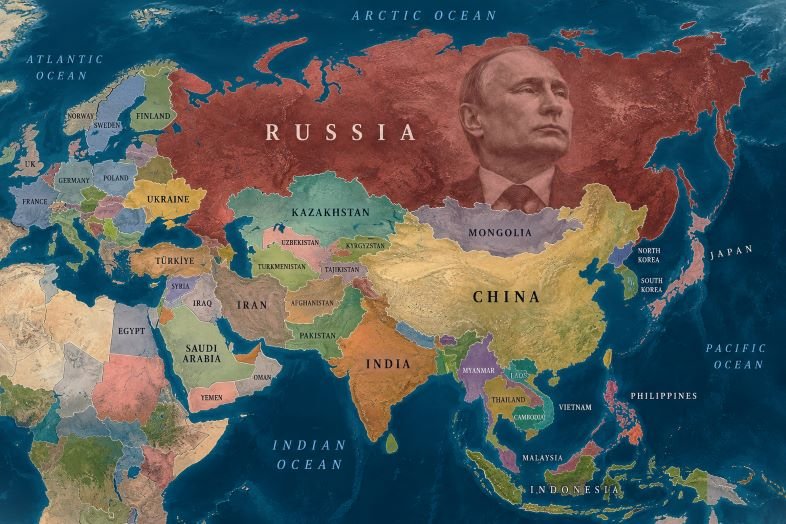
Just as in the interwar period, today’s elites are willing to sacrifice liberal democracy, social welfare, and peace to guarantee the security of capital and their own survival at the top of the pyramid. They use the threat from Russia and China as the new “Bolshevik danger,” a geopolitical scapegoat that allows them to impose austerity measures, curtail civil liberties, and divert public funds to the security apparatus. The external enemy is the perfect pretext for internal plunder.
The dispossession has become invisible, automated, and accepted as “common sense” by a population that has been educated to fear “hate speech” or “disinformation” more than poverty, war, or the loss of its sovereignty. The elites have succeeded in getting citizens to monitor, denounce, and self-censor each other, outsourcing the function of political policing to civil society itself—the very same society that Soros and his NGOs have meticulously trained in moral purity and technocratic obedience.
By dismantling the welfare state, European elites have eliminated the social safety net. They have replaced hope with fear, and fear, when it accumulates for too long in a cornered population, does not breed submission; it breeds explosive pressure. Dispossession has a physical limit. When the European middle class can no longer afford heating, when workers in deindustrialized cities have nothing left to lose, when the harsh realities of poverty and war come knocking at their doors, no “disinformation” law and no surveillance algorithm will be able to contain the fury of a society whose future has been stolen.
History, as Kershaw demonstrated and as Vuillard fictionalized, tends to punish such arrogance. Historical catastrophes are rarely caused by sadistic monsters at the outset; they are caused by conservative elites, bankers, and technocrats who believe they can manage chaos to protect their privileges. Today’s European elites, by financing the war against Russia and allowing the deindustrialization of Germany, are walking along the same precipice, convinced that their financial and military engineering will save them.
But the new twenty-four gentlemen—the Soros, the Rothschilds, the Finks, the Von der Leyens, the Macrons—have not learned the lesson of their predecessors. They believe this time will be different. They believe the monster will obey them. History, stubborn and repetitive, will remind them that monsters never obey those who fund them. Europe, once again, descends into hell. And this time there will be no 1945 to rescue it from itself.