How could one of the world’s oldest and most sophisticated civilizations, shaped for centuries by Confucian philosophy, suffer a humiliating defeat at the hands of Britain, a relatively small island nation, during the Opium Wars? How did this defeat usher in what the Chinese now remember as the “Century of Humiliation”? Why was China—then the world’s largest economy, possessing the most advanced bureaucracy and the greatest productive capacity—unable to recognize the transformative impact of the Industrial Revolution? More importantly, what lessons has modern China drawn from this painful chapter of its history?
The answers to these questions are essential not only for understanding China’s past but also for explaining its strategic behavior today. The legacy of the Opium Wars continues to shape Beijing’s priorities in national security, technological development, industrial policy, and maritime power. To understand China’s rise in the twenty-first century, one must first understand the profound trauma of its nineteenth-century decline.
China’s Imperial Past
By the beginning of the fifteenth century, Ming China stood among the most advanced civilizations and greatest economic powers in the world. Confucian philosophy provided the intellectual foundation of the state, emphasizing merit-based bureaucracy, educated officials, social harmony, disciplined administration, and centralized authority. Unlike many contemporary states, China’s political order rested not on hereditary aristocracy but on a sophisticated civil service selected through rigorous examinations. This system produced a remarkably stable and effective administrative structure that governed one of history’s largest empires. While Christian Europe remained fragmented by feudal rivalries, dynastic conflicts, and the constraints of religious dogma, Ming China possessed a powerful centralized government, an extensive bureaucratic apparatus, exceptional agricultural productivity, flourishing urban centers, and one of the world’s most advanced manufacturing economies. In virtually every major indicator—including population, industrial production, engineering capability, urbanization, and commercial activity—China significantly outperformed the West during the fifteenth century.
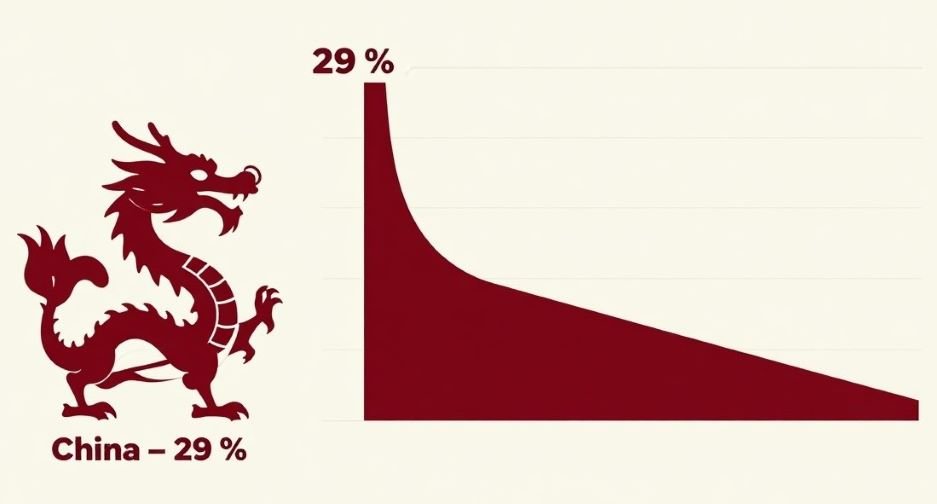
With a population of approximately 70 million, then China accounted for more than one-quarter of global economic output. By comparison, England represented only around two percent of world production, while the Ottoman Empire accounted for roughly four percent. In economic scale, administrative sophistication, and technological capability, China was unquestionably one of the dominant civilizations of its age. It possessed every advantage expected of a great power and appeared destined to remain the world’s leading civilization for centuries to come.
Maritime China
China was not only an economic giant but also a leading maritime civilization. Many of history’s most transformative inventions—including paper, printing, gunpowder, and the magnetic compass—originated in China centuries before they reached Europe. In maritime technology, Chinese achievements were particularly remarkable. Long before the European Age of Discovery, Chinese shipbuilders had developed sternpost rudders, watertight bulkheads, sophisticated celestial navigation, and the practical use of the magnetic compass for long-distance navigation. These innovations provided Chinese sailors with technological capabilities that Europe would not fully acquire until centuries later. During the early fifteenth century, China’s shipyards were constructing enormous multi-deck vessels capable of carrying hundreds of sailors and large quantities of cargo, while most European kingdoms were still cautiously exploring the Atlantic coastline in relatively small wooden ships. At the time, China possessed one of the world’s most advanced naval industries and maritime technologies.
When discussing the Age of Discovery, modern historiography generally focuses on European voyages of the fifteenth and sixteenth centuries. This perspective, however, reflects a predominantly Eurocentric interpretation of history. What Europeans “discovered” often represented the first European contact with lands that had long been inhabited or had already been reached by other civilizations. Later Western dominance enabled Europe to define its own discoveries as universal milestones in human history. A simple question illustrates this point. Portugal is widely celebrated for discovering the sea route to India, yet no one speaks of Portugal “discovering” China. The reason is straightforward. When Portuguese sailors reached the Chinese coast in the early sixteenth century, they encountered not isolated tribal societies but one of the world’s most sophisticated civilizations. According to Chinese accounts, the newcomers were regarded merely as foreign barbarians arriving at the gates of an already established empire. China could not be “discovered” in the colonial sense because it was already a powerful, centralized, and self-confident civilization.
China’s maritime strength reached its peak under the command of the great admiral Zheng He, a Muslim eunuch and one of history’s greatest naval commanders. Between 1405 and 1433, Zheng He led seven extraordinary expeditions across the Indian Ocean with massive treasure fleets consisting of around sixty large ships and approximately twenty-seven thousand personnel. These voyages projected Chinese political influence from Southeast Asia to India, Arabia, and East Africa, demonstrating an unparalleled capacity for long-range naval operations centuries before the rise of European maritime empires. In many respects, these expeditions represented an early form of naval diplomacy backed by overwhelming maritime power. Yet this remarkable achievement was never transformed into a permanent maritime strategy. Unlike the European powers that followed, Ming China failed to institutionalize its naval supremacy as a lasting element of state policy. Instead of expanding its maritime presence, China gradually abandoned the seas.
Historians continue to debate why the Ming court deliberately dismantled one of the world’s most powerful navies. Several explanations have been offered. Some argue that court astrologers and conservative officials interpreted a series of natural disasters as signs that Heaven disapproved of expensive overseas expeditions. Others suggest that the imperial court believed China, as the “Middle Kingdom,” already possessed everything it needed and therefore had little to gain from overseas expansion or colonial possessions. Another interpretation emphasizes political concerns: Zheng He’s extraordinary prestige and the growing influence of maritime officials may have alarmed the imperial court, which feared that powerful naval commanders and distant overseas bases could eventually challenge central authority. Whatever the precise reasons, the decision proved to be one of the most consequential strategic mistakes in Chinese history. By voluntarily withdrawing from the seas, China surrendered the maritime initiative just as European powers were beginning to build global naval empires.
China’s Decline
Despite signs of stagnation in several sectors, China remained one of the world’s largest economic powers at the beginning of the eighteenth century. Its population exceeded that of all the major European states combined, its domestic market was unmatched in size, and its production of tea, silk, and porcelain dominated global trade. In terms of economic output, China remained the center of the world economy. Economic size, however, did not necessarily translate into technological superiority. While China continued to derive its wealth from centuries-old agricultural productivity, handicrafts, and extensive commercial networks, Europe—and England in particular—was undergoing a transformation unprecedented in human history. The Industrial Revolution fundamentally altered the relationship between technology, production, and military power. Steam engines, mechanized manufacturing, modern shipbuilding, iron and steel industries, and increasingly sophisticated artillery systems revolutionized both economic productivity and the conduct of war. China, by contrast, remained committed to preserving its traditional political and social order. Confident in its position as the “Middle Kingdom,” the Qing Empire underestimated the profound strategic consequences of Europe’s scientific and industrial transformation. It failed to recognize that the global balance of power was no longer determined primarily by population, territory, or accumulated wealth, but increasingly by technological innovation, industrial capacity, and maritime supremacy.
The contrast was striking. Around 1820, China accounted for approximately 37 percent of the world’s population, one-third of global economic output, and nearly 30 percent of world manufacturing production. Britain, despite leading the Industrial Revolution, represented only about six percent of the global economy. Yet Britain possessed an overwhelming advantage where it mattered most: technological innovation, industrial production, naval power, and military capability. The decisive factor was no longer the size of an economy but its ability to convert scientific progress into national power. During the eighteenth and nineteenth centuries, as Europe advanced through the Reformation, the Enlightenment, the Scientific Revolution, the French Revolution, and finally the Industrial Revolution, Qing China steadily fell behind. The widening technological gap gradually eroded China’s military strength and strategic autonomy, leaving the empire increasingly vulnerable to external pressure.
This decline cannot be explained solely by foreign intervention. European powers had become extraordinarily powerful through centuries of maritime expansion, colonialism, mercantilism, and, ultimately, industrial capitalism and imperialism. At the same time, China failed to sustain technological innovation, industrial modernization, and naval development. Its manufacturing sector gradually lost its competitive edge, while the Industrial Revolution transformed the military and economic capabilities of its Western rivals. The result was one of history’s greatest geopolitical reversals. A civilization with thousands of years of statecraft, an exceptionally sophisticated bureaucracy, and one of the world’s richest economies was ultimately defeated by a small island nation located thousands of kilometers away. Significantly, the conflict was not fought over territory but over commerce—and more specifically, over opium.
The Opium Wars marked the beginning of what the Chinese now call the Century of Humiliation. More importantly, they confirmed the strategic consequences of China’s earlier withdrawal from the seas. A civilization that had once possessed one of the world’s greatest navies found itself confronting an industrial maritime empire without either the naval power or the technological capacity to resist it. The loss of maritime supremacy ultimately paved the way for the loss of strategic autonomy.
Background of the Opium Wars
By the late eighteenth and early nineteenth centuries, Chinese products such as tea, silk, and porcelain had become highly sought after across Europe. Yet the Qing government showed little interest in European manufactured goods. As a result, trade between China and the West was conducted largely in silver, creating a substantial and persistent trade deficit for Britain. For the British Empire, this imbalance became increasingly unsustainable. The solution it adopted would trigger one of the most consequential conflicts of the nineteenth century. Britain began exporting opium cultivated in British India to the Chinese market through an extensive smuggling network. What initially started as a relatively limited trade soon expanded into a massive illicit enterprise.
As opium consumption spread throughout Chinese society, millions became addicted. More importantly, enormous quantities of silver flowed out of China to pay for imported opium, severely weakening the empire’s monetary system. Government revenues declined, corruption within the bureaucracy became more widespread, and military discipline steadily deteriorated. What had begun as a commercial problem evolved into a national security crisis. Opium was no longer merely a narcotic; it had become a geopolitical weapon capable of undermining the economic, administrative, and military foundations of the Qing state. Before the outbreak of the First Opium War in 1839, only a relatively small proportion of China’s population used opium regularly. According to most historical estimates, between four and twelve million people out of a population of approximately 400 million were habitual users—roughly one to three percent of the population, with some estimates reaching as high as five percent.
The true danger, however, lay not in the percentage of addicts but in the strategic consequences of the trade itself. The continuous outflow of silver contracted the money supply, disrupted tax collection, increased the financial burden on the peasantry, and placed severe strain on Qing public finances. At the same time, opium consumption spread among civil servants, military personnel, merchants, and skilled artisans, reducing administrative efficiency, military readiness, and labor productivity. The rapid expansion of smuggling also fueled bribery and corruption among customs officials, port authorities, and local administrators, further eroding the state’s capacity to govern effectively. By the late 1830s, the Qing Empire faced not simply a public health problem but a multidimensional crisis affecting its economy, governance, military institutions, and social stability. Recognizing the existential nature of the threat, the imperial government finally decided to suppress the opium trade by force. Britain’s response to that decision would soon plunge the two civilizations into a war that would fundamentally reshape the balance of power in Asia.
The First and Second Opium Wars
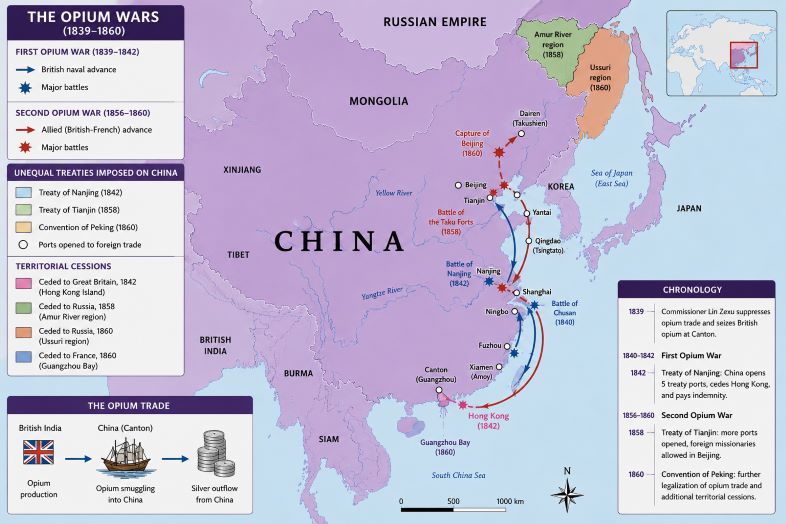
Determined to halt the devastating consequences of the opium trade, the Qing government decided to take decisive action. In 1839, Emperor Daoguang appointed the distinguished imperial commissioner Lin Zexu to suppress the illegal trade in Canton (Guangzhou). Lin confiscated more than 20,000 chests of opium belonging primarily to British merchants and ordered the narcotics to be publicly destroyed. The British government regarded the destruction of private property as a violation of commercial rights and used the incident as a justification for military intervention. Yet the conflict that followed was about far more than opium. At its core, it represented a confrontation between two fundamentally different worlds: an industrialized maritime power that had embraced scientific and technological transformation, and an ancient continental empire determined to preserve its traditional political order.
The Qing Empire found itself hopelessly outmatched by Britain’s steam-powered navy, modern gunnery, disciplined professional forces, and industrial production capacity. The First Opium War was therefore not simply a military conflict but a demonstration of the revolutionary impact of the Industrial Revolution on the global balance of power. Remarkably, this tragedy began only one year after the signing of the 1838 Treaty of Balta Limanı between Britain and the Ottoman Empire. That agreement fundamentally reshaped the Ottoman economy by granting Britain extensive commercial privileges and is widely regarded as a major step toward Ottoman economic dependence. Although the historical circumstances differed, the trajectories of the Ottoman and Qing Empires during the nineteenth century reveal striking similarities: both gradually lost their strategic autonomy under the growing pressure of industrialized Western powers.
During the First Opium War (1839–1842), the Royal Navy rapidly overwhelmed China’s coastal defenses, captured key ports, and advanced along the Yangtze River to Nanjing. The resulting Treaty of Nanjing (1842) forced China to cede Hong Kong to Britain, open five treaty ports to foreign commerce, pay substantial financial indemnities, and grant extensive commercial privileges to British merchants. More significantly, the treaty inaugurated what later became known in China as the era of the Unequal Treaties, a period during which foreign powers steadily eroded Chinese sovereignty through military coercion and diplomatic pressure. For Britain and the other Western powers, however, these concessions proved insufficient. Fourteen years later, the Second Opium War (1856–1860) erupted with objectives that extended well beyond protecting the opium trade. Britain and France sought unrestricted access to Chinese markets, the right to establish permanent diplomatic missions in Beijing, greater freedom for Christian missionary activity, expanded commercial privileges, and broader legal protections for their citizens throughout the Qing Empire.
Once again, overwhelming naval superiority proved decisive. Supported by French military forces, the Royal Navy captured Tianjin and eventually advanced on Beijing itself. The Qing government suffered another catastrophic defeat. The emperor fled the capital, while British and French troops looted and burned the magnificent Old Summer Palace (Yuanmingyuan)—one of the greatest symbols of imperial Chinese civilization. The destruction of the palace has remained one of the most enduring symbols of foreign humiliation in modern Chinese historical memory. The war concluded with the Convention of Beijing (1860), which imposed even harsher conditions on China. Additional ports were opened to foreign trade, Western powers obtained the right to maintain permanent diplomatic legations in Beijing, Christian missionaries received extensive legal protections, foreign merchants acquired broader commercial privileges, and China was compelled to pay substantial war indemnities. Most significantly, the opium trade was effectively legalized.
The Second Opium War represented far more than another military defeat. It marked a profound assault on China’s sovereignty, dignity, and political independence. Together, the two Opium Wars transformed the Qing Empire from one of the world’s greatest civilizations into a semi-colonial state increasingly subjected to foreign influence. For modern China, these conflicts constitute the opening chapter of the Century of Humiliation, a national trauma whose legacy continues to shape Chinese strategic thinking to this day.
Philosophy, Religion, and the Maritime Question
The Opium Wars were far more than a military defeat. At a deeper level, they represented the failure of an ancient civilization to adapt to a rapidly changing world. For generations, historians and Chinese intellectuals have asked the same fundamental question: Why were Confucian ethics, Buddhist wisdom, and China’s millennia-old state tradition unable to protect the country against the rise of the industrial West? Equally important, why were the moral teachings of Confucianism and Buddhism unable to prevent millions of Chinese from falling victim to opium addiction? The answers cannot be found solely in comparisons of military strength. They lie in China’s political culture, educational system, attitude toward science and technology, and its broader perception of the world. In many respects, this constitutes the true center of gravity of the Opium Wars. The humiliations that China endured until 1949—when Mao Zedong reunified the country and restored its territorial integrity under the Communist Revolution—revealed not merely the defeat of an army but the crisis of an entire civilizational model.
Confucianism was fundamentally a philosophy of state and society. Rooted in family, morality, discipline, hierarchy, and loyalty to the state, it sought to answer one essential question: How can society be governed in an orderly and harmonious manner? For centuries, this philosophy provided China with one of the most effective bureaucratic systems in world history. The challenge posed by the Opium Wars, however, was fundamentally different. The central question was no longer how to preserve domestic order, but how to confront industrial powers that had transformed science into military and economic superiority. The Confucian bureaucracy could identify moral decay and administrative corruption, yet it offered no institutional framework for industrialization, technological innovation, or naval modernization. It could govern an empire, but it could not transform that empire for the industrial age. China’s weakness, therefore, did not stem from a lack of morality. Rather, it resulted from confronting rivals whose technological capabilities had advanced far beyond their own.
Buddhism occupied a similarly important place in Chinese civilization, yet it addressed an entirely different set of human concerns. Whereas Confucianism focused on the state and social order, Buddhism concentrated on the individual. Its primary concern was not government but personal enlightenment; not war but suffering; not power but inner peace. Buddhist teachings encouraged detachment from worldly desires, self-discipline, and spiritual liberation. While these principles provided profound ethical and philosophical guidance, they offered little foundation for industrial development, naval expansion, or military strategy. When British steam-powered warships appeared off China’s coast, Buddhist monasteries could not build modern fleets, manufacture artillery, or organize industrial production. There was no direct relationship between the pursuit of nirvana and the technological revolution that was reshaping the global balance of power. Buddhism could strengthen society spiritually, but it could not provide a technological response to imperial aggression.
Nor could either Buddhism or Confucianism prevent the spread of opium addiction. Yet attributing the opium crisis solely to the limitations of these philosophical traditions would be misleading. Drug abuse has confronted societies of every religious and philosophical background throughout history. Buddhist, Confucian, Christian, Jewish, Muslim, and secular societies alike have struggled with narcotics and addiction. History further demonstrates that great powers have repeatedly employed addictive substances not merely for economic profit but also as geopolitical instruments to weaken rival societies. The Opium Wars remain one of the clearest historical examples of this strategy. For that reason, lasting success in combating narcotics cannot depend exclusively upon moral teachings or religious values. It requires effective state institutions, the rule of law, quality education, strong family structures, social cohesion, and determined public policy. Moral philosophy may shape individual character, but it cannot by itself defeat organized crime, economic interests, or state-sponsored narcotics trafficking.
The fundamental lesson of the Opium Wars is therefore broader than the failure of any single philosophy or religion. They demonstrated that moral civilization alone is insufficient to preserve national independence. A great power must combine ethical values with scientific progress, technological innovation, industrial capacity, and maritime strength. Only the integration of moral foundations with national power can ensure the long-term survival of a civilization in an increasingly competitive world.
Maintaining Order or Embracing Change?
For more than five centuries, the Ming and Qing dynasties—together ruling China for approximately 544 years—built their political order upon the Confucian ideal of bureaucratic stability while allowing Buddhism to shape much of society’s moral and cultural life. Together, these traditions fostered a civilization that valued harmony, continuity, and social order above radical transformation. Preserving stability was regarded as a greater virtue than pursuing innovation or revolutionary change. Across Europe, however, a fundamentally different intellectual and economic climate was emerging. In Protestant countries—particularly England and the Dutch Republic—commerce, private enterprise, profit, overseas expansion, and technological innovation increasingly came to be regarded as morally legitimate and even socially desirable. This divergence would profoundly influence the future balance of global power. The decisive difference, however, was maritime orientation.
At the beginning of the fifteenth century, Admiral Zheng He’s treasure fleets were technologically superior to any naval force in Europe. China possessed larger ships, more advanced navigational techniques, sophisticated shipbuilding technologies, and extensive experience in long-distance maritime expeditions. Yet the Ming court never regarded maritime power as the primary foundation of national prosperity or security. China’s wealth already lay within its own borders. Fertile agricultural plains, a vast domestic market, abundant natural resources, and a huge population allowed the empire to flourish without depending heavily on overseas commerce. For the Chinese state, maritime activity remained an option rather than a strategic necessity.
The situation facing England and the Netherlands was fundamentally different. Limited agricultural resources, relatively small populations, and island or coastal geography compelled these societies to look outward. Their prosperity depended upon trade, shipping, and access to overseas markets. Geography pushed them toward the sea, while their evolving religious and economic culture reinforced that direction. As the German sociologist Max Weber famously argued, the Protestant ethic transformed work, thrift, capital accumulation, and worldly success into moral virtues. Economic achievement increasingly came to be viewed as evidence of discipline, responsibility, and even divine favor. This cultural transformation encouraged investment in shipbuilding, banking, insurance, overseas commerce, and industrial enterprise.
Consequently, while China continued to educate highly competent civil servants through its imperial examination system, Europe increasingly produced successful merchants, shipowners, financiers, engineers, scientists, and entrepreneurs. Governments actively supported these groups because they generated both national wealth and the maritime power necessary to protect expanding commercial interests across the globe. China did not collapse because its civilization lacked moral foundations. Rather, it failed to recognize quickly enough that the very foundations of global power had changed. Europe was entering an era in which scientific discovery, technological innovation, industrial production, and maritime supremacy—not merely territorial size or bureaucratic sophistication—would determine the fate of nations.
Among European powers, England advanced furthest along this path. The Protestant Reformation challenged long-established religious authority and created an intellectual climate that increasingly valued inquiry, experimentation, and practical knowledge. Combined with maritime commerce, this environment accelerated scientific progress and ultimately made the Industrial Revolution possible. From a relatively small island, Britain developed iron and steel industries, steam-powered shipbuilding, heavy naval artillery, and an advanced financial system capable of supporting global commerce. Protected by the Royal Navy, British merchant shipping expanded across every major ocean, allowing Britain to dominate international trade routes and establish the largest maritime empire in modern history.
The British state actively encouraged private enterprise through institutions such as the East India Company and the Levant Company, demonstrating how commercial interests and national strategy could reinforce one another. At the same time, the establishment of the Royal Society in 1660 institutionalized scientific inquiry and symbolized the growing alliance between reason, scientific experimentation, and national power. The intellectual influence of Francis Bacon, whose philosophy emphasized empirical knowledge as the foundation of human progress, further strengthened this transformation. Bacon also understood the geopolitical significance of maritime power. His famous observation remains as relevant today as it was in the seventeenth century: “He that commands the sea is at great liberty and may take as much and as little of the war as he will.”
This single sentence captured a strategic reality that Britain would apply more successfully than any other nation. By combining maritime power, scientific progress, industrial capacity, and commercial expansion, Britain transformed itself into the dominant global power of the nineteenth century. China, meanwhile, continued to preserve an internal order that had once made it great but proved increasingly inadequate in an age defined by industrialization and sea power.
The Ottoman–Chinese Parallel
When the histories of the Ottoman and Chinese Empires during the nineteenth and early twentieth centuries are examined side by side, striking geopolitical parallels emerge. For nearly five to six centuries, both had stood among the most powerful political entities of their respective regions. Yet after failing to adapt to the Industrial Revolution, both found themselves confronted by industrialized Western powers whose global influence rested upon naval supremacy, technological innovation, and economic expansion. For China, this process began with the First Opium War (1839–1842) and continued with the Second Opium War (1856–1860). British naval firepower shattered China’s coastal defenses and forced the Qing Empire to accept humiliating concessions that steadily eroded its sovereignty. The process reached another critical stage following the Boxer Uprising in 1900, when the Eight-Nation Alliance—comprising Britain, France, Germany, Russia, Japan, the United States, Austria-Hungary, and Italy—occupied Beijing and effectively imposed their political will upon the Qing government. By the beginning of the twentieth century, China had become a semi-colonial state whose internal affairs were increasingly shaped by foreign intervention.
The Ottoman Empire experienced a remarkably similar trajectory. Long before its political collapse, its economic and strategic autonomy had already begun to erode under growing European influence. The Treaty of Balta Limanı in 1838 granted Britain extensive commercial privileges and significantly weakened the Empire’s ability to pursue an independent economic policy. Earlier, in 1807, Admiral John Thomas Duckworth had sailed a British fleet through the Dardanelles and threatened Istanbul itself, demonstrating the vulnerability of the Ottoman capital to modern naval power. The pattern continued throughout the nineteenth century. During the Congress of Berlin in 1878, Britain assumed control of Cyprus while simultaneously preventing Russian domination of the Straits. In 1881, the establishment of the Ottoman Public Debt Administration (Düyûn-ı Umûmiye) effectively placed much of the Empire’s financial system under European supervision. Only one year later, Egypt, the Empire’s most valuable province, was occupied by Britain. Strategic dependence gradually evolved into economic dependence, and economic dependence increasingly translated into political weakness.
The geopolitical partition of the Ottoman Empire accelerated further in the early twentieth century. At the Reval Meeting of 1908, Britain and Russia discussed the future of Ottoman territories without meaningful Ottoman participation. During the Gallipoli Campaign of 1915, Britain and France launched the largest combined naval and amphibious assault of the First World War in an attempt to seize the Ottoman capital. Although that operation ultimately failed, it demonstrated the decisive importance that maritime power had acquired in modern geopolitics. Four years later, the Greek occupation of İzmir on 15 May 1919, backed by the victorious Allied powers, marked the final phase of the attempt to partition Anatolia itself. The historical lifespans of the two empires are also remarkably similar. In China, the Ming Dynasty (1368–1644) was succeeded by the Qing Dynasty (1644–1912), together forming an uninterrupted imperial tradition of approximately five and a half centuries. The Ottoman Empire endured for more than six centuries, from 1299 to 1922. Both civilizations experienced a similar sequence of decline: first the gradual erosion of sovereignty through foreign intervention, followed by profound domestic political transformation.
The parallels extend even to the birth of their modern nation-states. China’s 1911 Revolution, led by Sun Yat-sen, resembles in several respects the Ottoman Second Constitutional Period that began in 1908, both representing transitional attempts to modernize declining imperial systems. Yet the definitive foundations of the modern states emerged later. In China, national reunification was ultimately achieved under Mao Zedong in 1949. In Türkiye, national independence was secured under the leadership of Mustafa Kemal Atatürk through the War of Independence (1919–1923) and the establishment of the Republic. Despite their ideological differences, Sun Yat-sen, Mao Zedong, and Mustafa Kemal shared one historic achievement: each transformed fragmented, externally pressured political entities into sovereign nation-states capable of exercising independent authority.
From that point onward, however, the strategic paths of China and Türkiye diverged significantly. Following 1949, China pursued a long-term strategy that prioritized national sovereignty, industrialization, technological self-sufficiency, and geopolitical independence while engaging with the global economy largely on its own terms. Türkiye, following its accession to NATO in 1952, became an integral component of the Western security architecture. The long-term strategic implications of this choice continue to be debated. Ultimately, the shared history of the Ottoman and Chinese Empires is not merely a history of imperial decline. It is the story of how two ancient civilizations lost—and later sought to recover—their sovereignty. The central lesson is that independence cannot be preserved through military victories alone. It must rest upon sustainable national power built through economic resilience, scientific and technological progress, industrial capacity, maritime strength, and strategic autonomy. Modern China appears to have internalized this lesson. Its rise over the past four decades reflects a patient, state-centered strategy aimed at ensuring that the humiliations of the nineteenth century can never be repeated. For Türkiye, the historical parallel suggests a similar conclusion: lasting sovereignty depends upon maintaining a balanced foreign policy while continuously strengthening national capabilities in industry, technology, maritime power, and independent strategic decision-making.
Lessons Learned by China
In many of his speeches, Chinese President Xi Jinping does not attribute China’s historical decline solely to Western imperialism or the Opium Wars. On the contrary, he frequently argues that China’s own historical mistakes also contributed significantly to its period of weakness. In particular, Xi has criticized the isolationist tendencies that emerged during the late Ming and Qing dynasties, arguing that China’s self-imposed isolation prevented it from keeping pace with the Scientific Revolution, the Industrial Revolution, and the rapid transformation of the international system. This interpretation has become one of the intellectual foundations of China’s contemporary modernization strategy. According to Xi, national rejuvenation requires not only resisting foreign pressure but also correcting the internal weaknesses that once allowed foreign domination to occur.
The official narrative of the Chinese Communist Party reflects a similar perspective. It condemns the unequal treaties imposed by the Western imperial powers—and later by Japan—but also acknowledges that those powers were able to exploit China’s internal weaknesses, technological backwardness, and strategic complacency. To understand China’s behavior today, one must first understand the psychological legacy of the Opium Wars. For the Chinese leadership, this period is remembered not primarily as a drug crisis but as the consequence of insufficient national power. Behind many of Beijing’s strategic decisions today still lies the determination to ensure that no foreign power will ever again arrive at China’s shores with “opium ships” and dictate its future.
This historical memory explains why modern China’s highest national priorities include political unity, economic independence, technological leadership, industrial capacity, scientific research, military modernization, and above all, maritime power. These objectives are not merely components of economic policy; they are viewed as essential guarantees of national sovereignty. An important part of the Chinese Communist Party’s political legitimacy is rooted precisely in this historical narrative. The Party presents itself as the force that ended the Century of Humiliation, restored national unity, rebuilt China’s industrial strength, and returned the country to the ranks of the world’s great powers.
In contemporary China, ideology has supplemented—rather than replaced—its older civilizational traditions. Although the state remains officially Marxist-Leninist in ideology, its economic model has evolved into a pragmatic form of state-directed capitalism operating alongside market mechanisms. Likewise, while communist ideology defines the political system, many characteristics of Confucian administrative culture—including meritocracy, respect for authority, long-term planning, and a strong state tradition—continue to shape the way China is governed. Modern China is therefore best understood not as a purely ideological state but as a unique synthesis of communist political authority, state capitalism, and a deeply rooted Confucian administrative tradition.
Lessons for Türkiye
The Opium Wars and China’s Century of Humiliation are not merely the story of China. In many respects, they also mirror the experience of the Ottoman Empire, which confronted similar geopolitical challenges during the same historical period. Both civilizations had stood among the world’s great powers for centuries, yet both failed to recognize in time the revolutionary implications of industrialization, scientific progress, and maritime supremacy. Consequently, both were gradually forced to retreat before the technological and naval superiority of the industrial West. There are striking similarities between the governing philosophies of imperial China and the Ottoman Empire. The Confucian bureaucracy and the Ottoman Enderun system each produced some of the most capable state administrators of their respective eras. Both were originally merit-based institutions that enabled imperial expansion and administrative excellence. Over time, however, these institutions increasingly evolved into mechanisms designed to preserve the existing order rather than transform it.
In China, the imperial examination system emphasized mastery of the Confucian classics, producing highly educated bureaucrats but relatively few scientists, engineers, or technological innovators. In the Ottoman Empire, Enderun and the broader educational system successfully trained military commanders and administrators, yet scientific inquiry and technological innovation gradually lost priority as conservative religious interpretations increasingly favored transmitted authority over independent rational inquiry. As a result, engineering, industrial development, and scientific research failed to receive the institutional support necessary for sustained modernization. From the seventeenth century onward, both empires also suffered from growing corruption, favoritism, patronage, and the commercialization of public office. In the Ottoman Empire, the deterioration of the devshirme system and the growing influence of palace factions weakened the effectiveness of central government. In China, conservative elements within the Mandarin bureaucracy frequently resisted reforms that threatened the established order. In both cases, institutions that had once generated national strength gradually became obstacles to adaptation.
Consequently, neither empire adjusted quickly enough to the revolutionary transformations taking place in science, technology, industry, and maritime affairs. Western superiority emerged not simply because European armies became stronger, but because Western institutions proved more capable of learning, innovating, adapting, and translating scientific progress into national power. Mustafa Kemal Atatürk drew profound lessons from these historical experiences. He conceived the Republic of Türkiye not merely as a new political state but as a comprehensive project of civilizational transformation. The Six Arrows that define Kemalism should therefore be understood not simply as political principles but as a coherent strategy for preventing the decline that had overtaken earlier great empires.
Statism sought to build national industrial capacity and strengthen strategic sectors. Populism aimed to create an educated, productive, and socially cohesive citizenry. Secularism removed dogmatic obstacles to reason, science, and modernization. Reformism (Revolutionism) institutionalized continuous adaptation to a changing world rather than passive preservation of inherited structures. Republicanism established popular sovereignty, while Nationalism created a shared civic identity capable of uniting the nation around a common purpose. The parallel decline of the Ottoman and Chinese Empires demonstrates a universal historical lesson. During an age defined by industrial revolutions and rapidly shifting balances of power, preserving the existing order can never substitute for embracing change. Even civilizations with the deepest historical roots inevitably decline if they fail to adapt.
Perhaps the Republic’s greatest intellectual legacy lies in establishing reason and science as the guiding principles of statecraft. Atatürk’s famous declaration—“The truest guide in life is science.”—should be understood not merely as a philosophical statement but as a comprehensive geopolitical strategy for national survival and development. The lesson for Türkiye today remains essentially the same. A strong state, a resilient economy, advanced technology, scientific research, industrial capacity, quality education, and maritime power are inseparable components of comprehensive national strength. Religions and philosophies can provide societies with ethical guidance, but history repeatedly demonstrates that the decisive foundations of great-power status are knowledge, science, technology, production, the rule of law, effective institutions, and state capacity.
The founding philosophy of the Republic was built upon precisely this understanding. Türkiye’s future will depend upon preserving Atatürk’s vision of reaching the level of contemporary civilization through continuous modernization, scientific progress, technological innovation, and an enduring commitment to becoming a truly maritime nation.