First, let’s remember that while “capital” has existed since the Neolithic period and the private ownership of land, capitalism dates back to the beginnings of the Industrial Revolution, which roughly coincides with the bourgeois revolution that was the French Revolution, at the end of the 18th century. The defining characteristic of “capitalism” is that, in addition to land ownership, it adds ownership of tools and machines and their income—the instruments of production in Marxist theory—as the foundation of economic power.
The idea that the Buddha’s doctrine contains the roots of an economic theory is not new. It began to take shape with the Enlightenment and the West’s discovery of this atheistic, and “realistic,” if not materialistic, religion/philosophy. In the 20th century, it was explicitly formulated by authors such as E.F. Schumacher[1] and his contemporary Western commentators. It was further developed somewhat later by Serge-Christophe Kolm in Le bonheur-liberté : Bouddhisme profond et modernité[2], where he presents a personal vision of Buddhism, imbued with a somewhat excessive enthusiasm—from which he later recanted—that he calls “deep Buddhism,” explaining aspects of this philosophy little known in the West.
This work was followed by many others, as well as numerous articles, including one on the economist Thomas Piketty.[3]
The idea of a Buddhist economy was also accepted by authors in East and South Asia, including P.A. Payutto[4], who considered it within the framework of liberal economics. It was taken up by significant factions of the Vietnamese, Laotian, Nepalese, and Sri Lankan communist parties, and, in India, by some Buddhists of the “Ambedkar” movement close to the Naxalian Marxists, as well as by some Muslims close to this movement.
Indeed, there is no fundamental metaphysical incompatibility between Buddhism, especially in its oldest form, Theravada, and Marxist atheism. Theravada is more akin to the materialism of the Greeks Democritus and Epicurus, or to Stoicism, than to any Indian, Middle Eastern, or European theism. With the materialism of Democritus and Epicurus – the subject of Marx’s doctoral thesis – he shares an atomistic physics, the qualification of “middle way”, a quaternary logic and an ethics of moderation.
Turning to the texts of the Pali Theravada Canon, we find the rudiments of domestic, public, and even “international” economics.
The Sigalovada and Dîghajânu suttas advise the “head of the household” to consume one-quarter of their income, invest two-quarters, and save one-quarter.
But they also warn against excessive frugality and the temptation of endlessly accumulating resources—akin to an intoxication resulting from a morbid sense of insecurity, a cause of dissatisfaction and psychological suffering.
The same Sigalovada sutta, in order to prevent poisoning from rites and rituals, rather than offering sacrifices to the sun, the moon and the cardinal points, advises the “master of the house” to take care of the well-being of his social environment: his family, close and extended, his friends and associates, his dependents, employees, servants (which at the time could, depending on the regions and contexts, mean slaves).
Elements of Public Economy
The Kutadanta and Cakkavatti Suttas contain elements of a public economy. The primary function of the state, the king, or “cakkavatti” is to ensure the well-being of the people, including the needy, and of course, those sacred mendicants such as monks and other hermits.
The cakkavatti is advised to consult experts before making decisions, not to burden the people with excessive taxes, to provide grain to farmers, funds to merchants, to build roads and bridges, and to plant groves of trees along trade routes (Samyutta Nikaya, I, 47) so that the merchants who traveled throughout the sixteen janapadas—small states of Northeast India—could rest in the shade.
The contemporary Western commentators cited above also emphasize how, contrary to classical Western economics, labor—already increasingly mechanized in the time of Adam Smith, Paretto, and others—is not considered solely in terms of its market value. Buddhist texts also view artisanal or intellectual work as an art, capable of providing pleasure, but also as a tool for moral development, fostering concentration and self-control. Indeed, it is with the advances in automation that work begins to be viewed as pure alienation, devoid of all pleasure and moral value, by classical economists as well as by Marx.
Non-capitalist or anti-capitalist economy?
It would be wrong to call the Buddha a proto-Marxist. Indeed, between the 6th and 1st centuries BCE, there was neither a proletariat nor automation.
Texts from that period speak of what we call castes: Brahmins (priests, intellectuals, landowners), Kshatriyas (landowners and sword nobility), Vaishyas (artisans and merchants), Shudras (workers employed by the other three castes), and finally, the outcasts, subject to arbitrary taxation and forced labor. There were also slaves, prisoners of war, and those in debt. We know from the texts that the Buddha, himself a Kshatriya, mocked the Brahmins’ claim to represent a “chosen caste,” asserting that nobility was a moral quality, not an inherited one, and that he would accept people of all castes into the Sangha, the organization he founded.
Since the 19th century and the Industrial Revolution, we have become accustomed to considering the word “capitalism” as the sole antonym of “Marxism” (socialism, communism). It is worth recalling here that feudal systems and mercantilist statism were not, strictly speaking, capitalist either, any more than were the communal systems of nomadic or hunter-gatherer societies.
So the question is not “was the Buddha a socialist, Marxist or communist?” ! It is good: “If he lived in our time, would the Buddha disapprove of the neo-liberal capitalism defended as it has imposed itself since the 70s with the social and climatic results, such as we can observe them: monopolization of resources by the 0.1, 1.0 and 10% of the population, destruction of the environment, climate change, melting of glaciers, rising sea levels?
The texts make it possible to state unequivocally that he would certainly side, in the West, with the countries and parties which defend the maintenance of the regulatory authority of the State over the economy. And that at the global level it would support the concept of “moderate development” defended by Xi Jinping’s China. He would also probably support the idea of multipolar “global governance”, as well as other ideas defended by Thomas Piketty.
These texts were for half a millennium, from the 6th century BC to the 1st century AD, transmitted orally by professional “reciters”, the “bhanakas”, before being put in writing in the 1st century CE in Sri Lanka.
Despite occasional differences between different bhanaka lineages, these traditions agree on the main points of the message and consider the “four noble truths” and the “eight-branched path” as the essentials. I think I can find in this very core of Buddhism the germ of a Buddhist economy perfectly reconcilable with socialism and Marxism.
The first of the Four Noble Truths, dukkha, observes that dissatisfaction is inseparable from the condition of being capable of sensation. Perfect happiness, like absolute misery (fortunately for most of us), is transient.
The second Noble Truth diagnoses that there is an origin (samudaya) to this dissatisfaction: ignorance (avidya) of desire (tanha) as the cause of alienation, anger (krodha), and hatred (dvesa). The cause of fundamental dissatisfaction is tanha, thirst, variously translated as “desire, greed, avarice”—in English, the “greed” that Adam Smith, the founding father of the ideology that underpins capitalism, elevates to a virtue.
More fundamentally, it is worth noting that in economics, it is desire that motivates demand and drives up the value of desired objects. Where the Buddha saw in tanha/greed the root of all alienation and suffering, Adam Smith saw the condition of the “wealth of nations.” This, he argued, is the condition, through the competition it engenders, of all technological, industrial, and social progress.
In this dissatisfaction, as capitalism, succeeding the controlled economy that reigned in the state mercantilism of the monarchies of the Ancien Régime, was only just beginning to take off, Adam Smith saw a good, a virtue.
The Buddha, for his part, saw it as the source of all alienation and suffering. He believed he had found the remedy for this fundamental existential suffering, the means to put a radical end to it. This is nirodha, the conviction that this suffering is not inevitable, that it can be managed, and eventually disappear completely with the attainment of nirvana.
The Fourth Noble Truth, atthangika magga (Sanskrit: astangamârga), describes the eight-point method for reaching nirodha/nirvana.
These eight points are:
- sammâ ditthi/ samyak drsti: acceptance of the validity of the first three noble truths
- sammâ sankappa/ samyak samkalpa: the decision to adapt one’s way of life
- sammâ vâcâ/ samyak vâc: the decision to adapt one’s language
- sammâ kammanta/ samyak kamânta: the decision to adapt one’s behavior
- sammâ âjîva/ samyak âjîva: the decision to adopt means of subsistence in accordance with these choices (refusal to sell weapons and intoxicants)
- sammâ vâyâma/ samyak vyâyamâ: the decision to strive towards the goal of nirodha/nirvana
- sammâ sati/ samyak smrti: the decision to train in “mindfulness” (self-observation)
- sammâ samâdhi/ samyak samâdhi: training in concentration, in order to pass through the eight jhanas or dhyânas, the stages leading to nirvâna, which I I’ll spare the reader if they’ve made it this far.
A difference between Buddhism and Marxism?
While Buddhism can be considered anti-capitalist, it has been noted that it differs significantly from Marxism: the fundamental desire, tanha, inevitably engenders competition and potentially anger and hatred, two of the Buddhist mental poisons. Liberalism, however, is indifferent to the conflicts and negative emotions that can accompany competition, whereas Marxism and communism legitimize the use of these emotions as fuel for popular revolts, the only means capable of overthrowing established powers.
This argument can be countered by distinguishing between anger (krodha) and hatred (dvesa). Marx, while acknowledging the reality of anger and “class hatred,” sought to channel these emotions in a way that made them effective. Nowhere does he encourage an essentialist hatred like that of certain racist or religious ideologies. He himself, as well as his accomplice Engels and many of his followers, were, moreover, members of the bourgeoisie.
The Buddha affirmed the psychologically disturbing nature of anger and hatred, as obstacles on the path to nirvana. He did, however, ridicule the pretensions of the Brahmin caste at a time when they had not yet consolidated their domination over Indian society. It is highly probable that he would have understood, and perhaps even supported, the revolt of the untouchables (Dalits), who form a significant part of the Indian Marxist-Naxalist parties. A Marxist Buddhist might respond that in politics, as in sports, as in business, emotions, in order to be used effectively, must be controlled, and that the psycho-physical techniques of Buddhism precisely allow this control, preventing, for example, anger from degenerating into hatred.
Has socialism with Chinese characteristics retained traits inherited from the 1500 to 2000 years of Buddhism’s presence in China?
The opposite would be surprising. It would similarly be impossible to imagine Europe if successive revolutions had completely erased the legacies of ancient Greece and Rome, of Judeo-Christianity and its relations with Islam; or to imagine the Middle East, if its pre-Islamic antiquity, the Jewish presence, its different Christian denominations and Islam had completely disappeared, or to imagine a China whose psycho-cultural traces of what the neo-Confucians call the Three Religions would have disappeared.
As a result, in China as in other East Asian countries, there are multiple traces. The most obvious are undoubtedly Xi Jinping’s insistence on the ambition he assigns to China of “moderate development”, as well as the relative indifference displayed by China to the fall in the growth rate of its GDP following sanctions from the West, from the USA in particular, and the tax rage of Donald Trump.
The economic impact of certain cultural traits common to the Chinese, as well as to much of “chopstick” Asia, can also be attributed to a predisposition for frugality and an avoidance of overconsumption—allowing East Asians to save up to 30% of their income. The origin of this trait can undoubtedly be traced to the “cult of moderation,” common to Buddhism and Confucianism.
Speaking of emotions, it is remarkable that while anger was certainly present in the revolutions that liberated the countries of South and East Asia from European colonization and Anglo-Saxon imperialism, this anger remains controlled in these cultures and is not expressed through ideologies of contempt and hatred.
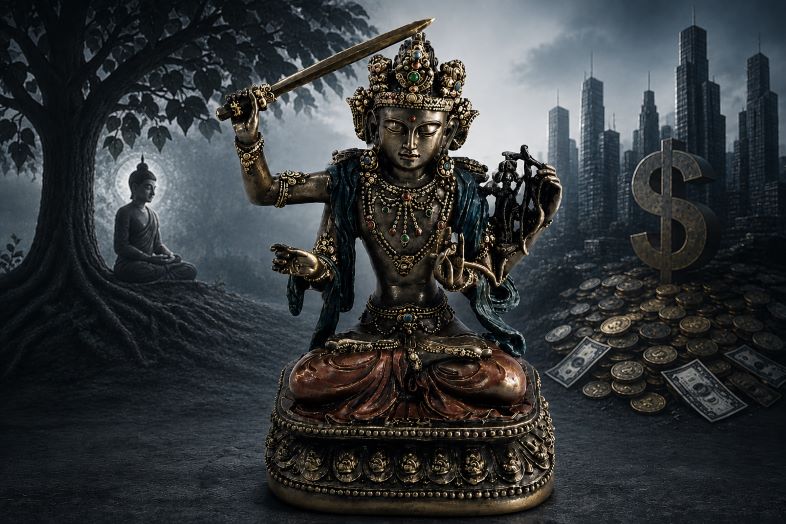
We could conclude thus: anger, yes, as fuel for revolt against stupidity (moha), its exploitation, against injustice, and against the cynicism of moneyed power. Hatred, no! Mahayana Buddhism has produced a very telling expression of this “holy anger” with the figure of the bodhisattva Manjushri brandishing the sword that slays ignorance, stupidity and other “mental poisons”, such as greed and hatred.
_____________________
Footnotes
[1] Small is Beautiful, Economics as if People Mattered, by E. F. Schumacher, first published by Blond and Briggs Ltd., London, 1973.
[2] Serge-Christophe Kolm in Le bonheur-liberté : Bouddhisme profond et modernité, PUF, 1982.
[3] Serge-Christophe Kolm, « Le livre capital du XXIe siècle. À propos du Capital au 21e siècle de Thomas Piketty », in Revue de philosophie économique 2016/2 Vol. 17, p. 181-193, Vrin Editions.
[4] Buddhist Economics: A Middle Way for the market place, by Ven. P. A. Payutto (1992-1994), translated by Dhammavijaya and Bruce Evans, compiled by Bruce Evans and Jourdan Arenson.