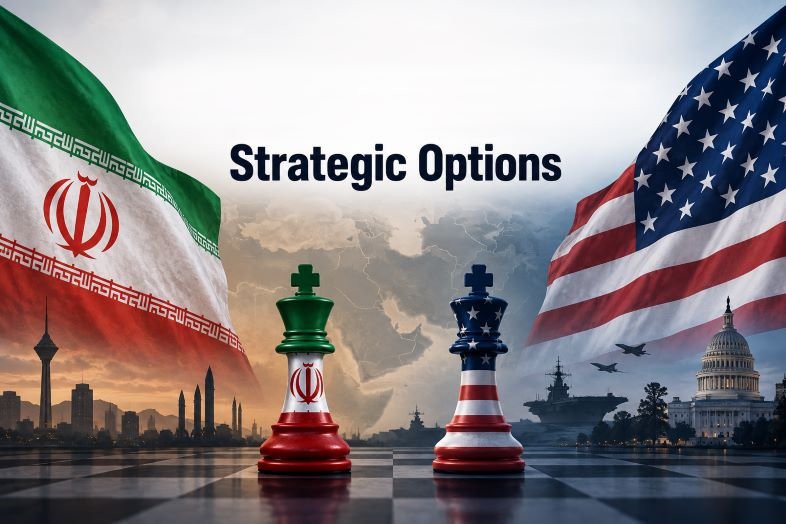

Can a criminal empire have the right to judge and condemn?
US foreign policy has historically been presented as “an expansive force for democracy, human rights, and the liberal international order.” However, an objective analysis reveals a diametrically opposite reality. This is not an occasional ethical deficit, but rather the necessary expression of the class nature of the American state and its structural position within the global capitalist system. The recurrence of unilateral measures, the extraterritorial imposition of domestic laws, direct military interventions, and covert coups d’état do not constitute correctable anomalies; they are the regular way in which the hegemonic power manages its empire. With this record of illegal and immoral aggression, this criminal empire lacks any right, moral authority, or faculty to condemn, criticize, or label any country on the planet. The question that gives this work its title—can a criminal empire have the right to judge and condemn?—finds its answer here: a resounding NO. US foreign policy operates in a constant state of exception vis-à-vis international law, sheltered by an increasingly generalized impunity.
250 years of permanent war: The United States as a military-industrial complex
Since its emergence as an independent nation 250 years ago, the United States has been permanently engaged in imperial wars of plunder, except for only about 15 years throughout its entire history. War is not the exception; it is the norm, the habitual operating state of a machinery that needs to constantly feed on conflicts to reproduce itself. More than a nation, the United States has existed as a vast military-industrial complex. As military historian Andrew Bacevich, a retired US Army colonel, has pointed out: “This is not about national defense. This is about empire maintenance. It is about preserving a military-industrial complex that profits from eternal war.”
The US economy, politics, science, and culture are subordinated to the production and deployment of means of destruction. Wars guarantee profit rates for defense contractors, perpetuate geopolitical influence, and justify the continuous expansion of the military budget—the highest on the planet, greater than that of the next ten countries combined. Without permanent war, the military-industrial complex would collapse, and for war to be permanent, there must always be a new “axis of evil.”
The military history of the United States is an uninterrupted chronicle of aggressions: from the wars against the aborigines who occupied the lands that today constitute the Union and the war against Mexico (1848) that stripped that country of half its territory, to the Spanish-American-Cuban War (1898) that marked the leap into overseas imperialism. Not to mention the dozens of military interventions, proxy wars, and coups d’état that marked the 20th century, the 21st century has brought not a change of course but an intensification of barbarism: Afghanistan (2001), Iraq (2003), Libya (2011), and now the escalation in West Asia against Gaza, Iran, and Lebanon. Each intervention has ended with hundreds of thousands of civilians dead, destruction of infrastructure, mass migration, and chaos.
The open front in West Asia: Gaza, Iran, Lebanon, and Resistance against the empire
The alliance between the United States and “Israel” has unleashed a multifaceted offensive against the peoples of the region. In this web, “Israel” has played a leading role as instigator, pressuring Washington to deepen its involvement on every front.
Gaza: Genocide and US complicity
Since October 2023, “Israel” has designed, executed, and escalated the aggression with the aim of annihilating and displacing the Palestinian population. The United States has provided unprecedented backing. More than 72,000 Palestinians have been killed (figures exceeding 100,000 when considering indirect effects), mostly women and children, and nearly two million have been displaced. Washington has vetoed UN resolutions demanding a ceasefire, sent 2,000-pound bombs, and deployed aircraft carriers to protect “Israel”.
“Israel” has known how to exploit Washington’s strategic dependence. It has filled the pockets of politicians and congressmen with compromising sums. Moreover, there are well-founded speculations that this pressure includes blackmail based on the voluminous Jeffrey Epstein files, which contain thousands of mentions of Trump. Declassified documents reveal that the US president has been “compromised by Israel.” As rapporteur Francesca Albanese has rightly denounced, the United States is an “active accomplice” to the genocide in Gaza.
Iran: Maximum pressure and shared aggression
On another front of this same regional offensive, “Israel” has pressured Washington to participate directly in the violent assault on Iran, an ancient country in the Middle East. It has instigated the hardening of US policies, favoured the failure of diplomatic efforts, and indefinitely prolonged the war. Tel Aviv has assassinated nuclear scientists, sabotaged facilities, and bombed targets in Syria. Washington, for its part, has provided full support. Without a doubt, “Israel” has set the pace of escalation, dragging the United States into an irresponsible confrontation with no way out.
The campaign against Iran includes a naval blockade in the Strait of Hormuz, sanctions on the parallel oil economy, restrictions on Iranian airlines, and sanctions on weapons procurement networks. The declared objective is to provoke “regime change”. However, Iran has not only not collapsed but has built a wall that has halted the aggressive advance, deepened its alliance with Russia and China, and consolidated itself as the head of an axis of resistance.
Lebanon: Extension of war as foreign policy
Unconditional support for “Israel” is a manifestation of Washington’s structural commitment to war as foreign policy. In Lebanon, “Israel” has pushed for an escalation against Hezbollah. Without US backing—weapons, fuel, UN veto, sanctions—this escalation would be impossible.
In May 2026, the Treasury Department expanded secondary sanctions against deputies, ambassadors, and high-ranking officials linked to Hezbollah. Any “material support”—including donations for schools and hospitals—is criminalized. Israeli bombings in southern Lebanon have destroyed civilian infrastructure and displaced hundreds of thousands of people. “Israel” conducts military violence; Washington provides fuel, weapons, and diplomatic cover. This is not a deviation from US foreign policy: it is its essence.
The ‘legality’ of the strongest: Impunity, no brakes
The international order that emerged after 1945 prohibits the use of force against the territorial integrity of any state. For the United States, this normative body has been an obstacle to bypass. The doctrine of American exceptionalism—”Manifest Destiny”—has served as the ideological foundation for systematically violating international law. The “preventive war” against Iraq in 2003, under the false premise of weapons of mass destruction, created the precedent of attacking any nation that the White House labels a threat.
Washington has legislated to protect itself from any supranational jurisdiction. The “Hague Invasion Act”—whose official name is the American Service-Members’ Protection Act (ASPA), enacted in 2002—authorizes the use of military force to free any U.S. citizen or citizen of allied countries detained by the International Criminal Court. Furthermore, it prohibits cooperation with the court and allows the suspension of military aid to ICC member countries that do not shield Americans from its jurisdiction. There is no court to judge those responsible for Iraq, Afghanistan, Libya, or Gaza. The UN Security Council is paralyzed by the veto of Western powers. The empire acts without restraint because its allies allow it. In the United States and Europe, incredibly, solidarity movements with Palestine are persecuted, labelled as anti-Semitic, thus criminalizing the denunciation of violations of international law.
The economic arm and historical pattern of the Empire
Unilateral extraterritorial measures constitute the economic arm of the empire. The Office of Foreign Assets Control (OFAC) can exclude any person, company, or country from the dollar-based financial system. The dollar is not just a currency; it is a weapon of mass economic destruction. Washington has used it against Cuba, Iran, DPRK, Venezuela, Russia, and even against allies such as France.
This economic warfare has a consistent historical counterpart: the elimination of governments that threaten the interests of US corporations. From the overthrow of Árbenz in Guatemala (1954) in defense of the United Fruit Company, the coup against Allende in Chile (1973), to the invasions of Iraq and Afghanistan. The looting of Iraq led to more than one million deaths and opened control of its oil to ExxonMobil, Chevron, BP, and Shell. The invasion of Libya (2011) destroyed the Libyan state, generating civil wars, human trafficking, and slave markets. The “despicable consequences” are not collateral effects; they are the predictable result of the destructive logic of the empire.
The total siege of Cuba: The microscopic obsession with harming every crack
Here, an elementary question arises: What has Cuba done to deserve this brutal, permanent punishment? The answer is nothing. Absolutely nothing. Because Cuba is not, nor has it ever been, a threat to the United States or to any country in the world. On the contrary, Cuba offers international solidarity: doctors who save lives, teachers who teach literacy, selfless cooperation in the face of natural disasters, vaccines for the Global South. There is not a single reason to punish Cuba. Instead, there are all the reasons to admire it: its dignified resistance, its ability to withstand almost seven decades of blockade without surrendering, its lesson that dignity is worth more than submission.
Despite this, legal perversion reached its zenith with the Helms-Burton Act (1996), whose Title III allows lawsuits in US courts against any company or person—of any nationality—that “traffics” in property nationalized in Cuba. To this were added the more than 240 sanctions that Trump applied during his first term. The Cuban case is the longest and most brutal expression of this policy of asphyxiation against a small island. Declassified documents from 1960 reveal the goal: “to provoke hunger, despair, and the overthrow of the government.”
Trump’s return in 2026 deepened the hostility. On January 30, 2026, his administration signed an order imposing tariffs on any country that supplies oil to Cuba. On May 1, 2026, he signed another executive order authorizing the blocking of assets of any foreign person operating in Cuba’s energy, defense, mining, and finance sectors, as well as secondary sanctions on foreign banks that facilitate transactions with sanctioned entities.
On May 7, 2026, sanctions were imposed against GAESA—a business organization designed to escape the complex web of anti-Cuban economic measures. On June 4, 2026, sanctions were imposed on the Ministry of the Armed Forces, the Cuban Institute of Friendship with the Peoples—to hinder donations from solidarity friends that this institute receives to partially alleviate the damage—the Committees for the Defense of the Revolution (a civil organization that brings together 80% of the population), and President Díaz-Canel and his wife. The Department of Justice, as an extreme measure, announced criminal prosecution against the leader of the Revolution, Raúl Castro Ruz, for the 1996 shooting down—30 years ago—of two aircraft belonging to the terrorist group “Brothers to the Rescue.” These planes violated Cuban airspace and dropped political leaflets against the Revolution more than 25 times despite repeated warnings, which the US government deliberately chose to ignore. This “indictment” is another political manoeuvre to justify military aggression.
On June 10, 2026, additional sanctions were announced against CUPET, the state oil company, based on flagrant lies to further justify energy asphyxiation. Washington has searched with a microscope for every crack to damage the Cuban economy. I dare to affirm that, in their desperation over the fact that Cuba does not surrender, they must have resorted even to artificial intelligence to find increasingly pernicious alternatives and track any type of transaction involving Cuba. The former European shield (Blocking Statute) and other “antidotes” have proven useless. Countries bow down: Meliá, Iberostar, Iberia, European shipping companies, and other business organizations have abandoned Cuba under Washington’s pressure. The same happened with the Canadian mining company Sherritt.
But there is something they cannot foresee: the unlimited capacity for resistance of the Cuban people. In their furious quest, perhaps they should ask AI why, after six decades of blockade, the Cuban people have not surrendered. There is a broad record in our history that serves as an explanation and that would allow AI to recommend that no more time be wasted and that no more useless harm be done. Cuba will not submit; the only solution is civilized, equal-to-equal dialogue. Cuban resistance is not a data point; it is a well-founded moral and historical decision. It is dignity.
Two announced failures for November 2026
If Washington dares to invade Cuba, or even if it continues with its extreme measures, it will arrive at the November 2026 elections with two major strategic failures:
Iran: Despite decades of sanctions and aggression, Iran has demonstrated a defensive capability that has effectively defeated the warmongers. Its response to the aggressors has inflicted multi-billion-dollar losses on the United States, which has had critical repercussions inside the empire. The strategic landscape in the Middle East has changed: US power has been challenged, and control of the Strait of Hormuz has indisputably passed into the hands of Iran, the country that leads the resistance. Surely, in the peace agreements, many of the Persian country’s demands will have to be addressed—including an end to Israeli aggression against Lebanon. Definitely, Iran has consolidated a new doctrine of asymmetric defense and has emerged from a position of strength. It is a lesson that imperial powers ignore at their own peril.
Cuba: Despite a nearly seven-decade-long blockade—intensified by executive orders, secondary sanctions, and a microscopic search of every crack—the Cuban people have not surrendered. The island resists. Total asphyxiation has not arrived, nor will it. Once again: Cuba is not a threat to anyone; it only offers doctors, solidarity, and example. There is no reason to punish it, but every reason to admire it. If Washington does not come to its senses and decides to launch a military aggression, a tragic bloodshed will occur on both sides. The Cuban Revolution is not a government or a regime; it is a phenomenon that encompasses the entire people, determined to firmly face any warlike adventure and make it fail. There would be great suffering, but the Yankee troops would get bogged down in a quagmire.
Iran does not fall. Cuba does not surrender. And no human or artificial intelligence will ever be able to bend the dignity of peoples who have decided to be free. That is why this criminal empire, which criticizes everything and respects nothing, has not—and has never had—the slightest authority to point a finger at anyone. The answer to the initial question is therefore unequivocal: no.
The urgent need to end impunity
The wars of plunder, invasions, extraterritorial blockades, the bombings of Gaza and Lebanon, the criminalization of solidarity with Palestine, the siege of Cuba, and the fraudulent indictment against Raúl Castro converge in the same unacceptable reality: the generalized impunity of the empire. There is no brake because there is no effective accountability mechanism. The ICC has been threatened, the Security Council is paralyzed, and national courts refuse to investigate. It is urgent to build a global movement for effective international justice.
Ending impunity is not an option: it is a necessary condition for the survival of international law and of humanity itself.
Pedro Monzon Barata, former Cuban Ambassador and Consul General in Sao Paolo; researcher at the Center for International Policy Research.
__________________
References:
Albanese, F. (2024). Genocide as colonial erasure. United Nations General Assembly.
Albanese, F. (2025). Gaza genocide: A collective crime (A/80/492). United Nations General Assembly.
Albanese, F. (2026). Torture and genocide. United Nations Human Rights Council.
American Service-Members’ Protection Act of 2002, Pub. L. 107-206, 116 Stat. 820 (2002).
Bacevich, A. J. (2002). American empire: The realities and consequences of U.S. diplomacy. Harvard University Press.
Bacevich, A. J. (2010). Washington rules: America’s path to permanent war. Metropolitan Books.
Chomsky, N. (2003). Hegemony or survival: America’s quest for global dominance. Metropolitan Books.
Cuban Liberty and Democratic Solidarity (LIBERTAD) Act of 1996, Pub. L. 104-114, 110 Stat. 785 (1996).
Executive Order 3447. (1962, February 3). Embargo on trade between the United States and Cuba. 27 Fed. Reg. 1085.
FBI Declassified Memorandum. (2026, January). Trump compromised by Israel [Epstein files].
Human Rights Watch. (2002, August 3). U.S.: ‘Hague Invasion Act’ becomes law [Press release].
Kinzer, S. (2006). Overthrow: America’s century of regime change from Hawaii to Iraq. Times Books.
Toft, M. D., & Kushi, S. (2023). Dying by the sword: The militarization of US foreign policy. Oxford University Press.
U.S. Department of Justice. (2026, January). Epstein Files Transparency Act [Declassified documents].
U.S. Department of State. (2026, May 19). Further U.S. sanctions on Cuban regime elites [Press statement].
U.S. Department of State. (2026, June 4). Sanctions on Cuban actors responsible for subversive anti-American activities [Fact sheet].
U.S. Department of State. (2026, June 5). Cuba sanctions [Fact sheet].