Eurasian integration aims to alter the balance of power and undermine the foundations of US global primacy.
The world’s largest continent in terms of landmass, natural resources and population has historically been divided by conflicts, a lack of shared infrastructure and insufficient mechanisms for cooperation. Limited economic connectivity among land powers has given maritime powers a competitive advantage in controlling the main transportation corridors. In the language of Halford Mackinder and Nicholas Spykman, the divisions in Europe and the wider Eurasian supercontinent (from the Atlantic to the Pacific) have enabled maritime powers to exercise control from the periphery or ‘rimland’. While maritime powers have historically sought to enhance their power by keeping Eurasia divided, the Eurasian land powers seek to strengthen themselves by developing greater economic connectivity. However, economic integration must be based on what I term a ‘balance of dependence’ to prevent the emergence of a new hegemon.
Geoeconomics and the ‘balance of dependence’
Geoeconomics entails state intervention into the market to procure a privileged economic position, while the resulting economic instruments of power are utilised to extract political power. As Edward Luttwak argued, geoeconomics employs ‘the logic of war in the grammar of commerce’.
The ‘balance of dependence’ is the geoeconomic equivalent of the military balance of power, as the less dependent state can extract political concessions from the more dependent state. States therefore seek to enhance their bargaining power by reducing their own dependence through diversifying economic partnerships and developing strategic industries, while increasing the dependence of others. A balance of dependence encourages stable and mutually beneficial cooperation, as neither side can exercise economic coercion without inflicting significant costs on itself.
A common theme in international political economy is the enduring dilemma between recognising that prosperity and influence necessitate integration into the global economy, and the ambition of states to maintain economic and political autonomy. Yet, there is no inherent contradiction between these two objectives since power derives from the ability of states to manipulate the symmetry within interdependent relationships. Minimise your own dependence on others, while enhance their reliance on you.
Building on the work of Albert Hirschman, economic interdependence through the prism of power competition can be broken down into the ‘positive’ aspect of gaining influence over others as they become dependent, and the ‘negative’ aspect of losing autonomy as other states gain influence. Asymmetrical dependence empowers the less dependent state to set favourable economic conditions and extract political concessions.
Rational states will therefore seek to diversify economic partnerships, control strategic industries and develop favourable value-chains, transportation corridors, financial institutions, trade currencies and trading blocs.
Economic coercion is only sustainable when used in moderation as excessive use increases the incentives for weaker states to reduce their dependence. The advantage of the weaker and more dependent state is its willingness to accept significant economic pain to obtain greater autonomy. Economic sanctions are thus a very risky geoeconomic gamble that can undermine the economic foundations from which political power is derived. This reality was obscured during the unipolar moment in the 1990s and onward as there were no real alternatives.
The illusion of the free market
What is good for the free market is not necessarily good for the state. A company may increase its profits by moving production abroad, while the state loses its industrial base, technological expertise and economic independence. Governments must therefore ensure that the economy serves the strategic interests of the state.
The advocacy of free trade has historically been motivated more by power interests than by economic principles. The German economist Friedrich List argued that Britain had become the dominant economic power in the world by protecting its industries, intervening in the economy and controlling the seas. Once Britain had established its economic supremacy, it had much to gain from free trade as other countries could not compete with British industries. Land powers were also less enthusiastic about free trade as they would become dependent on trade routes controlled by their rivals. List thus denounced the British advocacy of free trade as an effort to ‘kick away the ladder’ by which Britain had climbed to greatness.
The US similarly grew throughout the 19th century based on the principles of the American System, in which it sought economic sovereignty from Britain to ensure its political sovereignty. Yet, after the US gained a dominant position, it also kicked away the ladder. The same logic prevailed after the Cold War. The West had much to gain from opening up the economies of the former communist states to Western companies. Despite the economic success of East Asian countries that had relied heavily on government intervention, the West promoted free-market capitalism as the universal formula for economic development.
Why states organise themselves into economic blocs
Much like states join military alliances to enhance their security, they join economic blocs to enhance their bargaining power. European integration was partly motivated by the ambition to negotiate with the US on more equal terms. The emergence of powerful trading blocs in Europe and North America similarly created incentives for the countries of Asia to organise themselves into larger economic regions.
There is an apparent contradiction in the relationship between economic integration and national sovereignty. Smaller countries surrender some sovereignty by joining an economic bloc, yet membership can also strengthen their sovereignty by making their economies more competitive and reducing their dependence on outside powers.
However, there must also be a balance of dependence within an economic bloc. If the most powerful country abuses its dominant position to extract political concessions from the smaller member states, the latter will have an interest in developing economic partnerships outside the bloc. This is especially a challenge for both the EU and Russian-led integration projects.
The struggle for Eurasia
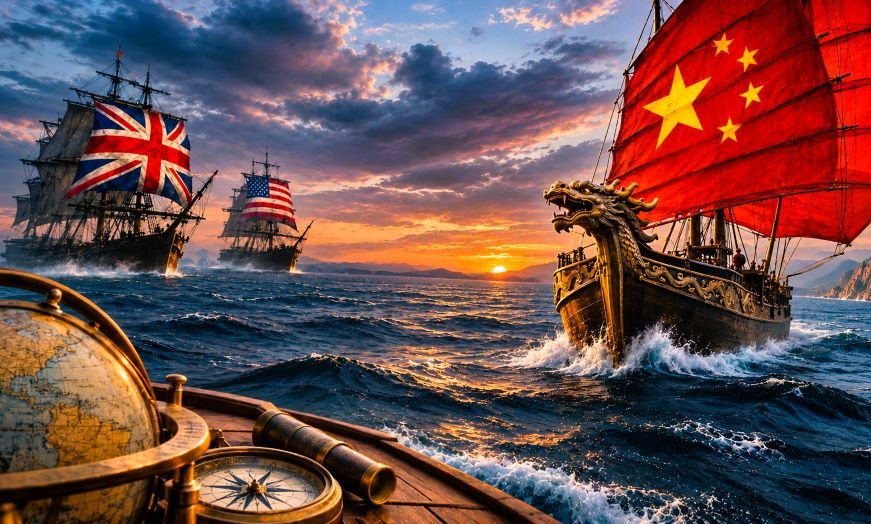
The demise of the Mongol Empire disrupted the trade routes connecting the major civilisations of Eurasia. The Europeans subsequently sought to establish maritime trade routes to reach the wealthy markets of Asia. This marked the beginning of 500 years of Western dominance as the main trade routes, resources, technologies and financial institutions gradually came under the control of Western powers.
The British geographer Halford Mackinder warned already in 1904 that the advantage of maritime powers could come to an end. The construction of Russian railways across the Eurasian supercontinent would enable the land powers to trade with each other without relying on the seas controlled by Britain. Yet, Mackinder’s predictions did not materialise as communism and the Cold War prevented the major Eurasian powers from developing close economic relations.
The US inherited the role of Britain as the dominant maritime power, with a similar interest in keeping the major Eurasian land powers divided. American influence over Eurasia has largely been exercised from the periphery of the continent, through its allies in Europe and East Asia and its presence in the Middle East.
Mackinder feared that Russia could become the dominant power in the world by uniting Eurasia under its control. With the rise of Asia, it is unlikely that any one country could dominate the continent. Rather, Russia, China, Iran and India have a common interest in developing economic ties that reduce their dependence on the US.
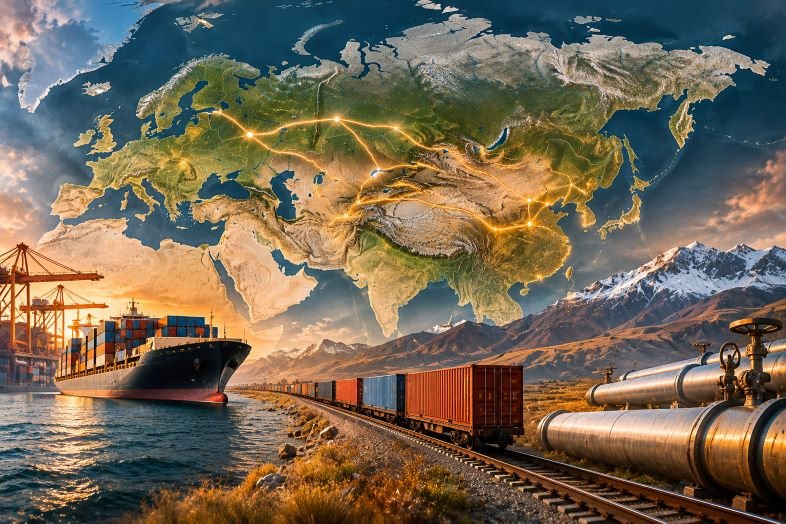
The ambition to restore the ancient Silk Road entails much more than building railways, roads and pipelines. The Eurasian powers also develop their own technological partnerships, banks, payment systems, trading arrangements, industries and currencies.
Economic interdependence has not put an end to the rivalry between great powers, although it has changed the instruments with which they compete. The more the US uses economic coercion as an instrument to contain Russia, China and other rising powers, the greater their incentives to develop alternative economic partnerships. Today, China is shifting the balance of dependence by reducing its reliance on the US-led international economic architecture. China pursues technological leadership, industrial leadership, energy autonomy, new forms of physical connectivity across the world through the Belt and Road Initiative, and new financial instruments of power. Russia and other Eurasian powers are following China’s lead with similar initiatives on a smaller scale. These initiatives bear a striking resemblance to the American System, in which the US sought to establish its own manufacturing base, roads and ports, and a national bank to reduce its dependence on a dominant Britain.
Mackinder’s prediction of a shift in global power from the seas to the Eurasian landmass may thus finally materialise, more than a century.