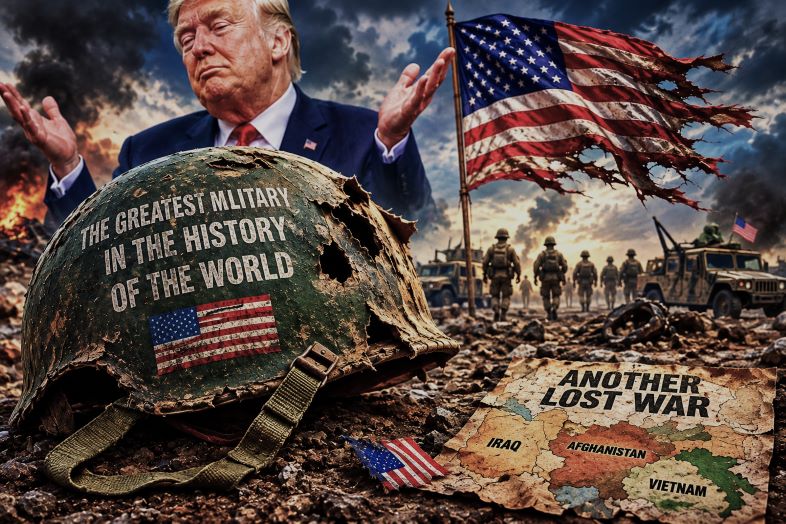
Trump was an idiot for starting the war, but it is the US military that lost it.
It makes my skin crawl whenever I hear someone recite the mantra – “the US has the greatest military in the history of the world”.
I know you have heard the same “truism” before.
Obviously, such “American patriots” have never heard of Genghis Khan.
The Mongols conquered most of Eurasia in the 13th century and put together the largest contiguous land empire in history.
They seldom lost a battle in the process.
The cheerleaders of the US war machine seem also unaware that German Wehrmacht was probably the deadliest military in the world in 1940 or the Soviet Red Army in 1945.
The pinnacle for US military power was the Desert Storm campaign against Saddam Hussein in 1991.
But it was 35 years ago.
The US has lost pretty much every major war since then.
I wouldn’t care to call the Venezuela snatch job either war or major. Wars usually involve your enemy fighting back.
Before the Desert Storm, the US also lost its last major war in Vietnam.
So, the Desert Storm is basically bookended by defeats. It is the exception that proves the rule.
In short, calling the US military the “greatest” is a hyperbole that has little empirical data to back up.
Perhaps a bit hard to swallow for those allergic to truth but it is what it is.
Statistically, there is no doubt the US military is the most expensive in the history of the world. But with a mixed record of effectiveness, if one is charitable.
I’m no doctor but it is clear anyone who claims the US military is the GOAT would medically benefit from a frontal lobotomy.
For the Iran war, the US’s latest adventure, Trump has been getting a shitstorm of criticism.
No argument that Trump is an ignorant and malignant doofus who was baited by the Jews and is guilty of launching a criminal war.
But let’s be fair – he was an idiot for starting the war, but it is the US military that has lost it on the battlefield.
The much-touted US war machine has simply failed to achieve victory, period.
I wrote an essay in mid-March, three weeks after the surprise attack, and titled it “Iran has already won”.
Back then, I was referring to Iran’s pending strategic victory of leveraging the Hormuz to defeat US war goals.
But things have gone farther than my predictions.
At this point, one can argue – with a strong case – the Pentagon has militarily lost the war.
It has dropped a lot of bombs and killed many but has failed to achieve any tangible success on the battlefields.
Unless its war objective is to hand Tehran control over Hormuz and make it the dominant regional power. Wink wink.
The failure in Iran has exposed the US military is truly a “paper tiger”, as Chairman Mao observed more than half a century ago.
Defining military victory
Chairman Mao wrote that “politics is war without bloodshed, while war is politics with bloodshed.”
Carl von Clausewitz said that war is an extension of politics.
Textbooks define “military victory” as: translating battlefield success into enduring political outcomes.
It requires not just defeating an enemy’s armed forces, but compelling that adversary to accept a permanent shift in political will and establishing a favorable post-conflict order.
By that measure, the US has failed miserably and totally – it didn’t defeat Iran’s army; the shift in its political will is to become more anti-USrael; and the war established a less favorable post-conflict order for the US, with Iran securing de facto control over Gulf oil supply.
Some argue that USrael achieved tactical/operational victory over Iran since they destroyed much of Iranian air defense and navy, killed its political and military leaders, and caused severe economic and humanitarian hardship.
They are wrong even on that account.
This line of argument is equivalent to a boxer claiming victory in the middle rounds because they landed more hits, ignoring the fact that their opponent is still standing and actively fighting back.
In the theater of war, just as in the ring, absorbing massive punishment but delivering the final, paralyzing counter-punch—or simply outlasting the opponent’s stamina until they want out—is the definition of winning.
Iran has effectively used a rope-a-dope strategy by absorbing the initial strikes from USrael while preserving its most lethal asset – the ability to choke global energy at the Strait of Hormuz.
Furthermore, Iran has used asymmetrical warfare with drones and missiles to achieve horizontal escalation dominance against the USrael targets across the Gulf region.
Iran has denied the enemies their political goals and forced the US to sue for peace.
It has defended its sovereignty and is dictating the endgame – the definition of success.
Iran’s success is not only at the strategic level. Even at a tactical level, Iran has prevailed as it has destroyed far more high-value US military assets than it has lost.
These include strategic early warning radars, fighter jets, AWACs, refueling tankers, ISR drones, and nearly all US bases in the region.
Iran has also exhausted much of US offensive and defensive arsenal, significantly reducing its capability to continue the fight or wage wars elsewhere.
Even the Trump regime now realizes it will almost certainly lose any war of attrition if a prolonged conflict ensues.
Most importantly, Iran has shown the world the US military is hardly an indominable power when confronted with a committed opponent willing and able to fight back.
The US military has lost fair and square
1) It has used all its power to wage a destructive war but just couldn’t win
Winning is the result of both intent and capability.
No one can claim the US military has lacked the “intent”.
It has thrown everything it has at Iran, including unproven military AI technology such as the Palantir Maven system which resulted in the massacre of 168 innocent school girls on the first day of the war.
The US has held back nothing, short of nuclear bombs.
I wrote about how the US has thrown the “kitchen sink” but to no avail in another earlier essay.
While it has the intent, the US military simply doesn’t have the capability to deliver a “W”.
This is in spite of an annual budget over 100 times bigger than Iran ($1 trillion vs. $10 billion).
2) It is not prepared for modern asymmetric warfare
The US has relied on its old playbook from the days of the first Gulf war – overwhelming firepower, air superiority, regional vassal network, military bases, and information warfare.
It also used sneak attack under the disguise of negotiations to further improve its position.
In theory, USrael has every advantage over Iran.
However, Iran was not Iraq.
It didn’t collapse under USrael bombardment. Instead, it absorbed the attack and fought back with its own asymmetrical arsenal of drones and missiles.
Iran further escalated horizontally by attacking the Gulf states who are enabling USrael aggression.
Iran methodically targeted radar and satellite communication systems across US bases from the outset.
By destroying these, Iran has eliminated the US military’s advanced early warning capabilities, leaving forces vulnerable with only minutes of notice before incoming strikes.
Iran deployed coordinated drone swarms and missile salvos to deliver saturation attack on US assets, which the US is ill-prepared to handle.
A critical component of the asymmetric war is the lopsided cost exchange where the US was forced to expend interceptors costing millions to fend off incoming drones and missiles that cost a small fraction.
The world now knows the US military is one that can deliver punches but cannot handle counterpunches.
Interestingly, it is the same US trait when it comes to trade and technology wars with China.
When Beijing pushes back with reciprocal tariffs and counter sanctions such as ban on rare earth magnets, Washington quickly loses leverage and is forced to fold.
Last summer, I wrote an essay titled “Revolution is not a dinner party”, criticizing Iran’s soft response to US bombing of its nuclear facilities in June 2025.
The new Iranian leadership’s approach contrasts sharply with the old regime under Ayatollah Ali Khamenie.
The new government has hardened its resolve and hit back firmly, to its great benefit.
On top of not able to handle counterpunches, the US has behaved like a whining loser when it was hit by a proactive Iranian attack on its Muwaffaq Salti Air Base in Jordan on July 17th.
It cried foul and accused Iran of “reckless escalation”, never pausing a second to compare this “treachery” with USrael’s own sneak decapitation attack which also included bombing a girl’s school.
This clownish hypocrisy reminds me of an old Stephen Chow movie Justice, My Foot where a small-time hooligan announced to his enemy: “the rule of the fight is I can hit you in the face, but you can’t”.
Never did I think the “mighty” US military would resort to the same thuggish logic.
3) The US bases are liability, not asset – for itself and the “host” nations
One of the cornerstones of the US global power projection is its network of some 800 military bases in its “allied countries” – more accurately, vassals or occupied territories.
These are forward-deployed outposts near the borders of its designated foes where the US stocks weaponry and personnel.
The US has over 300 such bases in Asia encircling China and a similar number in Europe against Russia.
The Iran war has shown such forward basing is in fact a liability, rather than asset.
The two dozen US bases surrounding Iran have been relentlessly attacked by Iranian drones and missiles.
Most are unlikely to be rebuilt since the US clearly cannot protect them.
Furthermore, such bases expose the “host nations” to retaliatory attacks. They are effectively hostages in conflicts that they may or may not want to be involved in.
Finally, such vulnerable forward basing is no match with geography itself. They fail to overcome the tyranny of distance that no logistics chain can compensate for.
Iran can rely on its mountainous terrain and proximity to the Hormuz chokepoint as home court advantage to defeat an overstretched enemy from outside the region.
4) Unfixable structural issues facing the US military
The most damning verdict from the war is found here.
The Iran war, short as it is, has exposed US military problems that are structural and unfixable in the current military industrial system.
– Inability to handle high intensity war. It is important to note that actual intense fighting in Iran added up to less than 8 weeks (the opening 39 days plus the 13 days second-wave attacks after the US broke the MOU).
Yet the US has already exhausted much of its arsenal, both offensive and defensive. Imagine how it would fare in a true high-intensity war with a peer superpower such as China and Russia.
It’s doubtful the US could sustain for more than a couple of months in a war near China’s shores.
A WW2-style prolonged conflict is simply off the table.
– Low magazine depth and low-density boutique weapons. The US weapon inventory consists of a small number of pricy and complex weapons such as air defense interceptors and stand-off long-range missiles.
It has become public knowledge that the US has exhausted most of its critical ammunitions, according to reports from Reuters, CNN, and CSIS.
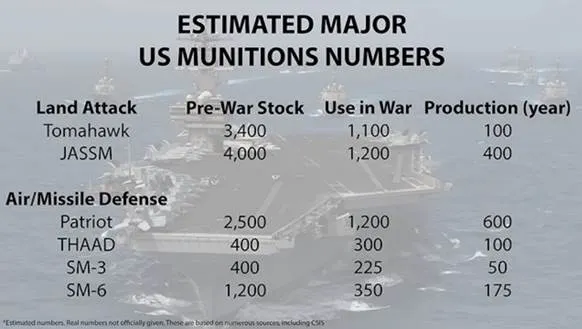
Note that the above numbers are already outdated and the current level of US stockpile is even lower.
– Lack of industrial depth and supply chain dependency. This is even worse than a temporary weapons shortfall.
It is estimated that it will take 3 to 5 years for the US military to replenish the modest number of ammunitions expended during the war.
Again, I emphasize the Iran war is not a high-intensity conflict that a US-China war would be, for example. CSIS war games show that the US will use up its entire missile arsenal within two weeks in a conflict with China.
Given the massive backlog of the military industrial complex even before the war, it’s likely the process could take even longer than the estimates.
While the US regime can print any amount of paper money to buy weapons, it cannot print bombs or missiles.
To expand production, you need factories, materials, and skilled labor – the kind of things that a deindustrialized economy is ill prepared to supply.
Beyond capital expenditure and skill development, the US military industrial complex suffers from massive supply chain dependence on the very enemy it plans to fight – China.
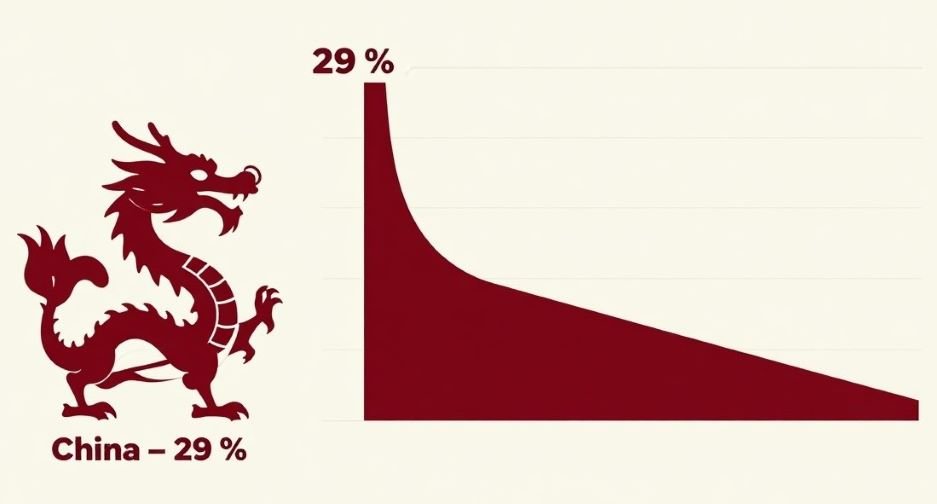
It is well known by now China has a chokehold on rare earth elements indispensable for modern weapon production. China produces over 90% rare earth globally and has a virtual monopoly for the critical heavy rare earth.
The US dependency on China extends beyond rare earth and extend into other minerals critical for weapon systems such as gallium, germanium, tungsten, graphite, and antimony.
A 2025 report by the US-China Economic and Security Review Commission found that 78% of components used in Pentagon weapons systems contained critical minerals sourced from China.
92% of the US Navy weapon systems are affected.
Such dependency goes even further and includes drone parts, energetics, and even key pharmaceutical ingredients such as antibiotics, something they would need during wartime.
There is little prospect that the US can achieve supply chain independence in these critical inputs in the next decade or so.
For those interested in the rare earth chokepoint, I wrote an article last April on the subject.
– Unreformable for-profit private military contract system. The essence of the US military industrial complex today is a grift system.
The MIC is in cahoots with politicians and Pentagon generals to loot the defense budget through over-engineered weapon platforms that deliver little bang for the buck.
Cheap weapons, even if perfectly effective, are not profitable for the oligopolistic military suppliers.
This is why weapons like the LUCAS cheap drones get no attention while expensive ammos like Patriot and THAAD are heavily promoted.
Complex weapons that take years to make and millions more to service are the default choice in the “cost plus” and “no bids” military contracting oligopoly system.
The MIC ecosystem includes the “revolving doors” between Pentagon and defense contractors, congressmen on the payroll, legions of lobbyists and “think tankers”.
It is simply too profitable a gig to temper with.
The beauty of such profiteering enterprise is celebrated as the pinnacle of “shareholder capitalism”.
Fortunately for US’s foes, such superstructure of how the US economy is organized cannot and will not be reformed.
For some entertaining reading of the scheme, I recommend the 2003 satirical work by William Hartung How Much Are You Making on the War, Daddy? A Quick and Dirty Guide to War Profiteering in the Bush Administration.
Hartung is a meticulous researcher on the subject of the US military industrial profiteering. His works also include Prophets of War and Trillion Dollar War Machine.
5) Arrogance and sense of entitlement that is the last straw
The Iran war has exposed an unavoidable truth – the US military doesn’t have the mindset to win against strong-willed opponents.
It was led into the war by Israel’s manipulation. It vastly underestimated Iran’s resilience as well as its industrial and technical capacity. It believed in the ludicrous and constant disinformation campaign waged by its own “commander-in-chief”.
It is also psychologically weak – bemoaning Iran’s retaliations and blaming China and Russia for supporting Iran.
What makes the US feel that it’s OK to launch a decapitation attack during negotiations and threaten civilization-ending “military terror”, but if Iran hits back, it is a “reckless escalation”?
What makes the US feel that it’s OK to sell arms to Taiwan and provide weapons and intelligence to Ukraine, but if China supplies MANPAD to Iran or Russia provides satellite images, it is entitled to cry foul and demand a cease-and-desist?
Such child-like narcissism and cynical hypocrisy inevitably weaken the mind like poisons weaken the body.
Confucius wrote 2,500 years ago in his Analects that “don’t do to others what you don’t want them do to you.” (“己所不欲,勿施于人”).
This is known as the Golden Rule in Chinese culture.
For a country or a military that doesn’t understand this universal human principle, no amount of military power is enough to compensate for its lack of wisdom.
The US lost the war and deserved it.