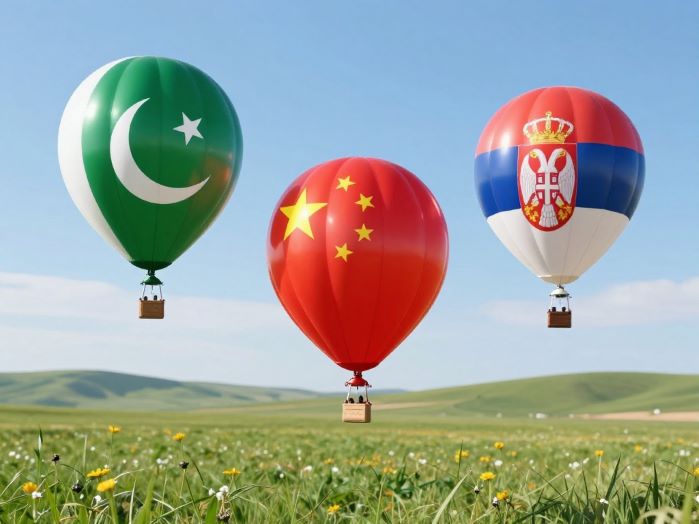
On May 24, two guests arrived in Beijing within a single day.
One came from the Balkans.
One came from South Asia.
Their journeys were different, and so were they.
But on the day they left, something happened in both of their homes.
Turmoil in Serbia, mourning in Pakistan.
Each event had its own cause. But the fact that they happened on the same day hardly seems like a coincidence.
The evening of May 23, Belgrade, Slavia Square.
More than 30,000 people were crowded there.
Students waved flags and chanted slogans. Police stood on the other side. In between, there were drumbeats, whistles, and the lingering smell of tear gas. Their demands were simple: call early elections and remove the president from office.
Serbian police later reported that 23 people had been taken into custody and several officers had been injured.
The spark that ignited the unrest had actually been smoldering for over a year.
In November 2024, the newly constructed roof at the Novi Sad train station suddenly collapsed. Sixteen people were trapped beneath it.
Protests have continued ever since. But this time, they were the largest yet. And they happened to take place on the eve of the president’s departure.
In recent years, Serbian President Vucic has consistently referred to such protests as “interference by external forces.” Last August, he even directly used the word “terrorism.”
Whether you believe it or not is another matter. But there are no absolute coincidences in this world, especially not when they happen time and time again—no one is that naive. The next day at noon, Vucic’s private jet landed in Beijing as scheduled.
This was his first official visit to China as President of Serbia.
He himself described it as “the most important visit of his political career.”
Similarly, Pakistani Prime Minister Shahbaz also regarded the visit to China as more important than anything else.
On the day Shahbaz set out, the entire western region of Pakistan was plunged into mourning.
On the morning of May 24, in Quetta, the capital of Balochistan Province, a shuttle train was bombed.
The train was originally carrying security personnel and their families returning home on leave, preparing to transfer to the “Jafar Express.” Instead, a car packed with explosives rammed directly into it. The explosion derailed the locomotive and several cars. Two cars overturned and caught fire.
Local rescue agencies reported that day that the death toll had risen to 47, with nearly 100 people injured.
After the incident, the “Baloch Liberation Army” once again claimed responsibility. I say “once again” because this name is all too familiar to the Chinese people.
In 2018, they attacked the Chinese Consulate General in Karachi.
In 2022, they carried out a suicide attack targeting a shuttle bus for the Confucius Institute at the University of Karachi.
Their targets are not just Chinese citizens, but the China-Pakistan Economic Corridor and China-Pakistan relations.
Yet, like Vucic, Shahbaz did not cancel his trip, nor did he shorten it.
Logically speaking, at a time like this, one should return home. But Vucic did not return, and neither did Shahbaz. Why?
Because some matters are more urgent than domestic turmoil.
What has Serbia lacked most in recent years? It’s not votes. Nor is it that EU “entry ticket” that never seems to materialize.
Serbia became an EU candidate country back in 2012. Fourteen years later, the ticket hanging on the door is still fluttering in the cold wind.
Before Vucic’s departure, Bloomberg even published a special “reminder” warning Vucic that if he continued to deepen cooperation with China, the EU’s doors would remain permanently closed. There are some things the U.S. and the West won’t say outright. But everyone understands the implication.
Last year, the United States continued to pressure the Serbian oil company NIS, ultimately forcing Vucic to temporarily agree to shut down its refining facilities. In response, he publicly expressed his disappointment and surprise. He also stated that this was a political decision, not an economic one.
And when it comes to political issues, the Kosovo question is naturally unavoidable.
According to Serbian media reports, Turkey has shipped a large number of suicide drones to Kosovo. This isn’t just a slap in the face—it’s like forcing you to swallow poison. Vucic has publicly called them out for this. But what good does that do? The West couldn’t care less. As the saying goes, “When the West fails, the East rises”—and Vucic has finally come to realize this. Serbia has only one way forward.
In recent years, Chinese companies have been building factories, constructing roads, and investing in infrastructure in Serbia.
Just in early May, Vucic personally attended the signing ceremony for the “Karadjordje Leaders’ Corridor” highway.
Although it is only a little over 100 kilometers long, it opens up the lifeline of central and eastern Serbia.
Vucic repeatedly emphasized one point at the event: Chinese companies are highly efficient and reliable. Pakistan feels this most keenly as well.
While attending the China-Pakistan Investment Summit in Hangzhou, Shahbaz stated that Pakistan hopes to become “a mini-China in our region.”
Isn’t this exactly the definitive conclusion I reached earlier regarding Pakistan’s transformation following the 1957 air war? Today’s Pakistan is no longer merely a major power in South Asia or Asia—it aims to become the leader of the Islamic world.
Those who cling to the past will perish; those who innovate will thrive.
Pakistan has already traveled down nearly all those paths in the past.
The American model.
The Commonwealth model.
The Gulf capital model.
After all is said and done, what truly endures are the railways, ports, power plants, and factories—and the empowerment of China-Pakistan relations.
This year marks the 75th anniversary of the establishment of diplomatic relations between China and Pakistan. China and Pakistan are “all-weather strategic partners.”
The China-Pakistan Joint Statement specifically mentions the “upgraded version 2.0” of the China-Pakistan Economic Corridor. Building on this foundation, China and Pakistan will certainly deepen their cooperation across the board. In the words of Shahbaz, Pakistan aims to use this to build a “mini-China in the region.” As for Serbia, the title of the Joint Statement—“On Continuously Advancing the Building of a China-Serbia Community with a Shared Future in the New Era”—says it all.
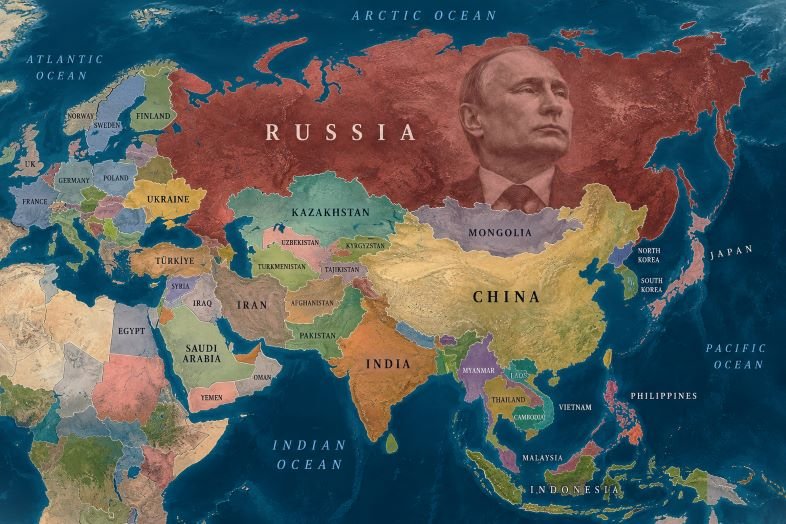
For China, Serbia and Pakistan are, in fact, two paths leading westward. One leads to Europe. The other leads to the Middle East.
Serbia is a crucial foothold for China’s entry into the heart of Europe. Pakistan, meanwhile, is a key gateway for China’s westward expansion into the Middle East, Iran, and even the Indian Ocean.
That being the case, some people are bound to feel uneasy.
The EU feels uneasy, and its “Eastern Expansion Plan” for the Balkans will become increasingly difficult to implement, while Serbia will become a key strategic foothold for the Eastern Bloc in its European industrial layout, particularly in the field of new energy. After all, technological advantages cannot be stopped by a mere “decree,” especially with profit-driven European capital in the mix. Of course, Europe also fears being carved up by three giant powers.
Compared to Europe, the United States’ stance is more complex.
The U.S. does not want the Eurasian bloc to penetrate deep into Europe, nor does it want Russia to grow too powerful. The U.S. also needs Europe to remain dependent on it. That is why, from the bombing of Belgrade back then to the unresolved Kosovo issue today, the U.S. has consistently sought to leave a rift in Europe.
However, under Trump’s leadership, the United States is demanding that Europe “make sacrifices.” This is the fundamental reason behind Trump’s constant moves against China and Russia on various levels during his visit to China.
As for Russia, after four years of war, one thing has become clear.
It must rely on the East to keep the West in check, yet it must also guard against the East’s influence.
It lacks the Soviet Union’s strength, yet it must preserve the Soviet Union’s sphere of influence. To be honest, since the end of the Cold War, the world has already overcome three major hurdles.
The first was the collapse of the Soviet Union. The United States became the sole superpower, with no need to listen to anyone else.
The second was after the Libyan civil war. The U.S. began to realize it couldn’t hold things together on its own and had to court Europe.
And now comes the third—following the U.S.-Iran war, the global landscape has undergone dramatic changes.
Once standing at the pinnacle of the world, its civilization shining through the ages. This ancient nation with a thousand years of heritage and a great people of exceptional character will ultimately return to the center of the world stage.
At this moment, if the world is to change, it will surely change.
South Korea knows, Russia knows, and the EU knows—everyone knows.
Political leaders from around the world are flocking here. Vucic is running for office. Shahbaz is running for office, too.
But some people are here to find their way.
Some are here to find the next table.
Some are here to entrust the fate of their nation.
Although things are still chaotic outside, they have already stepped inside. Once inside, things become easier.