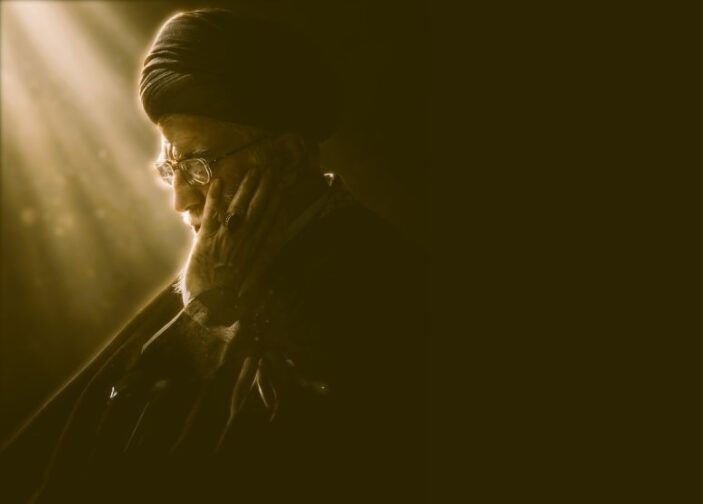
Based on a paper that offers a comprehensive forward-looking analysis of Ayatollah Ali Khamenei’s vision for managing the historic conflict between the Islamic Republic of Iran and the United States.
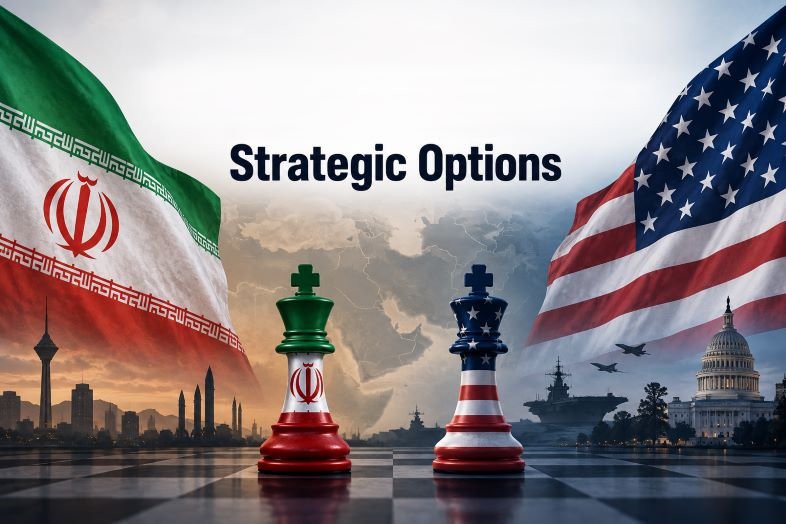
This text presents Ayatollah Ali Khamenei’s final strategic vision of Iran’s confrontation with the United States as a long-term, existential struggle rather than a conventional geopolitical dispute. Drawing primarily on his speeches and directives between June 2025 and February 2026, it argues that the confrontation must be understood historically, ideologically, militarily, technologically, and psychologically-and that its ultimate consequence could be the emergence of a post-American international order.
1. The conflict is structural, not circumstantial
Sayyed Khamenei rejects the notion that U.S.-Iran hostility stems from rhetoric such as “Death to America” or from political misunderstandings. He frames it instead as a clash between two incompatible models: American global hegemony, or what he calls “global arrogance,” and Iran’s insistence on sovereignty and strategic independence.
In this interpretation, Washington’s fundamental objective is not simply to contain Iran but to restore it to a position of dependency, controlling its strategic choices and resources.
2. The historical roots precede the Islamic Revolution
The text traces Iranian distrust of Washington to the 1953 CIA- and MI6-backed coup against Prime Minister Mohammad Mosaddegh, whose government had nationalized Iran’s oil industry. The 1979 seizure of the U.S. Embassy is consequently presented not merely as an emotional reaction to the Revolution but, in Khamenei’s interpretation, as a pre-emptive response to what he viewed as an American effort to engineer another coup.
Thus, the confrontation is portrayed as having deep historical memory, rather than beginning in 1979.
3. America’s “hybrid war” requires a multi-front response
After direct military intervention failed to achieve decisive political change, the United States allegedly shifted toward what Khamenei describes as “compound” or hybrid warfare, combining military pressure, internal destabilization, sanctions, information warfare and diplomacy.
The response rests on four principal fronts:
Breaking the psychological impact of U.S. military power: American threats and displays of military force must not be allowed to produce political paralysis or surrender.
Containing internal unrest: Domestic protests and instability are portrayed as a potential avenue for externally supported regime destabilization, making internal cohesion and public “awareness” strategically decisive.
Winning the cognitive and information war: The most dangerous battlefield is described as the mind. Propaganda, pessimism and the amplification of Iran’s weaknesses are seen as tools designed to erode public confidence-requiring an active strategy of tabyin, or clarification and counter-narrative.
Rejecting coercive negotiations:Negotiations conducted under American pressure are characterized not as genuine diplomacy but as a mechanism for extracting Iran’s strategic assets-first nuclear capabilities, then potentially missiles and other elements of national power.
4. Concession is presented as a strategic trap
The argument is uncompromising: surrendering strategic capabilities in exchange for promises of security or sanctions relief would not eliminate pressure but invite further demands. Negotiation becomes legitimate only when it occurs between parties with sufficient leverage to impose costs on one another.
The underlying principle is simple: strength deters coercion; weakness encourages it.
5. National power extends far beyond the military
Khamenei’s concept of power is presented as a composite of science, technology, military capability, national cohesion, ideological commitment and political will.
Scientific achievement is therefore treated as a strategic weapon in its own right. Advances in aerospace, medicine, biotechnology, nanotechnology and energy demonstrate that sanctions and technological isolation can be transformed into incentives for self-reliance and indigenous innovation.
The same logic applies militarily: Iran’s deterrence must be domestically produced and therefore insulated from foreign suppliers and political pressure. Indigenous missile development is presented as the clearest expression of this strategic autonomy.
6. Military power requires a “spiritual” foundation
The text argues that weapons and technology alone cannot sustain resistance. What it calls Iran’s “soft power from within”-religious conviction, national solidarity, sacrifice and willingness to endure hardship-is portrayed as the force that gives material power its staying power.
The culture of martyrdom is consequently presented not simply as religious symbolism but as a form of strategic resilience designed to neutralize the psychological advantage of a materially superior adversary.
7. The central geopolitical claim: American power is declining
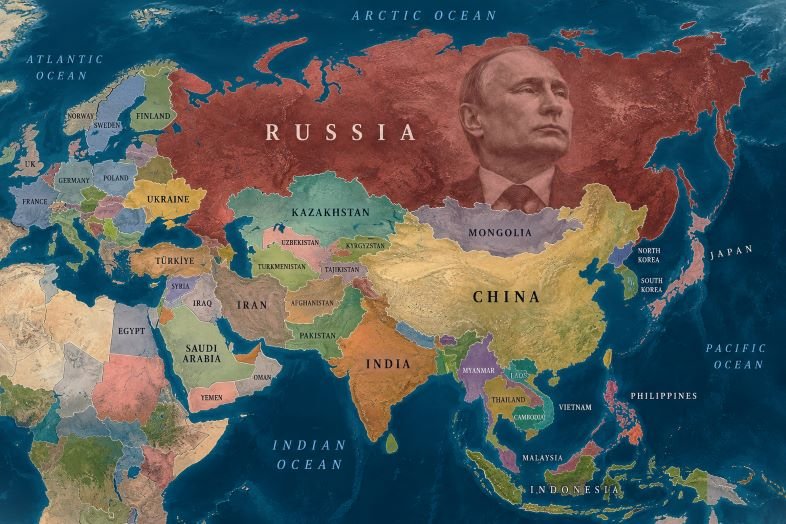
The text’s most ambitious conclusion is that the Iranian-American confrontation is part of a broader transition away from U.S.-dominated unipolarity.
Khamenei’s reading of American decline rests on several indicators: political polarization, economic and social crises, declining legitimacy, and-most importantly-the perceived inability to translate overwhelming military capabilities into decisive political outcomes.
The argument is therefore not that America lacks power, but that American power is increasingly failing to produce the political outcomes it once could.
8. Iran as the nucleus of a broader resistance network
Iran is portrayed as more than a state defending its own territory. The concept of the “Resistance Front” is presented as an expanding transnational model based on endurance, sovereignty and rejection of external coercion.
What began, in this narrative, as an Iranian experience is portrayed as spreading across the region and potentially beyond it-turning resistance from a military concept into a broader political and ideological framework.
9. The envisioned “post-American” order
The ultimate objective is not perpetual war but to make the cost of attempting to subjugate Iran so high that the adversary becomes strategically convinced that coercion will fail.
In this vision, Iranian strength is intended to produce deterrence, deterrence to produce strategic stalemate, and strategic stalemate ultimately to contribute to the erosion of American hegemony.
The text therefore sees a future international system in which sovereign states possess greater freedom of action and major powers are less capable of imposing their will through military force, sanctions or political diktat.
Bottom line
The document’s core thesis can be reduced to one strategic proposition:
Iran’s path to a post-American order runs through self-reliance, deterrence, internal cohesion, control of the information battlefield, and refusal to negotiate from a position of weakness.
In this framework, sanctions become an engine for technological independence; military threats become a test of deterrence; information warfare becomes a battle for public will; and negotiations become meaningful only when backed by sufficient power.
The broader claim is that Iran’s resistance is not merely defensive. It is presented as part of a historic transition from American unipolarity toward a more contested and multipolar international system.