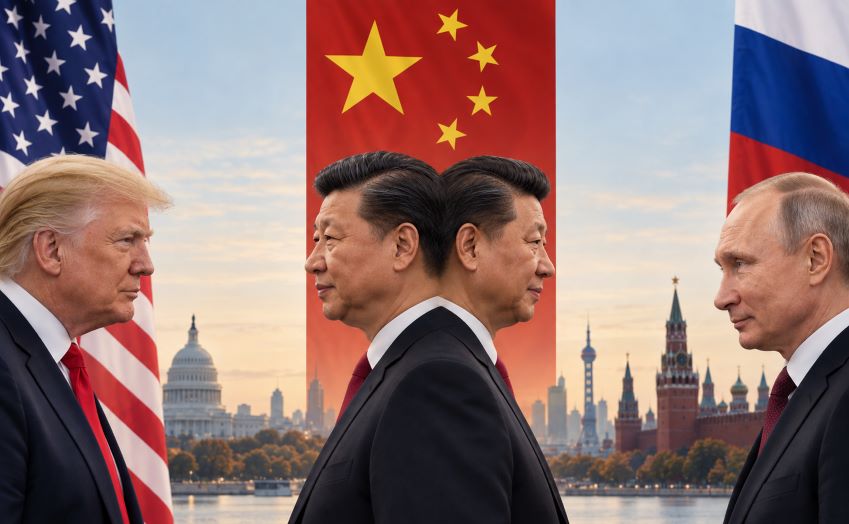
Global geopolitics has entered a phase of naked brutality, where multilateralism and international law are mere illusions, and the great powers are reconfiguring the planet according to clear zones of influence, without masks or hypocrisy, as Andrei Martyanov warns.
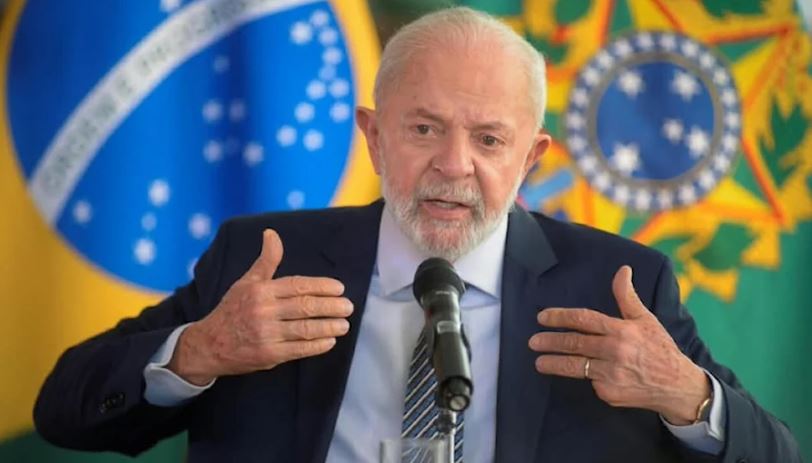
In a recent capsule, Andrei Martyanov (1), a highly cited analyst specializing in Russian military and naval issues who served in staff positions in the Soviet Coast Guard until 1990 and in the aerospace sector of the US technological-industrial complex after the dissolution of the Soviet Union, argues that the world has fully entered a historical phase where any pretense of international legality, multilateralism, or global governance is abandoned.
For him, discourses on norms, the UN, international law, and “rules-based order” have been exposed as a convenient fiction. What truly structures the international system, he argues, is naked power and the capacity to impose one’s will. In this context, the division of the planet into zones and spheres of influence reappears, stripped of ideological masks, exactly as it did during the great imperial periods of the past.
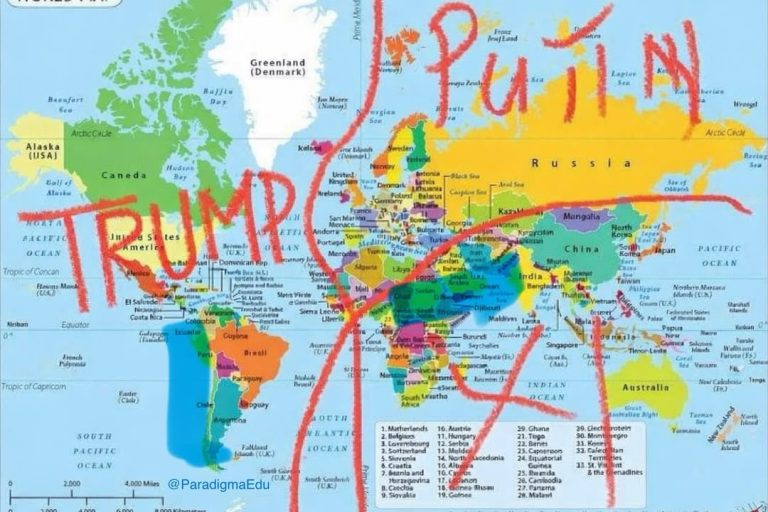
To accompany his presentation, Martyanov presented a map that summarizes this reality: the world is de facto organized into three major poles.
The United States is consolidating its control over the Western Hemisphere, including North America, Central America, the Caribbean, and South America, as well as strategic positions like Greenland and areas of the Atlantic. This bloc reflects the old Monroe Doctrine, now unabashedly revived, where Washington considers these regions its backyard and acts openly to prevent Russian or Chinese presence. For Martyanov, the attempt to seize Greenland is not a Trump extravaganza, but rather the coherent expression of this renewed imperial logic.
In this framework, Russia is consolidating its sphere of influence in Eurasia, Eastern Europe, the Caucasus, Central Asia, and key areas of North Africa and the Middle East. Martyanov emphasizes that Moscow operates primarily from a continental perspective, prioritizing strategic depth, territorial control, and land-based logistical lines. The conflict in Ukraine, he argues, is not an isolated event but rather the catalyst for a global realignment: by curbing Western expansion, Russia is accelerating the collapse of the old order and forcing the recognition of new power boundaries. In this process, Europe is reduced to a subordinate actor, incapable of acting with strategic autonomy and completely dependent on Washington.
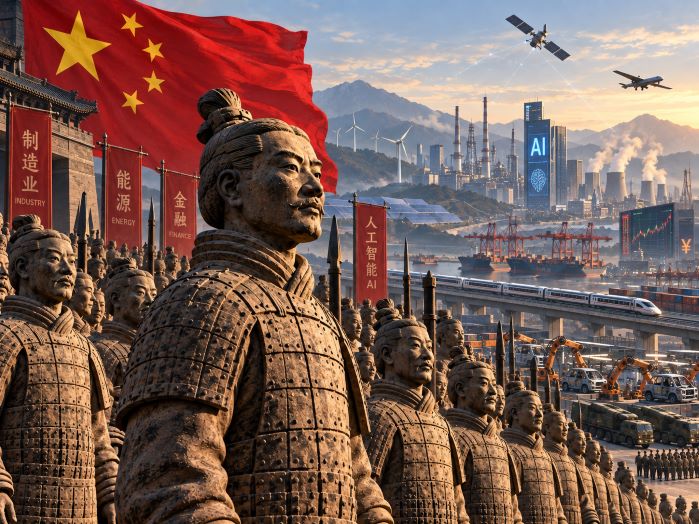
China has emerged as the third major power, with a sphere of influence encompassing East Asia, Southeast Asia, the Indian subcontinent, much of Central Asia, the Middle East, Africa, and extending into Oceania. Unlike the United States, China prioritizes economic, technological, and infrastructural instruments, such as the Belt and Road Initiative, to consolidate its influence. According to Martyanov, this expansion is not “benign” but strategic: Beijing builds structural dependency through trade, debt, investment, and control of supply chains, thus securing its geopolitical weight without always resorting to direct military force.
Martyanov insists that this division is not the product of formal agreements or diplomatic treaties, but rather the actual balance of power. Spheres of influence emerge where a power can impose prohibitive costs on any rival. In this sense, Martyanov asserts that Europe has ceased to be an autonomous pole: it lacks real military power, is energy-dependent on external actors, and its elites are politically subordinate to Washington. Therefore, on the map, Europe appears absorbed within the orbit of other powers, without the capacity to define its own destiny.
Martyanov celebrates, with bitter irony, the end of liberal hypocrisy. He considers it positive that the fiction of the “rules-based world” has been shattered, because international relations are now returning to their true historical form: domination, coercion, and direct competition among great powers. In this new scenario, there are no permanent allies or universal values, only strategic interests. Small states are caught between blocs, forced to align themselves or pay the price for resistance.
In his view, Trump is not the architect of this system but its messenger. The world was already being reconfigured before him; he simply accelerated the process and made it explicit. The division into spheres of influence is not a personal project, but the inevitable consequence of the collapse of the post-Cold War unipolar order. For Martyanov, history returns to its starting point: power rules, force decides, and geopolitics is once again brutally honest.
The map presented by Martyanov was found on the X account of MMA fighter Paulo Costa , known as “Borrachinha.” The image also bears the signature of Paradigma Education, a Brazilian organization focused primarily on research and education about cryptocurrencies, especially Bitcoin and the crypto market.
It is striking that the map is relatively similar to another that, in theory, does not represent a real geopolitical division, but comes from the fictional universe of George Orwell’s novel 1984, where the world appears divided into three permanent superpowers: Oceania, Eurasia, and East Asia.
This cartography has been commonly used in illustrated editions and academic analyses of the work to explain the system of perpetual war and totalitarian control described by Orwell, which until now was not descriptive of contemporary reality.
Footnotes
1. Andrei Martyanov, on SmoothieX12: Orthodox Christmas. January 7, 2026.