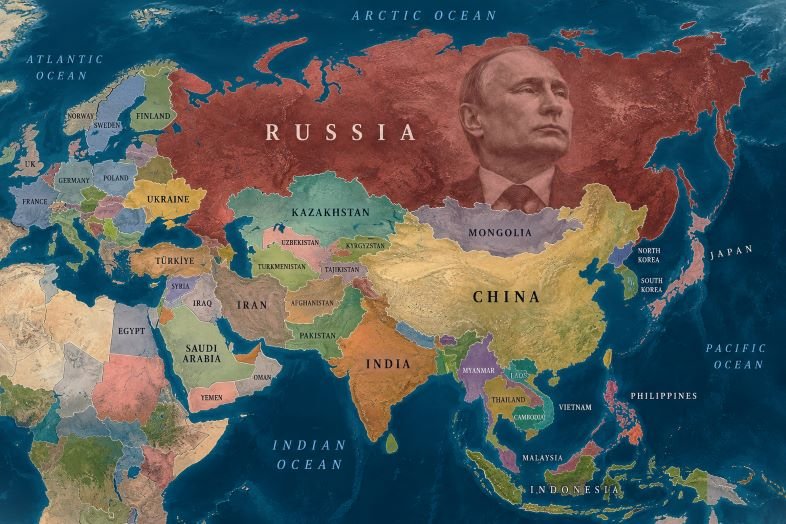
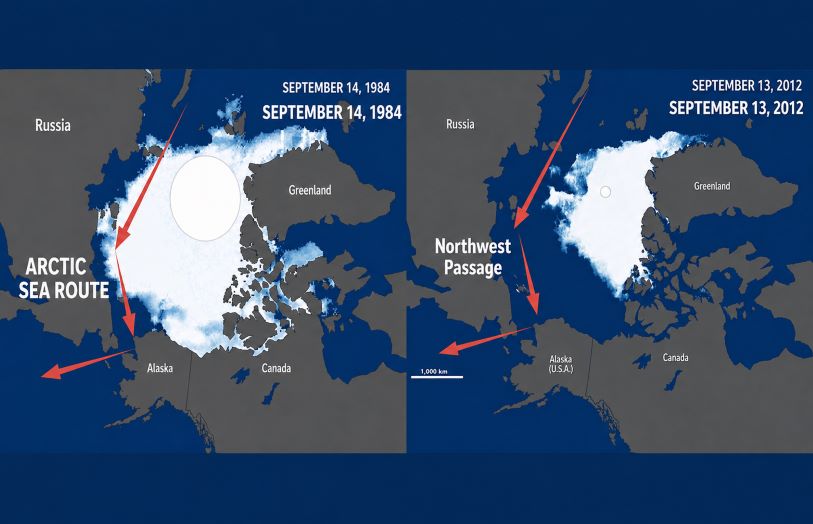
Today, let’s talk about a few seemingly insignificant but very important pieces of news that could potentially cause dramatic changes in the global geopolitical landscape.
Here are the latest developments regarding the Arctic shipping route. In August, there were several news items related to the Arctic shipping route, and the situation suddenly became very popular, going from “it’s really cold” to “it’s really appealing.”
In August, many Chinese shipping companies headed “north” all at once.
On August 24, the “Xin Xin Hai 2” departed from Lianyungang Port and headed for Arkhangelsk Port in Russia, marking the official entry of the “Lianyungang – Arkhangelsk” Arctic route into a normalized and mature operation phase.
On August 20, Murmansk, Russia, welcomed its first container ship arriving from China via the Northern Sea Route, which will establish Murmansk as a major logistics hub in the Arctic region.
On August 15, Haijie Shipping launched its weekly Arctic Express service, departing from Ningbo-Zhoushan Port, then loading cargo at Shanghai Port, Taicang Port, and Qingdao Port, before sailing via the Arctic Northeast Passage to Felixstowe Port in the UK.
It’s not just China; other countries are also turning to Arctic shipping routes.
On August 22, it was reported that amid the Middle East conflict disrupting global shipping, South Korea dispatched its first trial container ship to begin testing the Arctic route.
These messages indicate that the Arctic shipping route is gradually moving from occasional, exploratory trials to a normalized, commercially viable era.
The Arctic shipping route has suddenly become popular, mainly for two reasons.
One reason is the turbulent situation in the Middle East, which frequently subject the Red Sea-Mandeb Strait-Suez Canal route to harassment and blockade by regional powers due to conflict.
Another reason is the accelerating global warming, which has led to faster melting of Arctic ice and created favorable conditions for navigation. Yet another, self-evident reason, is the significantly shorter route and the considerably lower shipping costs compared to the southern route.
The rising popularity of the Arctic shipping route is a landmark event in the dramatic changes in global geopolitics.
According to the latest report from the IPCC (Intergovernmental Panel on Climate Change), Arctic sea ice extent will decrease by 43% to 94% by the mid-21st century. The shipping industry predicts that the Arctic shipping routes will be navigable on a large scale around 2030, not even needing to wait until 2050. At that time, the Arctic shipping routes will be frequently used, and the opening of the Arctic shipping routes will be the second major shift in global geopolitics since the opening of the Suez Canal.
Recent actions taken by various countries regarding the Arctic are made against this backdrop. China’s Ice Silk Road is also progressing steadily.
From the perspective of maritime transport efficiency, the Arctic shipping route can reduce the voyage by 12-15 days compared to other traditional routes, such as the Suez Canal route . From Rotterdam in Europe to ports in China, Japan, and South Korea, the journey via the Arctic route takes only about 20 days, 10 days shorter than via the Suez Canal. This significantly reduced distance will save substantial costs for goods transported between Asia and Europe. Therefore, the maritime industry also refers to the Arctic shipping route as the “golden waterway.”
Do you remember the grounding of the Evergreen cruise ship in April 2021, which caused a major blockage in the Suez Canal? The Suez Canal is only 345 meters wide at its widest point, and can usually only accommodate one medium-sized ship at a time. However, modern cargo ships are constantly increasing in size, and the Suez Canal’s slender shape makes it difficult to accommodate large ships, resulting in frequent ship jams. Giants exceeding 300,000 tons often have to sail south around the Cape of Good Hope.
Just as the international community is struggling to cope with the severe impact of the Middle East situation on shipping, many countries are considering alternative shipping routes, and the use of the Arctic shipping route has entered the agenda of many countries.
The Korea Maritime Institute predicts that the number of ships traveling along the Arctic route will increase significantly in the next decade, and by 2030, goods transported via the Arctic route will account for one-quarter of trade between Asia and Europe.
As a near-Arctic nation, the opening of the Arctic shipping route is of great significance to China.
Currently, maritime transport accounts for more than 90% of my country’s international trade. If the Arctic shipping route is successfully opened, it will provide my country with two more convenient routes to Europe and North America. This will not only reduce maritime transport costs and mitigate the risks associated with passing through politically sensitive areas such as the Strait of Malacca, the Panama Canal, the Red Sea, and the Suez Canal, but will also facilitate the development of new resource and energy procurement destinations.
By utilizing the Arctic shipping route, the voyage from my country’s coastal ports to the east coast of North America will be 2,000-3,500 nautical miles shorter than that via the Panama Canal; the voyage to European ports will be significantly shortened, with ports north of Shanghai reaching Western Europe, the North Sea, and the Baltic Sea ports by 25%-55% compared to traditional routes. The Arctic shipping route will greatly reduce the distance between my country and markets in Europe and North America.
We are also actively developing the Arctic shipping routes. In addition to our years of continuous Arctic scientific expeditions and the well-known “Xuelong” icebreaker, we are also promoting the Ice Silk Road. The Ice Silk Road refers to the maritime route that crosses the Arctic Circle and connects the three major economic centers of North America, East Asia, and Western Europe.
The Ice Silk Road holds significant strategic importance for us.
First, it significantly reduces the costs of commercial shipping and the geopolitical risks of southern routes;
Secondly, it will drive the development of Northeast China, help revitalize the Northeast, and make the Northeast a frontier of opening up;
Third, Russia’s Far East and Arctic regions are rich in oil and gas resources, making them another energy option besides the Middle East, ensuring a continuous, stable, secure, and short-distance energy supply.
Many people look down on the Arctic shipping route, believing that the coastal economy is underdeveloped, there are not as many large ports as the southern route, and not enough cargo to be loaded and unloaded along the way, making the trip unprofitable. This is a typical case of short-sighted calculation, ignoring the political and strategic implications. If only short-term commercial gains were considered, there would be no Ice Silk Road strategy.
Leadership is about foresight. Strategic foresight means seeing future trends in advance, that is, having advanced knowledge and forward-thinking.
China must also anticipate the profound impact of the Arctic shipping route on global geopolitics.
Looking to the future, the opening of the Arctic shipping route will directly alter the existing global maritime shipping landscape. The existing global maritime transport route is located in the central north-south region of the Earth. This “world transport artery” connects a series of strategic locations and global hotspots, stretching from the Strait of Malacca—Northern Indian Ocean—Red Sea—Suez Canal—Mediterranean Sea—Strait of Gibraltar—Caribbean—Panama Canal—Southeast Asia, forming numerous strategic hotspots and areas of contention for military conflicts.
Once the new Arctic shipping route is opened, it will reduce the importance and status of southern shipping routes, and the influence and status of the countries along the route will also decline. The strategic importance of the central route will decrease, while the strategic importance of the Arctic region will increase. This shift will cause the world’s center of gravity to move northward, and to some extent, change the global landscape.
This major shift in global geopolitics has both advantages and disadvantages for Russia. The advantage is that the previously barren Far East and Arctic regions will see significant development; the disadvantage is that Russia’s northern border will face considerable security pressure. Russia predicted several years ago that conflict and war between the United States, Canada, and Russia in the Arctic region were possible.
Once strategic pressure forms on the northern front, it will alter Russia’s previous geopolitical status quo of being able to defend its western border without worrying about its rear. Given Russia’s slow population growth and its long northern border, this newly generated security pressure will be difficult for Russia to bear in the future, but it also provides broader space for strategic cooperation between China and Russia.
The opening of the Suez Canal fundamentally altered the global geopolitical landscape, making the Indian Ocean and the Middle East geopolitical focal points. In the future, as the Arctic shipping routes become more accessible, the geopolitical weight of the Suez Canal will partially shift to the Bering Strait , and the focus of great power rivalry will move to the North Pacific region.
This geopolitical shift will have a profound impact on China.
At that time, Japan’s focus will shift from the Southern Islands to the Northern Territories and the Northeast Pacific region. The conflict between Japan and Russia over the Northern Territories will escalate. The strategic hub of the Taiwan Strait in the Western Pacific will be replaced by Japan. The strategic passage status of the Ryukyu Islands will be replaced by the Kuril Islands, the Ogasawara Islands, and the Northern Mariana Islands. The strategic status of the East China Sea will be partially replaced by the Sea of Okhotsk and the waters east of Japan.
The increasing navigability of the Arctic shipping routes will enhance the strategic importance of the Bering Strait, forcing Japan, Russia, and the United States to focus more on the Bering Sea region. Without giving up its ambitions in the Western Pacific, the United States will need to allocate considerable resources from the southern route to the Bering Sea.
Some geopolitical conflicts between China and Japan will gradually give way to the competition between the United States, Russia, and Japan in the Northwest Pacific, especially the Bering Sea.
The rising strategic importance of Russia’s northern front and Japan’s eastern front in the global geopolitical landscape will make China a strategic rear area for Russia and Japan.
At that time, the Taiwan Strait’s position in the geostrategic interests of the US and Japan will decline, and the “pro-independence” forces will become a useless pawn (assuming they can still operate at that point). China’s eastern security border will expand further eastward. By then, the other side may have already returned to China; if not, then the conditions for reunification will be ripe, and the conditions for resolving the South China Sea issue will be even more mature.
In summary, climate change, internally, makes North and Northwest China increasingly humid, bringing about changes in the Chinese nation’s destiny; externally, it brings about a reshuffling of the global geopolitical landscape, which is also beneficial to China.
Of course, everything has two sides, and global warming certainly has its downsides, but that’s not the focus of this article.
The Earth is changing, the climate is changing, geopolitics is changing, the boundaries of interests are changing, and enemies and conflicts are also changing. Change is the only constant!
Historical processes can sometimes be abrupt; we must anticipate these changes and respond accordingly.