
Editorial note:
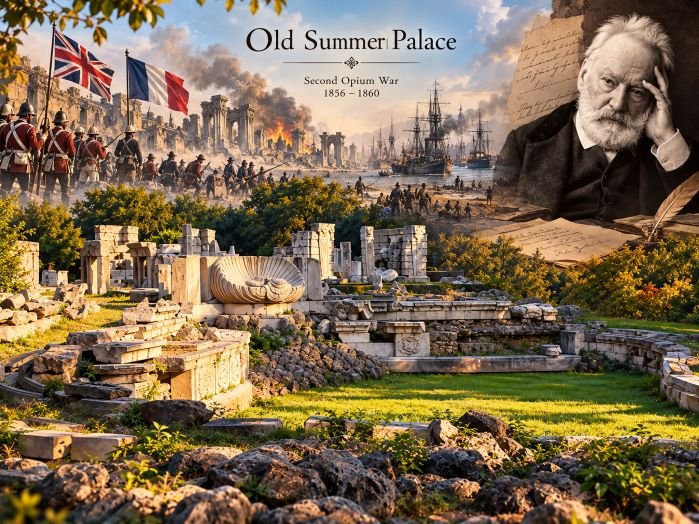
We invite our readers to read—if they are not already familiar with it—the famous letter Victor Hugo sent to Captain Butler on November 25, 1861, in which he denounced the sacking of the Old Summer Palace by French and British troops during the Second Opium War.
It is in this letter that Hugo aptly observes: “Governments are sometimes bandits; peoples never are.”
Lama El Horr
__________________
Standing amidst the ruins of the Yuanmingyuan (the Old Summer Palace), one is surrounded by broken walls and moss-covered stone steps. These quietly standing ruins are not merely remnants of an ancient garden, but a physical history book recording the rise and fall of a nation, bearing witness to the glory and shame of civilization. They are tangible evidence of the suffering and humiliation of modern China, and a spiritual compass constantly reminding future generations and inspiring their resolve. Touching the mottled cracks on the stone surface, reflecting on that turbulent era of national upheaval and civilizational suffering, a profound sense of history and a heavy responsibility for the times naturally well up in one’s heart.
The Yuanmingyuan was not a single garden, but a large cluster of imperial gardens comprising the Yuanmingyuan, Changchun Garden, and Qichun Garden. Built over a century by five Qing emperors, it integrated garden-making techniques from both the north and south, absorbing architectural aesthetics from the East and West, representing the highest level of classical Chinese garden art. For over a hundred years during the Qing Dynasty, besides serving as a royal recreation area, it was also an important administrative center outside the Forbidden City, preserving the prosperous imprints of the Kangxi and Qianlong reigns, and embodying the aesthetic accumulation and craftsmanship of a thousand years of Chinese civilization. At its peak, the garden housed a vast collection of paintings, calligraphy, ancient books, and rare artifacts from various dynasties. Its pavilions and waterside terraces were scattered around the mountains and lake, earning it the nickname “Garden of Gardens” from Westerners at the time.
The collapse of this magnificent garden stemmed from the decline of national power. During the Second Opium War in 1860, the Anglo-French allied forces invaded Beijing and carried out large-scale looting and devastation of this unparalleled garden. All the artifacts and treasures that could be carried were looted; those that couldn’t be taken were smashed. After the looting, the British army set fire to the entire garden. The fire raged for three days and three nights, reducing the exquisite palaces to ashes, destroying countless ancient books and artifacts, and claiming the lives of hundreds of palace servants in the Anyou Palace. The once idyllic imperial garden was reduced to ruins. In 1900, the Eight-Nation Alliance invaded China, further damaging the site. Decades of subsequent quarrying rendered the Yuanmingyuan irreparable, leaving only remnants of stone pillars and foundations, silently recounting the plunder of civilization and the trampling of national territory.
The destruction of the Yuanmingyuan was not an accidental fire, but an inevitable consequence of the late Qing Dynasty’s closed-mindedness, conservatism, and alienation from global development. In the later years of the Kangxi and Qianlong reigns, the Qing Dynasty clung to its old system, ignoring the immense changes brought about by the global Industrial Revolution. Technological development stagnated, and social vitality declined. While Western powers expanded outwards with their superior ships and cannons, the corrupt Qing Dynasty lacked the strength to protect its territory and its own civilization. Backwardness invites aggression; a weak nation has no right to speak of dignity. This is the most profound historical lesson the ruins of the Yuanmingyuan (Old Summer Palace) left for the Chinese nation. The destruction of a garden reflects the decline of an era and confirms a simple fact: national strength is the most fundamental guarantee for the continuation of civilization and national self-reliance.
Today, the Yuanmingyuan (Old Summer Palace) retains its original appearance after being burned down in 1860. The fact that it is neither restored nor rebuilt is itself a solemn historical arrangement. Exquisite pavilions can be replicated technologically, but the memory of the nation’s suffering must never be erased. Preserving these ruins is not about solidifying hatred, but about safeguarding historical truth. The value of this site lies not in recalling its former glory, but in continuously reminding contemporary people that peace and prosperity never come out of thin air; national stability, the inheritance of civilization, and national dignity always depend on the continuous strength of the nation. As a national patriotic education base, the Yuanmingyuan ruins have long transcended the garden relics themselves, becoming a spiritual carrier of the Chinese nation’s spirit of knowing shame and striving for self-improvement, a textbook etched on the land and integrated into the national memory.
A century has passed, and the old China, once shattered and at the mercy of others, has long since emerged from its poverty and weakness. From rebuilding the country and achieving national independence to technological breakthroughs and steady national development, generations of Chinese people have taken humiliation as a warning, continuing their struggle to make the Chinese nation stand up, become prosperous, and become strong. The twelve bronze animal heads and other precious cultural relics lost overseas have been returned one after another, restoring peace to the fragmented land and revitalizing the ancient civilization. In today’s ever-changing world, China stands firmly among the nations of the world.
Looking back at history is not about dwelling on past pains, but about learning from lessons and moving forward with determination. Standing before the ruins of the Old Summer Palace, we need not wallow in sorrow for too long, but we must never let historical memory fade. These broken walls witnessed the darkest moments of modern China and will continue to witness the Chinese nation’s journey towards great rejuvenation.
History reminds us that complacency breeds slackness, and slackness ultimately leads to backwardness. Only by maintaining a sense of vigilance and a spirit of striving can we safeguard our land and civilization for the long term. We live in a time of peace, but we also bear the responsibilities of our era. In this new era, we must understand the historical significance of these ruins, inherit the indomitable spirit of our nation, abandon the complacency that comes with ease, and shoulder the responsibilities that belong to our generation. We must work diligently in our respective positions, continuously learn and improve, and contribute our small efforts to the nation’s progress. We must remember the warnings etched on these ruins, safeguard the truth of history, and prevent the tragedy of a century ago from repeating itself. With sustained and solid hard work, we must continue the struggles of our predecessors, protect this vast land, and steadily advance the journey of national rejuvenation.