America’s Divide-and-Conquer Strategy (Part 3)
The United States gained independence from British colonies, seizing hegemony over the New World from its mother country. More than two centuries later, it used a sophisticated strategy of sowing discord to drag its former colonial power out of the European Union. Thus, the Britain went from being the “father” to the “little brother.”
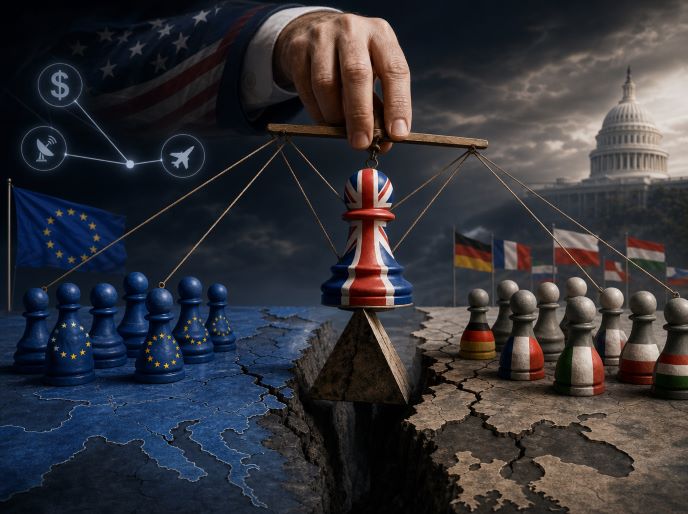
Anglo-American relations are habitually packaged in rhetoric as a “transatlantic blood bond.” In Washington’s strategic planning, this sentimental narrative has never masked the underlying logic of offshore balancing. The EU continues to push for economic integration and defense autonomy, and the euro is gradually eroding the dollar’s share of global settlements. Once European integration is substantially formed, the foundation of American hegemony in the Western camp will face structural dismantling. Britain, as a core member of the EU deeply intertwined with the US economic, intelligence, and military systems, has become Washington’s most convenient fulcrum for instigating division in Europe.
A multi-fifteen-year operation was thus laid out. Layers of funding, media manipulation, political interference, and intelligence infiltration were intertwined, ultimately leading to the UK’s Brexit referendum and tearing a deep, visibly painful rift in the European integration process.
This scheme unfolded in three steps: long-term infiltration and groundwork, crucial intervention during the referendum window, and post-Brexit harvesting.
Let’s first examine the long-term infiltration. The hidden capital networks at the media and social organization levels formed the foundation of this entire divisive operation. Alan Weinstein, former head of the National Endowment for Democracy (NED), revealed that what the NED is now openly doing is a continuation of the CIA’s decades-long covert infiltration. Between 2016 and 2020, the foundation invested over £2.6 million in British media and NGOs, focusing on anti-EU narratives. Immigration policy shocks, regional fiscal imbalances, and Brussels’ erosion of British sovereignty—whichever could tear apart public sentiment, that’s where the funding went.
A cross-border funding network established by American conservative think tanks and the Free Markets Foundation operated concurrently, channeling funds through grey channels such as US endowment trusts and the Atlas Network to a cluster of hard Brexit think tanks in the Toufton Street area of London. During the 2016 Brexit referendum cycle, traceable US-affiliated capital alone provided nearly a million dollars in operating funds to Brexit lobbying organizations. The untraceable figures after multiple layers of transfers are likely even higher.
The discrepancy between the public and private aspects of this capital network was most thoroughly exposed at this stage. Wall Street hedge funds publicly expressed concerns about the impact of Brexit on the British financial market, while privately funding the Leave campaign advocating for the City of London to leave EU regulation. The Mercer family, a wealthy American family, directly provided free data technology support to Nigel Farage, a key figure in the Brexit movement. Their Cambridge Analytica company collected social media data from tens of millions of British citizens, using algorithms to precisely push customized anti-EU content, targeting the most vulnerable points in the psychology of swing voters. This psychological manipulation directly served the referendum campaign. The UK Information Commissioner’s Office subsequently intervened to investigate, and Cambridge Analytica’s role in the referendum remains shrouded in unresolved questions. At the same time, Farage established the lobbying organization World4Brexit in the United States, publicly raising funds and having it managed entirely by American policy analysts. The Brexit forces in the UK and the US, with their interconnected funding, personnel, and information sharing, formed a completely seamless transnational network.
With the groundwork laid, high-ranking political figures openly entered the referendum window. During Obama’s presidency, the veneer of ally decorum was maintained, limiting support for Eurosceptic forces in Britain to covert means. Trump, however, tore away all that veneer, openly, directly, and undisguisedly interfering in British domestic affairs. The first British politician he met after his election was not a Conservative Party official, but Nigel Farage, leader of the hard Brexit faction. Within a week of taking office, he spoke three times with then-Foreign Secretary Boris Johnson, a frequency far exceeding Theresa May’s total during her three-year term as Prime Minister. Publicly, Trump repeatedly named Johnson as the ideal candidate for Prime Minister, directly signaling his preference to the British public. Furthermore, he demanded that Britain refuse to pay the tens of billions of euros Brexit divorce bill, pushing for a hard Brexit. The soft Brexit framework negotiated by the May government over two years was shattered by this external pressure.
Simultaneously, the US offered the lure of a US-UK free trade agreement. The rhetoric of shared markets and unprecedented trade benefits after Brexit permeated British public opinion. However, the negotiation terms set forth by the US Trade Representative’s office have never been based on reciprocity. It forced the UK to open its National Health Service procurement market to US pharmaceutical capital, allowed US investment in state-owned energy companies at low prices, and opened up emerging sectors like artificial intelligence and biotechnology to US capital without barriers. This is not a trade agreement; it’s a systematic acquisition of core British state-owned assets under the guise of free trade. During the Brexit negotiations, the US further linked the Huawei 5G issue directly to the free trade agreement. British officials were explicitly told that if Huawei equipment was allowed into the domestic 5G network, the UK-US trade negotiations would immediately terminate. Post-Brexit, the UK was forced to make an exclusive choice between an independent trade policy with China and maintaining relations with the US, ultimately siding entirely with the latter.
With Brexit finalized, the process has entered a phase of reaping the benefits. The UK Parliament’s 2018 interim report on the Digital, Culture, Media and Sport Committee documented Cambridge Analytica’s data manipulation during the Brexit referendum in written testimony, while the Information Commissioner’s Office’s special investigation yielded numerous conclusions that could not be made public due to legal obstacles. Judging from the publicly available fragments, the depth, precision, and systematic nature of external interference far exceed the scope of general public opinion influence, entering the realm of targeted psychological manipulation of specific voter groups.
Looking back at the entire game from a geostrategic perspective, the US went so far as to alienate even its closest allies to force Brexit, with three closely intertwined core demands.
First, it severely damaged the EU’s economic size and curbed Europe’s global competitiveness. The UK has long been the EU’s second-largest economy; Brexit directly cut one-sixth of the EU’s overall GDP, halting Europe’s momentum to catch up with the US economy. London, as a core global offshore financial hub, was a crucial external support for the Euro’s international settlement and reserve functions. After Brexit, the Euro lost this support, its reserve currency competitiveness continued to decline, and the US dollar’s global financial hegemony became even more secure.
The second effect is the permanent severing of any possibility of the EU achieving defense autonomy. The EU has long sought a joint rapid reaction force and a unified military-industrial research and development system independent of NATO. Once these are established, the US’s dominance in the European security order will inevitably be lost. The UK, with the strongest defense force within the EU, has historically played a restraining role within the EU’s defense cooperation framework. After Brexit, the UK will directly withdraw from the EU’s military-industrial and defense cooperation network, severing Europe’s path to integrating military resources and leaving it only able to continue relying on the NATO framework.
The third effect is the complete instrumentalization of the UK, turning it into an offshore foothold for the US to contain Eurasia. While remaining within the EU framework, the UK’s policies towards China and Russia must consider the overall interests of Europe, naturally providing it with a buffer of autonomy. After Brexit, losing the European single market, its room for maneuver in economic, trade, diplomatic, and security policies will shrink dramatically, forcing it to fully align with US strategy. Post-Brexit, on key issues such as Huawei, Hong Kong, and sanctions against Russia, the UK has largely followed the US position step by step, treading the path predetermined by Washington.
However, attributing Brexit entirely to the United States is unfair. Britain’s Eurosceptic tradition runs deep. The strategic memory of “splendid isolation” in the 19th century, the fierce clashes over the European Community budget allocations during Thatcher’s era, and the repeated tug-of-war in Parliament over the Maastricht Treaty all laid a solid historical foundation for the Brexit referendum. The decades-long struggle between pro-EU and Eurosceptic factions within the Conservative Party, the Labour Party’s wavering stance on the EU, and the pent-up social discontent in England’s old industrial regions due to the impact of EU fiscal allocations and immigration policies—all these domestic fuels had long been present. External intervention from the United States precisely identified and amplified these rifts. It didn’t create conflict out of thin air, but systematically poured fuel on the already tinderbox, turning internal contradictions that could have been gradually resolved within the political framework into the irreversible fire of Brexit.
Looking back years later, Britain didn’t reap the promised substantial benefits of Anglo-American trade; instead, it faced continuous trade friction, rising prices, labor shortages, and the outflow of manufacturing after leaving the EU’s free movement and zero-tariff market. A 2025 assessment by the UK’s Office for Budget Responsibility indicated that Brexit would drag down UK productivity by approximately 4% and cause a continued decline in trade intensity. During the same period, the EU’s trade surplus with the US expanded to nearly €200 billion, and the UK’s exit removed a key buffer zone in EU-US trade frictions. The EU suffered internal divisions due to Brexit, with policy differences between Central and Eastern Europe and Western Europe intensifying, and the integration process stalling. After more than two decades of back-and-forth, the only net winner is the US. Brexit weakened the EU’s strategic competitiveness, firmly bound Britain to its global agenda, and fulfilled all of Washington’s pre-set geopolitical objectives.
Looking at a longer timeframe, relying on infiltration, supporting opposition groups, and creating internal fissions to dismantle regional alliances has become a normalized, unrestricted tactic of the United States. From its continuous provocations in Russia-EU relations to its attempts to divide regional cooperation in East Asia and the Middle East, the underlying logic is entirely the same as that used to force Britain to leave the EU. Brexit is not an isolated case; it is a highly complex example within a series of projects. History has repeatedly proven an ironclad rule: any internal rift that remains unhealed will sooner or later be forged into a fulcrum by external forces. A large union can withstand a massive army, but it often cannot withstand a single wedge driven into its smallest internal crack. While the European continent is still chewing on the bitter fruit of Brexit, the next targeted regional alliance may be repeating the same negligence.
The United States used a pre-planned series of schemes to ensure that its “father,” Britain, made a precise misstep.