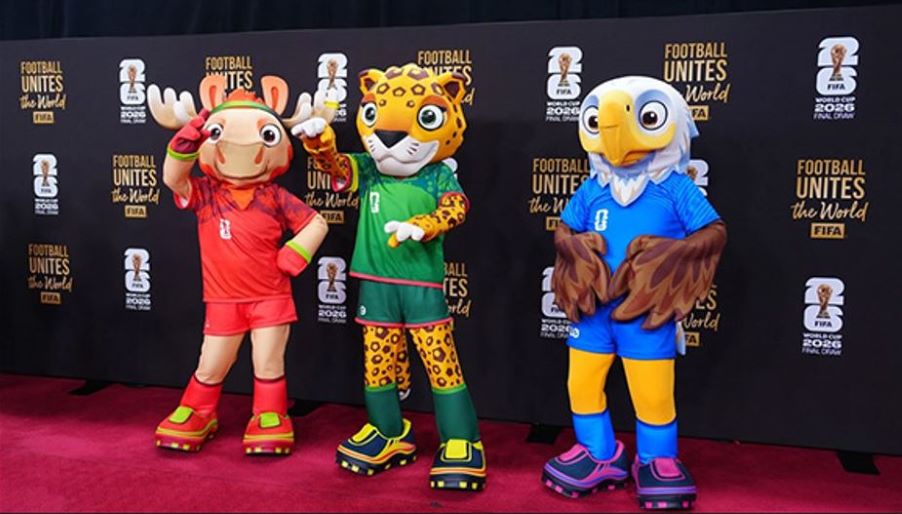
Every World Cup functions as a gigantic mechanism of social anesthesia on a global scale through a simultaneous display of business, advertising, excitement, spectacle, and a simulacrum of collective nationalist identity—exaggerations taken to the point of nausea.
It is a phenomenon that, on the surface, commercially celebrates diversity, coexistence, and passion for sports, but which, at its core, has become an efficient tool for disabling critical thinking and covering up the most painful contradictions of global capitalism.
Under this system, millions of people channel their desires, frustrations, and hopes into an event that, far from becoming a space for emancipation, serves to reinforce market logic and reproduce the dominant order—all while turning a blind eye to the harshest realities. The opium of soccer.
It will be a year of “labor reforms,” but during the weeks of the World Cup (and even long before and after), the public’s attention turns away from everyday reality and focuses on an epic narrative carefully crafted by marketers. The strains of precarious employment, structural inequality, debt, violence, social cuts, and political crises are pushed into the background—not because they have diminished, but because the spectacle offers an anesthetic escape that promises an illusion of belonging and triumph.
The soccer fan, who in daily life has no control over the economic processes that affect him, feels that he is participating in something decisive through his symbolic identification with a national team, for which he pays a fortune. That identification, however, is mediated by corporations, global brands, financial interests, and organizations that have turned the sport of soccer into a multibillion-dollar business.
The result is an ideological mechanism that transforms legitimate emotions into politically wasted energy. Their “World Cup” not only diverts attention, it also reshapes social sensibilities. Collective emotion is managed and guided by a pre-established script, in which every match becomes a narrative of heroes, villains, miracles, and tragedies, designed to keep the public in a state of sustained emotional excitement, under the control of media monopolies.
The euphoria is interrupted by commercials promising instant happiness through consumption; broadcasts replay images from the past that elevate players to the status of modern legends, while governments capitalize on the enthusiasm to reinforce opportunistic nationalism and revive empty patriotic rhetoric. The anesthesia works because collective exaltation simulates a community that, in reality, is not organized to transform its own life, but rather to passively contemplate a spectacle beyond its control.
This “soccer anesthesia” also operates through a mechanism of symbolic substitution; the national team’s victory is presented as a victory for the people, even though nothing changes in the material lives of those people. The victory is experienced as symbolic compensation that dampens discontent and reduces the propensity for political mobilization. In this sense, the World Cup delivers a collective thrill that leads to no concrete transformation, but rather recycles the frustration at the end of the tournament, setting the stage for the cycle to begin anew four years later. They saturate the public sphere with soccer-related ideological merchandise, endless analysis, replays, anecdotes, artificial controversies, emotional narratives, and camouflaged marketing strategies.
Deliberate exaggeration creates an environment where it is difficult to maintain a critical distance, and where even those who have no interest in soccer find themselves caught up in the symbolic current that shapes public discourse. The logic of ratings becomes the logic of public sentiment, and collective opinion is shaped according to the needs of the brands, sponsors, and corporations that sustain the spectacle.
That anesthesia also works by creating the illusion of equality. During the World Cup, there is a constant emphasis on the fact that “all nations compete on equal terms,” as if athletic competition could magically erase the economic, political, and technological inequalities that plague the planet.
We are presented with a scenario where any country can “pull off an upset,” when in reality the economic structure of professional soccer replicates the inequalities of the global system: the same countries have historically dominated, the same economic powers control the clubs, and the same corporations reap extraordinary profits. The spectacle hides these asymmetries beneath the glitz of the “sports festival,” transforming an unequal structure into a seemingly democratic show.
Despite everything, soccer—as a human expression—has liberating, creative, and community-building potential. The problem is not the game itself, but its hijacking by an industry that turns popular passion into a constant flow of capital. The critical task is to reclaim the human meaning of the sport and prevent it from being used as an instrument of mass distraction.
This involves developing a perspective capable of looking beyond the surface of the spectacle and subjecting the economic, political, and psychological mechanisms that underpin it to rigorous scrutiny. Only on the basis of this understanding can we conceive of a cultural practice that reevaluates play as a collective experience rather than as an emotional commodity designed to neutralize social discontent.
Instead of a community numbed by spectacle, we must imagine active communities that channel their emotional energy toward solidarity, the struggle for social justice, and the creation of more dignified ways of life. The challenge lies in transforming popular passion into political power—not merely into fuel for a global machine that, while celebrating the spectacle, reinforces the very conditions that make this numbing necessary.
In that transformation lies the possibility that collective euphoria will cease to be a mere interlude and become the conscious construction of a world where the game once again belongs to the people. It is an anesthesia that the people pay for with astronomical sums that end up in the pockets of a few profiteers.
(La Jornada via Cubadebate)