On the eve of the meeting between the Chinese and US leaders, To Lam, General Secretary of the Communist Party of Vietnam and President of Vietnam, visited New York and attended the 81st session of the United Nations General Assembly. This is To Lam’s second major diplomatic trip to the US this year, following his trip to Washington in February to attend the first meeting of the Gaza Peace Committee. To Lam brought with him high-ranking officials and business representatives from various sectors, including economy, energy, science and technology, and finance, and held separate meetings with US Trade Representative Greer and Acting Secretary of the Navy Kao Hung, sending several signals.
What were the outcomes of To Lam’s visit to the United States?
On diplomacy and security, the two sides exchanged views on the South China Sea issue and the regional security situation. The US hopes that Vietnam will play a greater role in the “Indo-Pacific Strategy,” but Vietnam insists on its independent diplomatic stance and has not made any commitment to militarily align itself with the US.
In trade matters, the United States has been pressuring Vietnam regarding its entrepot trade practices, which involve goods from third countries being relabeled in Vietnam to circumvent US tariffs and enter the US market. In response, To Lam pledged to close these trade loopholes. He stated that Vietnam will not accept such entrepot trade, and that all products exported from Vietnam to the US must be genuinely manufactured in Vietnam.
Meanwhile, To Lam also stated that a reciprocal trade agreement between Vietnam and the United States is very close to being reached. Vietnam has proposed to expand imports of high-tech products and aviation equipment from the United States in order to improve the bilateral trade imbalance and in exchange for tariff preferences and market access from the United States.
Furthermore, during To Lam’s visit to the United States, Vietnam and the US held consultations on semiconductors, digital communications, clean energy, and aerospace, discussing expanding US investment in Vietnam and advancing the implementation of the memorandum of understanding on science and technology cooperation. The US also hopes to develop Vietnam into an important node in the regional industrial chain. It is worth noting that this visit focused primarily on negotiations, and many cooperation agreements remain at the consensus stage. Whether the final agreements can be implemented depends on subsequent negotiations between the two sides.
Where will Vietnam-US relations go?
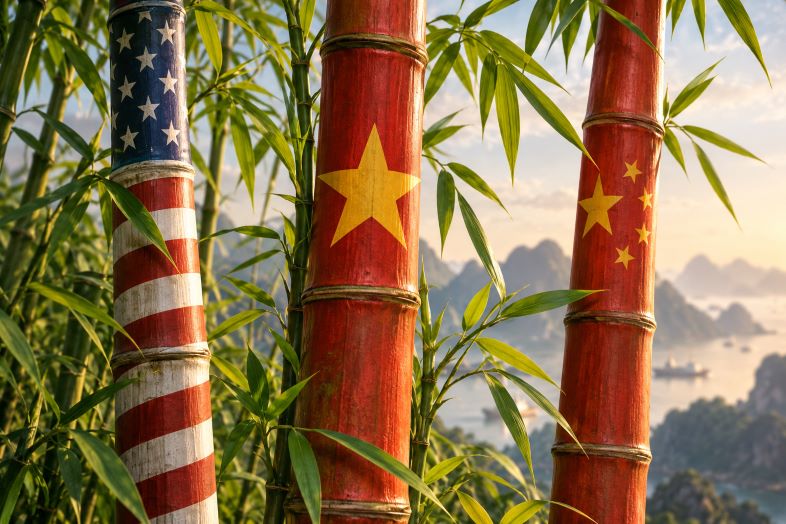
Vietnam has long pursued a “bamboo diplomacy,” maintaining a balance among major powers without taking sides, while leveraging the strength of these nations to develop its own economy. Looking ahead, economic cooperation between Vietnam and the US is likely to continue to intensify, but a deep political and security entanglement is unlikely.
On the one hand, Vietnam urgently needs the US market, capital, and technology. Vietnam’s manufacturing sector is highly dependent on exports, and the US is Vietnam’s largest export market. Vietnam also needs high-tech investment from the US to upgrade its industries. These are all practical needs for Vietnam’s own development.
On the other hand, there are irreconcilable differences between Vietnam and the United States. First, Vietnam’s historical memory and ideological differences objectively exist; second, Vietnam is unwilling to sacrifice its strategic autonomy and be tied to the US’s strategic competition with China; third, Vietnam’s manufacturing industry is fundamentally inseparable from China’s supply chain, and even with the deepening of Vietnam-US economic and trade relations, Vietnam will find it difficult to completely sever its ties with China’s supply chain.
Therefore, it can be predicted that Vietnam and the United States will continue to grow closer, but will not form a military alliance. The two countries will deepen economic cooperation, but will maintain distance in political and security matters.
What impact will To Lam’s visit to the United States have on China?
First, it will bring certain challenges in the trade sector. Vietnam’s commitment to strengthen rules of origin supervision and crack down on entrepot trade will reduce the space for some Chinese goods to indirectly enter the US market via Vietnam, putting pressure on some Chinese foreign trade enterprises.
However, it should also be noted that trade between China and Vietnam has continued to rise in recent years, with Vietnam’s imports from China maintaining rapid growth. The development of Vietnam’s manufacturing sector is inseparable from China’s supply chain. This deep integration of the China-Vietnam supply chain cannot be easily changed by a single reciprocal trade agreement between Vietnam and the United States.
Secondly, the United States will also intensify its efforts to win over Vietnam, attempting to persuade Vietnam to cooperate with the US strategy toward China on issues such as the South China Sea and regional trade.
For China, on the one hand, it is necessary to continue to consolidate the traditional friendship between China and Vietnam, make good use of the high-level dialogue and cooperation mechanism, and continuously deepen pragmatic cooperation in areas such as trade, infrastructure, new energy, and agriculture, so as to solidify the material foundation for the China-Vietnam community with a shared future. On the other hand, it is also necessary to maintain strategic focus, do our own things well, continuously consolidate and strengthen the competitiveness of China’s production and supply chains, and expand the space for mutually beneficial international economic and trade cooperation.