In late July, Washington imposed sweeping Section 301 tariffs targeting 60 trading partners that it alleged had failed to ban imports from China’s Xinjiang region. In this interview, Victor Gao argues that Beijing should turn the situation to its advantage by routing rare-earth exports through a Xinjiang-based hub.
Guancha: In late July, the United States rolled out the so-called “forced labor” Section 301 tariffs and the expansion of the UFLPA Entity List, among other measures. It also demanded that 60 trading partners establish so-called “forced labor” import bans according to U.S. standards, or face additional tariffs. In your view, why has the United States chosen to once again hype the Xinjiang issue in the run-up to the midterm elections? Is the United States turning tools originally aimed at Xinjiang into an institutional weapon against China’s entire supply chain?
Victor Gao: First, regarding the United States and many Western countries seizing on the Xinjiang issue, refusing to let it go, and engaging in smears, distortions, slander, and all sorts of hostile acts against China, I want to offer a suggestion once again. Given the importance of rare earths and the importance of China’s rare earth exports to the development of the entire world economy, I propose establishing a “China Rare Earth Export Corporation” to handle all of China’s rare earth export business in a unified way.
Why do I say that?
China’s rare earth industry is quite complex. Many rare earth enterprises are not centrally administered state-owned enterprises, and some are not even locally state-owned. Quite a large share of them are private enterprises, and the industrial network is extremely extensive. In the past, there were many players and complicated channels in the export process, which easily generated all sorts of loopholes and could also be exploited by hostile external forces.
Therefore, I propose establishing the China Rare Earth Export Corporation. It does not necessarily have to be a central state-owned enterprise or even a state-owned enterprise. The key is that it should assume the function of unified management of China’s rare earth exports. That is the first point.
Second, I propose locating the headquarters of the China Rare Earth Export Corporation in Xinjiang. This point is crucial.
Look at what the United States did on July 31. It is fixated on the Xinjiang issue, fabricating all sorts of reasons and banning the purchase of various products from Xinjiang, including tomato paste, cotton, garments, textiles, minerals, equipment, and so on.
Since the United States has been making baseless accusations and turning facts upside down, we can absolutely do something openly and honorably: Don’t you need to import China’s rare earths? If you believe you are qualified and can obtain approval from the relevant Chinese government authorities, then you are welcome to come and talk.
Where should you come to talk? Not to Shanghai, not to Shenzhen or Guangzhou, but to Urumqi, regional capital of Xinjiang. After the talks, all contracts should be signed with the China Rare Earth Export Corporation headquartered in Xinjiang. At the same time, all export packaging for rare earths should openly and proudly carry the label “China Xinjiang.”
In addition, when purchasing Chinese rare earths, payment may only be made in renminbi. We will not accept U.S. dollars, Japanese yen, euros, or anything else—only renminbi. As an intellectual, I have always thought this is an excellent proposal, so I have been calling on the relevant Chinese authorities to seriously consider it.
Why do I believe this is entirely feasible?
First, it can further strengthen China’s unified management of rare earth exports. This in itself is of vital importance.
Second, locating the China Rare Earth Export Corporation in Xinjiang would let the whole world see whether those Western countries and Western companies actually mean what they say when they claim they want to reject all so-called “Xinjiang products.” Let us see whether they dare refuse to import Chinese rare earths because of that.
I believe they will have to crawl to Xinjiang if that is what it takes. Even if you tried to stop them from signing a contract, they would still insist on signing. To obtain Chinese rare earths, they will find every possible way to sign. If we further insist that all transactions be settled only in renminbi, they will also do everything they can to convert their dollars, euros, and yen into renminbi and then pay us. Why shouldn’t we have greater wisdom, greater courage, and the ability to coordinate affairs on all fronts?
On the one hand, we can truly manage China’s rare earth exports well. On the other hand, we can thoroughly smash the measures aimed at China and Xinjiang announced by the relevant U.S. agencies on July 31.
No matter what the United States does, and no matter what other Western countries do, we cannot merely stop at protests. In my view, China has become increasingly strong. We should have more wisdom, more boldness, and more courage to do things that make the other side truly realize that they have been sawing off the branch they are sitting on.
In 2024, after a Chinese spacecraft landed on the far side of the moon and brought back lunar soil, the United States expressed interest in obtaining China’s lunar soil samples. At the time, we could have said that the U.S. Congress itself passed a law, and the president signed it—the so-called “Wolf Amendment”—which prohibits relevant U.S. government agencies from carrying out space cooperation with relevant Chinese agencies. Since the United States wants our lunar soil, it must first change its own law. In other words, the United States has tied its own hands.
It passed a law itself prohibiting relevant U.S. government agencies from conducting space cooperation with China. Now it wants to cooperate with China on the lunar soil we brought back from the far side of the moon, so it first has to remove its own legal obstacles.
Now the Xinjiang issue has provided us with another similar opportunity.
Therefore, I once again call on the relevant Chinese authorities to seriously consider establishing the China Rare Earth Export Corporation in Xinjiang as soon as possible. Whether they are American companies, Japanese companies, or companies from other countries, if they believe they are qualified to buy Chinese rare earths, they are certainly welcome to come and talk.
But they must come to Xinjiang to talk, and they must talk with our company based in Xinjiang. All rare earth exports will be handled uniformly through the China Rare Earth Export Corporation registered in Xinjiang. Then we will see whether they really have the nerve not to buy Chinese rare earths.
Based on my analysis and judgment, they do not have that nerve.
In the end, they will only end up slapping themselves in the face and will have to admit that whether it is the U.S. government or other Western governments, making an issue of Xinjiang over the long term, first, cannot change China’s principled position, and second, will only put themselves in a difficult position without truly solving their own problems.
Over all these years, in international settings, I have had countless discussions and debates with Western media and Western think tanks. You could say I am already “riddled with bullet holes.”
Why?
Because we must keep fighting them and make the truth clear. Xinjiang is part of China. Our Uyghur brothers and sisters in Xinjiang are our brothers and sisters. No country should harbor any illusion that it can separate Xinjiang from China. That is absolutely impossible. Xinjiang’s affairs are China’s own affairs. We will handle Xinjiang’s affairs well ourselves. There is no need for other countries to meddle or interfere.
In my view, the fact that the U.S. government is once again seizing on the Xinjiang issue at this moment itself shows two things: First, the United States has never truly abandoned its anti-China, anti-Chinese, and hostile designs. Second, the United States has never truly abandoned its attempt to knock China to the ground.
So what should we do?
This is extremely critical. We must stand firm, move forward steadily, and at the same time use piercing eyes to see through what they are really plotting. In addition, we cannot remain only at the level of “moral diplomacy.” We must go further and enter the realm of “rule-of-law diplomacy.” We must possess strong countermeasure rights and strong countermeasure tools to bring the other side back to its senses.
Whether on trade issues or tariff issues, or on matters involving China’s political system, human rights, Xinjiang, Taiwan, Hong Kong, Xizang, and many other aspects, we must have not only moral strength but also rule-of-law strength. We must be able to put forward credible measures and propose solutions that conform to generally accepted international rules and can be understood and accepted by the international community.
For example, if China decides to locate the headquarters of the China Rare Earth Export Corporation in Xinjiang, who in the world has any standing to object?
No country and no person has any standing to object to China doing this. This is China’s own affair. Moreover, doing so can accomplish multiple goals at once, and in particular it can completely rip off the hypocritical mask of those Western countries that have long been fixated on the Xinjiang issue.
Guancha: Is the United States using human rights issues to impose its domestic laws and supply chain standards on the whole world? Does this reflect that Trump does not truly care about his allies, but instead hopes to use tariffs to force countries to submit to American rules?
Victor Gao: I think that, given how far the United States has gone, everyone should recognize one reality. President Trump said something last year like“I don’t need international law,” and the only thing to stop him is “my own morality, my own mind”. When a president of a country has spoken so plainly, can we still fail to wake up to reality?
If the president and government of that country are simply not prepared to respect international law, and do not even play by the rules, then we must have our own response tools and countermeasures.
The example I just gave—locating the China Rare Earth Export Corporation in Xinjiang—is one such method we can use. Once we do this, it will force the other side to make concessions. Otherwise, they can simply choose not to buy Chinese rare earths.
But if they do not buy, it is not because China does not allow them to buy. Our rules are very clear: If you meet the purchasing conditions, come to Xinjiang to negotiate and sign a contract with the China Rare Earth Export Corporation headquartered in Xinjiang. When purchasing Chinese rare earths, payment must be made in renminbi. All of this can be handled as normal market behavior, so what grounds do you have to object?
If our only response is always the same—shouting a few slogans and lodging a few protests when the other side rolls out policies to suppress Xinjiang—that is not enough.
In the past, when our strength and conditions were limited, we had no choice but to do that, and I fully understand. But now things are different. We already have other means. We can pool wisdom and solicit ideas from across the whole country, and then select several of the most effective and most reasonable methods to respond to such suppression.
Both China and the West have similar sayings, such as “Give him an inch and he will take a mile.” If you give him an inch, he will keep pushing forward, and eventually he may even climb onto your neck and lord it over you. From this perspective, on the one hand, we must clearly present a strategic posture: there is no so-called “Thucydides Trap” between China and the United States.
Between China and the United States, the only correct path is “inevitable peace.” Do not try to scare China with war. War cannot crush China while leaving the United States itself completely unharmed and able to walk away unscathed. So do not talk to me about war between China and the United States; we must talk about peace.
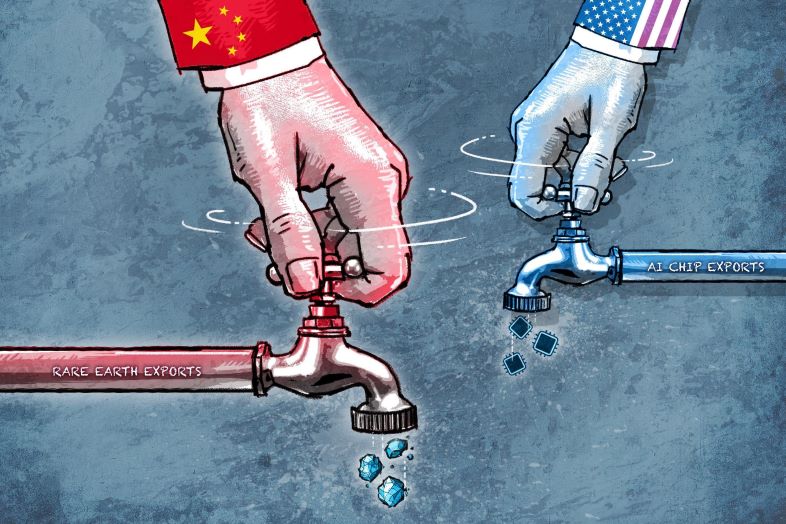
On the other hand, rare earths are now absolutely an important trump card in our hands. Before the United States launched its tariff war against China, China had not made large-scale use of the rare earth card. It was the United States that first undermined free trade and pushed us to this point, so China truly began to consider rare earths as a means of response. Even today, I believe China’s approach on the rare earth issue remains entirely reasonable and legitimate.
As long as you have legitimate and reasonable demand, China can still satisfy it.
But when the United States once again raises a clamor, smears, spreads rumors, suppresses China’s Xinjiang policies, and even tries to create an atmosphere internationally aimed at tearing Xinjiang away from the embrace of the Chinese nation, while spreading a great deal of negative influence against China around the world, should we simply let them suppress us? If someone slaps us on the left cheek, should we turn the right cheek and let them slap that too?
I do not think we should do that.
Wherever the West suppresses China, we should seriously study that very issue and find effective countermeasures and methods. If they hit us, we must hit back. But our counterattack should not use the other side’s underhanded methods, much less so-called low-down tricks. We can absolutely adopt open, aboveboard, and honorable measures, and carry out countermeasures in a way that is consistent with international law and with the rules of international free trade.
This is also something I have felt especially urgent about in recent days. We cannot allow others to repeatedly suppress us, repeatedly torment us, and repeatedly bully us. We should truly use our wisdom and our minds to break the impasse. This has become our top priority.
(Guancha via The China Academy)