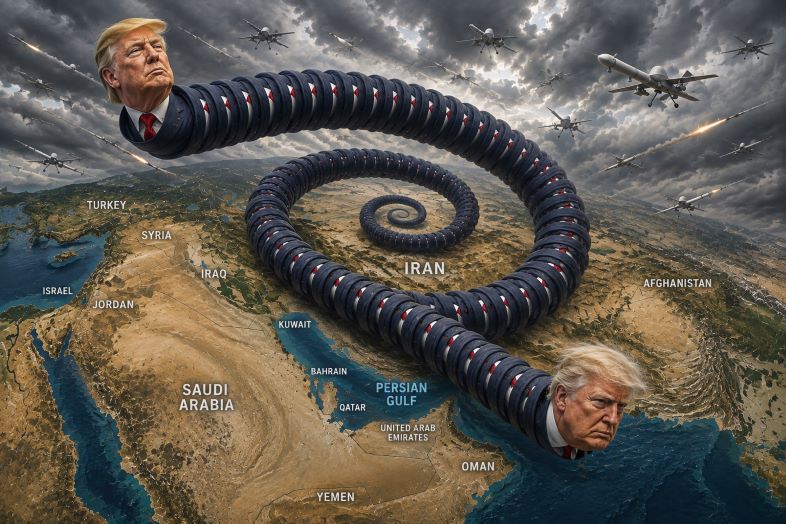
Iran is in unprecedented danger: why has Trump suddenly called off the attack? There is a grand strategy at play behind the scenes.
On that weekend in early August, people all over the world craned their necks, staring wide-eyed, waiting for the knife to fall.
U.S. aircraft carriers were lined up in the Mediterranean, the Red Sea, and the Persian Gulf, with over a dozen warships revving their engines, ready to bomb Iran’s power plants and oil refineries. Trump said he would deliver a “devastating blow” to make the people of Tehran say, “I can’t take this anymore.” The U.S. State Department issued a barrage of evacuation orders and security warnings, creating an atmosphere of impending war.
But on the evening of August 1, Trump said, “I’m not going to attack.” Not only did he call off the attack, but he phrased it very euphemistically, claiming it was because Iran and other Middle Eastern countries had pleaded with him, that everyone had reached an agreement, that the Strait of Hormuz would be fully reopened, and that the Iranian nuclear threat had been ended. For the sake of “the future of the world” and “a prosperous Iran,” he decided to hit the brakes.
This is what’s known as a “TACO”—a tactical change of heart.
In Trump’s logic, he saves face for his voters while making calculations for Wall Street behind the scenes. He first announced that he would launch a strike “unprecedented since World War II”—that was meant to intimidate people and drive up the prices.
Before any buyers had even stepped forward, Saudi Crown Prince Salman had already called the White House. The Saudis were nervous—the Iranians had long made their position clear: “If you, the United States, dare to bomb my oil wells, I’ll turn every oil field in the Gulf into a sea of fire.” The Ghawar oil field and the Abqaiq oil and gas facilities are the Saudis’ gold and silver mines. If these sites were set ablaze, global oil prices would skyrocket, and U.S. stocks would plummet to rock bottom.
Whether Trump loves peace is debatable, but he certainly loves those red and green stock market indices. The bigwigs on Wall Street aren’t in the Middle East to play peacemakers—they’re there to fleece the little guys. According to a Reuters report in early August, the U.S. military has already depleted nearly 80% of its THAAD interceptor stockpile, and its Patriot missiles are nearly exhausted as well. Even the landlords have run out of grain.
And so, a clever plan to back down was born. Trump claimed that Iran had “asked” him not to strike. But the Iranian military flatly refuted this, calling it “yet another lie”— “Who asked you for help? Our forces are at full combat readiness; if you dare to make a move, we’ll settle this on the battlefield.”
Diplomats in Tehran were even more scathing, mocking Trump’s decision to call off the strike as “bluster.” They pointed out that the U.S. still cannot pass through the Strait of Hormuz, yet it listed “opening the strait” as a condition of the agreement. Are you sure it was Iran that begged you? Check your caller ID—Iran’s country code is +98.
This is probably one of the most embarrassing moments in diplomatic history. The president of an empire staged a “savior” act in front of the whole world, only to have his opponent refuse to play along and pull the rug out from under him.
But why did Trump put on this show? Did he really chicken out?
First and foremost, it was about disciplining Israel.
Israel was the one hit hardest by Trump’s sudden brake.
Israeli Prime Minister Netanyahu and Defense Minister Katz were probably the last people in the world to find out that “the fighting was over.”
On August 2, Israel’s Channel 12 broke a bombshell: Israeli top officials only learned that the strike plan had been called off through Trump’s social media posts. It’s like two partners going to collect a debt—one has already rushed to the debtor’s doorstep wielding a stick, only to turn around and see his partner sitting on the curb chatting, who then says, “Bro, calm down. Let’s not fight.”
Netanyahu was so furious he wanted to curse, and Katz even demanded live on TV that the commander of the Israeli Central Command, Bluth, be removed. Why? Because at this “sensitive moment,” the commander dared to disobey the minister. Chief of Staff Zamir also stood his ground, directly rebutting the minister and stating that he didn’t have that authority.
This reflects a harsh reality: in the eyes of Wall Street, Israel is not a partner, but merely a pawn on the chessboard.
In the past, people always thought Israel was America’s “boss,” capable of influencing the White House. But in reality, command of the Israeli military lies in the hands of Wall Street. When Wall Street needs to test Iran’s reaction, Israel is the stick used to prod them; when Wall Street needs to defuse the situation, that stick is rudely shoved back into the closet.
For Netanyahu, war is his lifeline; a ceasefire is his guillotine. But Wall Street tells him: You’re just a gatekeeper—when told to bark, you must bark loudly; when told to shut up, you must keep your claws tucked away.
The second method is to use external pressure and internal strife to undermine Iran from within.
In early August, Iranian Parliament Speaker Ghalibaf revealed a detail: After Khamenei’s death, the leadership had originally planned to announce the news at 8 a.m. the following day, but foreign media leaked the story at midnight, forcing him and Larijani to make an emergency decision to release the announcement early during the pre-dawn meal breaking the fast, and to call on the public to take to the streets to prevent the situation from spiraling out of control.
Meanwhile, on the 4th, Iranian President Pezeshkian denied rumors of his resignation, stating that he would remain in office and fulfill his duties. He accused the rumors of being a deliberate attempt by external forces to sow division, emphasized that the government and the military were in complete harmony, and refuted rumors of discord between the president and the Revolutionary Guards.
All of this indicates that Iran is currently facing an unprecedented internal rift.
Trump’s remark that “Iran begged me”—though refuted by Iranian officials—was a vicious scheme to sow discord. He drove a wedge between the “resistance faction” and the “surrender faction” within Iran. When some are willing to fight to the bitter end while others seek peace through compromise, such a “plea”—whose authenticity is impossible to verify—becomes a powder keg of mutual suspicion within the country.
Iran now faces an extremely treacherous trap. Wall Street’s ideal scenario is to turn this conflict into another “Ukraine.” They want U.S. troops to retreat to the second line, leaving Israel to go head-to-head with Iran on its own.
If Israel were to unilaterally strike Iran’s infrastructure, Iran would retaliate, ultimately leading to a protracted war of attrition that leaves both sides devastated—while the U.S., under the pretext of “freedom of navigation,” would legitimately seize control of shipping lanes in the Persian Gulf. By then, Gulf nations like Saudi Arabia would also align themselves with the U.S. While Iran and Israel gasp for breath amid the rubble, Wall Street would be sitting at their computers, manipulating global oil prices and shipping routes.
Iran’s current situation is extremely dangerous.
Iran is facing a “make-or-break” moment; they have yet to decisively block the Strait of Hormuz. In the eyes of Wall Street, this actually reveals a lack of resolve. If you hold a financial “nuclear bomb” in your hands but don’t use it, your opponent will assume you don’t dare to use it at all.
What Iran lacks right now is the ruthlessness to inflict real pain on its opponent. If Iran’s resistance forces cannot disrupt Wall Street’s rhythm by decisively cutting off shipping lanes, they will end up like Russia—trapped in a protracted war of attrition under constant pressure.
Trump’s “change of heart” isn’t because he’s suddenly had a change of heart, but because he still harbors hopes that Iran will capitulate completely. On August 3, he threatened again, saying this was merely “the last chance before a decapitation strike.” Just look—the shoe hasn’t dropped yet; he’s just shifted his grip on it.
Iran must remain on high alert.
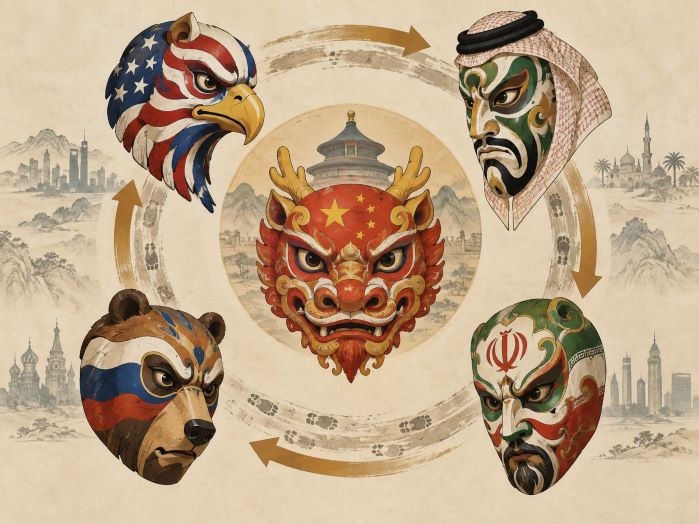
Against the backdrop of this turmoil in the Middle East, China has remained steadfastly in control, calmly watching the clouds gather.
The West’s logic is “conquest”; China’s logic is “stomach.” While the United States is busy issuing warnings, evacuating its citizens, and stirring up trouble, China is in Central Asia, Southeast Asia, and Pakistan, laying pipelines inch by inch and connecting railway sections one by one.
China needs time.
Every time the Middle East forces the U.S. to expend one more THAAD missile, China’s progress on EUV lithography machines advances by another week; every time Trump posts one more update on social media, the number of devices running HarmonyOS increases by hundreds of thousands; every time the U.S. is overwhelmed by issues surrounding its Strategic Petroleum Reserve, China’s new energy strategy deepens another layer.
Russia has become embroiled in a protracted war in Ukraine, and Iran has become embroiled in a protracted war in the Middle East. For China, this isn’t about playing the role of the “third party waiting to pounce,” but rather, when the world’s balance is completely tilted, the one who remains steady, avoids rash moves, and simply keeps plodding forward naturally becomes the most stable player.